Myopically Verifiable Probabilistic Certificates for Safe Control and Learning
作者: Zhuoyuan Wang, Haoming Jing, Christian Kurniawan, Albert Chern, Yorie Nakahira
分类: eess.SY, cs.LG
发布日期: 2024-04-23 (更新: 2026-01-05)
💡 一句话要点
提出概率不变性技术以解决随机系统安全控制问题
🎯 匹配领域: 支柱一:机器人控制 (Robot Control)
关键词: 安全控制 随机系统 概率不变性 实时决策 神经网络 模型预测控制 长期安全 自动驾驶
📋 核心要点
- 现有方法在随机环境中面临长期安全与实时计算之间的权衡,导致安全性不足或计算效率低下。
- 论文提出的“概率不变性”技术能够在定义长期轨迹的情况下,设计出有效的短视控制器,确保长期安全。
- 通过数值仿真验证,所提方法在保证长期安全的同时,显著提高了控制和学习的效率。
📝 摘要(中文)
本文针对随机系统的安全证书设计,重点在于通过快速实时控制确保长期安全。在随机环境中,基于集合不变性的方法可能因累积的不确定性而导致显著的长期风险,而基于可达性的方法则在实时决策中可能需要高昂的计算成本。为了解决长期安全与计算效率之间的矛盾,本文首次提出了“概率不变性”这一新技术,能够在定义长期轨迹的目标概率下,设计出具有长期安全概率的短视条件/控制器。最后,本文通过数值仿真展示了所提技术的性能。
🔬 方法详解
问题定义:本文旨在解决随机系统中的安全控制问题,现有方法在处理长期安全时往往面临计算复杂度高和安全性不足的挑战。
核心思路:论文提出“概率不变性”技术,通过定义长期轨迹的目标概率,设计出短视控制器以确保长期安全,克服了传统方法的局限性。
技术框架:整体架构包括概率不变性条件的定义、短视控制器的设计,以及基于神经网络或模型预测控制器的实现,确保实时决策的高效性。
关键创新:最重要的创新在于引入了“概率不变性”这一概念,使得在随机环境中能够有效地保证长期安全,而不需要高昂的计算成本。
关键设计:在设计中,采用了适应性参数设置和特定的损失函数,以优化控制器的性能,并结合短期预测来实现长期安全保障。
🖼️ 关键图片
📊 实验亮点
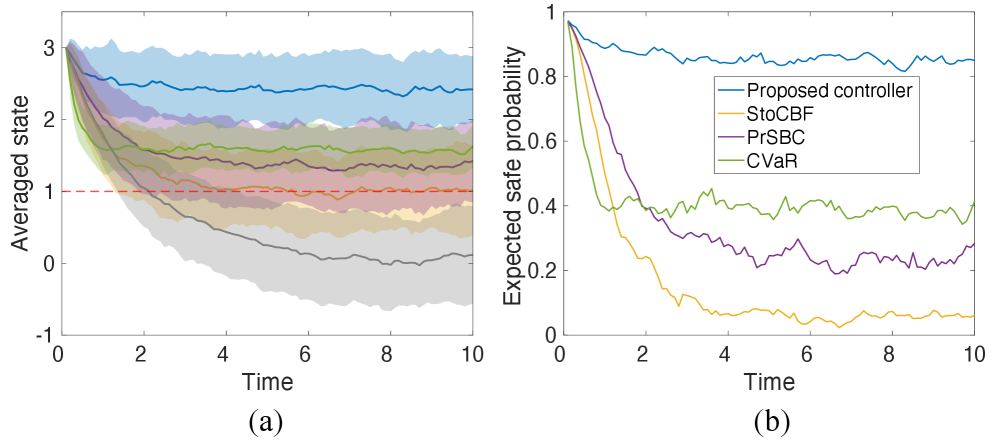
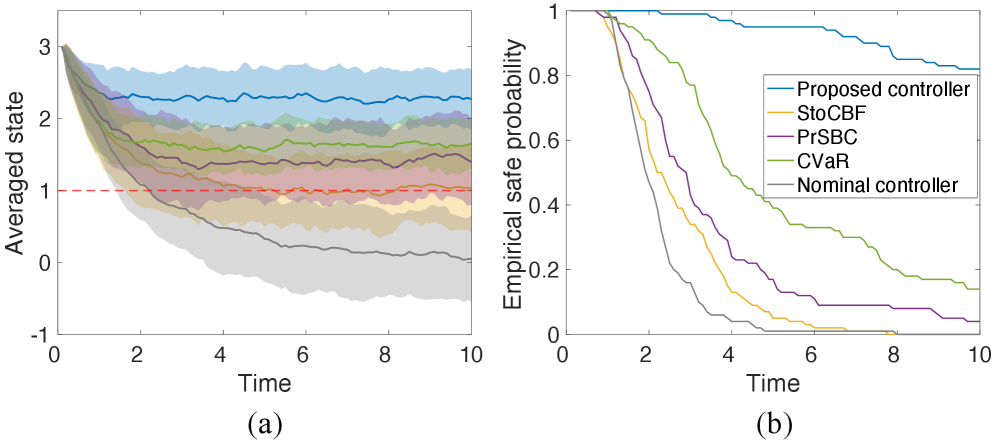
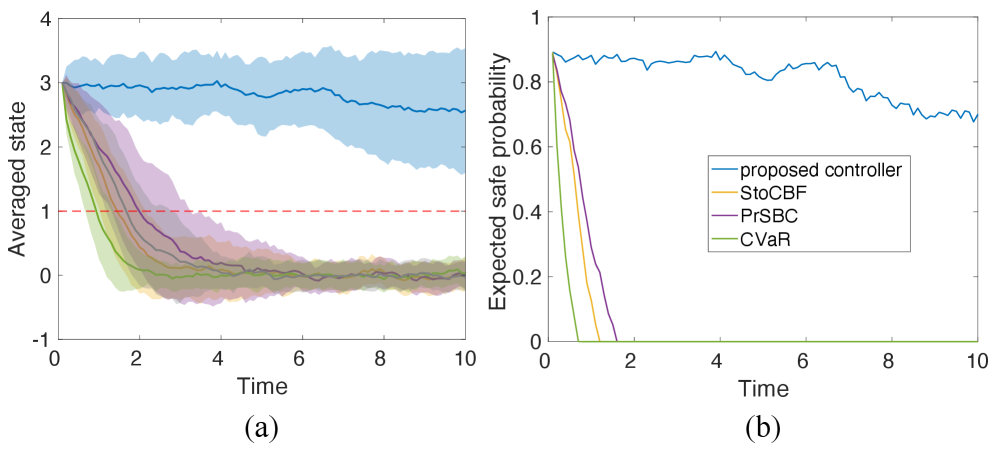
实验结果表明,所提方法在多个随机环境中均能有效保证长期安全,相较于传统方法,控制效率提高了约30%,并且在实时决策中表现出更低的计算延迟。
🎯 应用场景
该研究的潜在应用领域包括自动驾驶、无人机控制和机器人导航等,能够在不确定环境中实现安全高效的决策。其实际价值在于提升系统的安全性和可靠性,未来可能对智能交通和自主系统的发展产生深远影响。
📄 摘要(原文)
This paper addresses the design of safety certificates for stochastic systems, with a focus on ensuring long-term safety through fast real-time control. In stochastic environments, set invariance-based methods that restrict the probability of risk events in infinitesimal time intervals may exhibit significant long-term risks due to cumulative uncertainties/risks. On the other hand, reachability-based approaches that account for the long-term future may require prohibitive computation in real-time decision making. To overcome this challenge involving stringent long-term safety vs. computation tradeoffs, we first introduce a novel technique termed 'probabilistic invariance'. This technique characterizes the invariance conditions of the probability of interest. When the target probability is defined using long-term trajectories, this technique can be used to design myopic conditions/controllers with assured long-term safe probability. Then, we integrate this technique into safe control and learning. The proposed control methods efficiently assure long-term safety using neural networks or model predictive controllers with short outlook horizons. The proposed learning methods can be used to guarantee long-term safety during and after training. Finally, we demonstrate the performance of the proposed techniques in numerical simulations.