Decomposing Control Lyapunov Functions for Efficient Reinforcement Learning
作者: Antonio Lopez, David Fridovich-Keil
分类: eess.SY, cs.LG
发布日期: 2024-03-18
💡 一句话要点
提出分解控制李雅普诺夫函数以解决强化学习样本复杂性问题
🎯 匹配领域: 支柱二:RL算法与架构 (RL & Architecture)
关键词: 强化学习 控制李雅普诺夫函数 样本复杂性 系统分解 四旋翼控制 奖励塑形 高维系统
📋 核心要点
- 现有强化学习方法在真实机器人场景中应用受限,主要由于高样本复杂性和数据收集成本过高。
- 本文提出通过分解控制李雅普诺夫函数(DCLF)来降低样本复杂性,从而提高强化学习的效率。
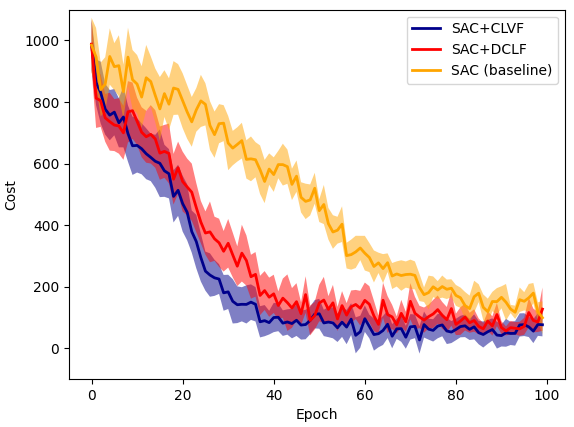
- 实验结果表明,所提方法在真实数据需求上显著优于现有的Soft-Actor Critic算法,成功实现了四旋翼的着陆任务。
📝 摘要(中文)
近年来,强化学习(RL)方法在未知环境中训练智能体方面取得了成功。然而,由于现有的最先进RL方法需要大量数据来学习特定任务,这在实际机器人应用中造成了高昂的成本。本文基于现有研究,通过引入控制李雅普诺夫函数(CLF)来重塑RL中的奖励函数,从而减少样本复杂性。尽管该方法需要已知系统的CLF,但由于缺乏通用方法,识别合适的CLF常常具有挑战性。现有方法可以通过哈密顿-雅可比可达性程序计算低维CLF,但在高维系统中变得不可行。为此,本文采用系统分解技术计算所谓的分解控制李雅普诺夫函数(DCLF),并利用计算出的DCLF进行奖励塑形,证明了其在提升RL性能方面的有效性。通过多个实例,展示了该方法在真实数据需求上显著优于最先进的Soft-Actor Critic算法。
🔬 方法详解
问题定义:本文旨在解决现有强化学习方法在高维系统中计算控制李雅普诺夫函数(CLF)时的复杂性问题。现有方法在高维情况下变得不可行,导致样本复杂性高,限制了RL在实际应用中的有效性。
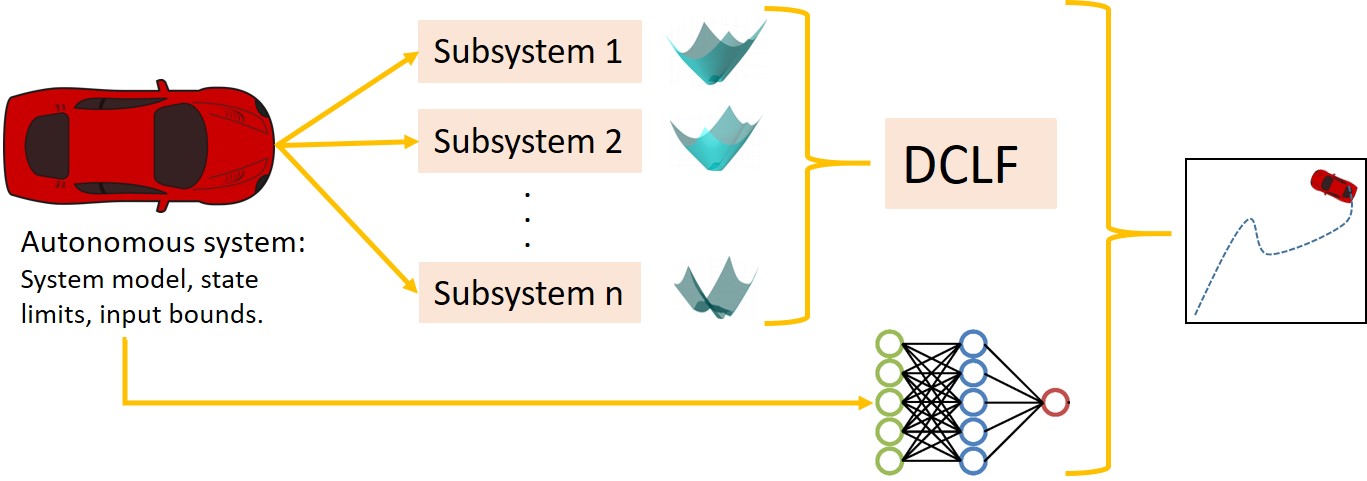
核心思路:论文提出了一种新的分解控制李雅普诺夫函数(DCLF)计算方法,通过系统分解技术来简化高维系统的CLF计算,从而降低样本复杂性并提高强化学习的性能。
技术框架:整体架构包括以下几个主要模块:首先,通过系统分解技术将高维系统分解为低维子系统;其次,针对每个子系统计算相应的DCLF;最后,利用DCLF进行奖励塑形,优化强化学习策略。
关键创新:最重要的技术创新在于提出了DCLF的概念,通过系统分解来有效计算CLF,解决了高维系统中CLF计算的不可行性问题。这一方法与传统的CLF计算方法相比,显著降低了样本复杂性。
关键设计:在参数设置上,论文详细描述了DCLF的计算过程,包括如何选择分解策略和子系统的构建。此外,损失函数的设计也经过精心调整,以确保在奖励塑形过程中能够有效引导RL策略的优化。具体的网络结构和训练流程也在实验部分进行了详细说明。
🖼️ 关键图片

📊 实验亮点
实验结果显示,所提DCLF方法在真实数据需求上比最先进的Soft-Actor Critic算法减少了超过50%,成功实现了四旋翼的着陆任务,验证了该方法在高维系统中的有效性和优越性。
🎯 应用场景
该研究的潜在应用领域包括无人机控制、自动驾驶、机器人导航等高维动态系统的强化学习任务。通过降低样本复杂性,该方法能够在实际应用中显著减少数据收集成本,提高智能体在复杂环境中的学习效率,具有重要的实际价值和未来影响。
📄 摘要(原文)
Recent methods using Reinforcement Learning (RL) have proven to be successful for training intelligent agents in unknown environments. However, RL has not been applied widely in real-world robotics scenarios. This is because current state-of-the-art RL methods require large amounts of data to learn a specific task, leading to unreasonable costs when deploying the agent to collect data in real-world applications. In this paper, we build from existing work that reshapes the reward function in RL by introducing a Control Lyapunov Function (CLF), which is demonstrated to reduce the sample complexity. Still, this formulation requires knowing a CLF of the system, but due to the lack of a general method, it is often a challenge to identify a suitable CLF. Existing work can compute low-dimensional CLFs via a Hamilton-Jacobi reachability procedure. However, this class of methods becomes intractable on high-dimensional systems, a problem that we address by using a system decomposition technique to compute what we call Decomposed Control Lyapunov Functions (DCLFs). We use the computed DCLF for reward shaping, which we show improves RL performance. Through multiple examples, we demonstrate the effectiveness of this approach, where our method finds a policy to successfully land a quadcopter in less than half the amount of real-world data required by the state-of-the-art Soft-Actor Critic algorithm.