Online Ecological Gearshift Strategy via Neural Network with Soft-Argmax Operator
作者: Xi Luo, Shiying Dong, Jinlong Hong, Bingzhao Gao, Hong Chen
分类: eess.SY
发布日期: 2024-02-28
备注: 6 pages, 5 figures, submitted to 8th IFAC Conference on Nonlinear Model Predictive Control
💡 一句话要点
提出基于软-Argmax操作符的神经网络生态换挡策略
🎯 匹配领域: 支柱一:机器人控制 (Robot Control)
关键词: 生态换挡 神经网络 软-Argmax 能耗优化 混合整数模型预测控制 电动车 实时控制
📋 核心要点
- 现有的换挡策略往往无法实时响应,导致能耗较高,难以满足生态驾驶的需求。
- 本文提出了一种基于软-Argmax操作符的神经网络优化器,将换挡策略转化为MIMPC问题,以实现能耗最小化。
- 实验结果表明,所提方法在节能效果上与传统方法相当,但解决时间显著缩短,提升了实时性。
📝 摘要(中文)
本文提出了一种基于软-Argmax操作符的神经网络优化器,以实现实时的生态换挡策略。该策略被重新表述为混合整数模型预测控制(MIMPC)问题,以最小化能耗。通过引入外部凸化,将整数变量转化为放松的二进制控制。在训练过程中,应用软-Argmax操作符以适当地逼近二进制解,并确保所有操作可微分。此外,该操作符有助于将放松的二进制变量推向0或1。通过在一款两速电动车上部署该策略,结果显示与成熟求解器Bonmin相比,提出的方法不仅实现了相似的节能效果,还显著减少了解决时间,以满足实时要求。与基于规则的方法相比,节能效果达到6.02%。
🔬 方法详解
问题定义:本文旨在解决现有换挡策略在实时性和能耗方面的不足。传统方法往往无法快速响应驾驶环境变化,导致能耗增加。
核心思路:提出的解决方案是将换挡策略重新表述为混合整数模型预测控制(MIMPC)问题,并引入软-Argmax操作符以实现对二进制控制的有效逼近,从而优化能耗。
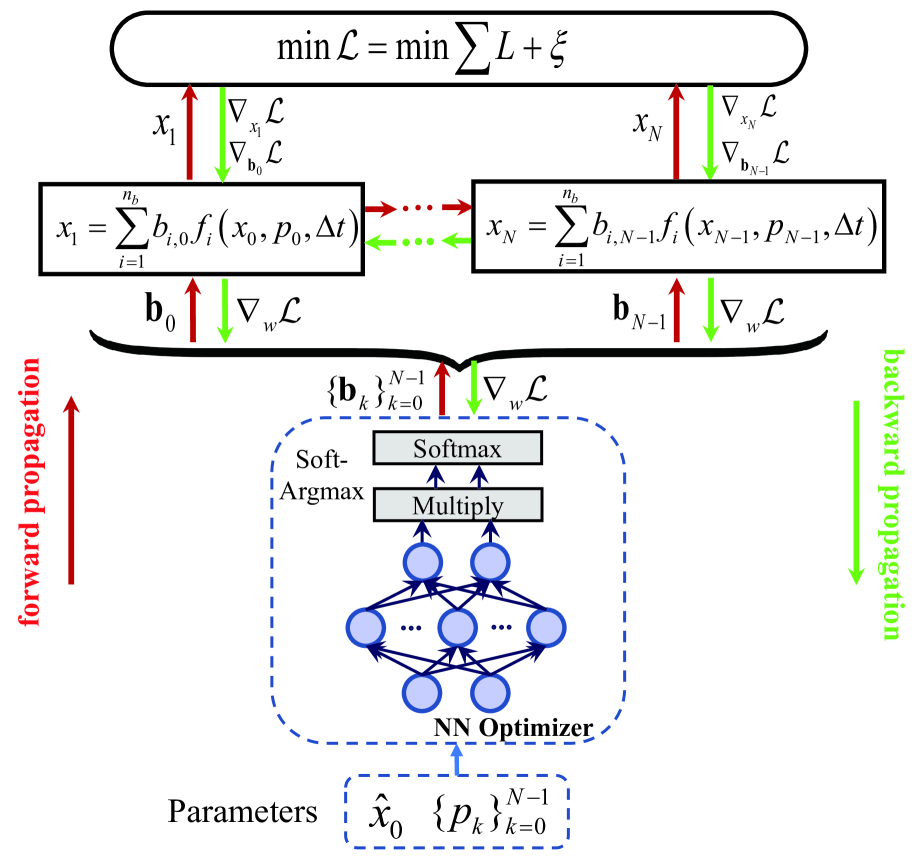
技术框架:整体架构包括数据输入、神经网络优化器、软-Argmax操作符和控制输出模块。首先,输入驾驶环境数据,然后通过神经网络进行优化,最后输出控制指令以实现换挡。
关键创新:最重要的技术创新在于使用软-Argmax操作符,使得神经网络能够在训练过程中有效逼近二进制解,同时保持所有操作的可微性。这一设计与传统的整数优化方法有本质区别。
关键设计:在网络结构上,采用了适合MIMPC问题的深度学习架构,损失函数设计为能耗最小化目标,关键参数设置包括学习率和正则化项,以确保模型的收敛性和泛化能力。
🖼️ 关键图片


📊 实验亮点
实验结果显示,所提方法在节能方面与成熟求解器Bonmin相当,但解决时间显著缩短,满足实时需求。与基于规则的方法相比,节能效果达到6.02%,展示了其在实际应用中的优势。
🎯 应用场景
该研究的潜在应用领域包括电动车的智能控制系统、自动驾驶技术以及其他需要实时决策的交通管理系统。通过优化换挡策略,可以显著提高电动车的能效,降低运营成本,推动可持续交通的发展。
📄 摘要(原文)
This paper presents a neural network optimizer with soft-argmax operator to achieve an ecological gearshift strategy in real-time. The strategy is reformulated as the mixed-integer model predictive control (MIMPC) problem to minimize energy consumption. Then the outer convexification is introduced to transform integer variables into relaxed binary controls. To approximate binary solutions properly within training, the soft-argmax operator is applied to the neural network with the fact that all the operations of this scheme are differentiable. Moreover, this operator can help push the relaxed binary variables close to 0 or 1. To evaluate the strategy effect, we deployed it to a 2-speed electric vehicle (EV). In contrast to the mature solver Bonmin, our proposed method not only achieves similar energy-saving effects but also significantly reduces the solution time to meet real-time requirements. This results in a notable energy savings of 6.02% compared to the rule-based method.