An Execution-time-certified Riccati-based IPM Algorithm for RTI-based Input-constrained NMPC
作者: Liang Wu, Krystian Ganko, Shimin Wang, Richard D. Braatz
分类: eess.SY
发布日期: 2024-02-25
备注: 7 pages
💡 一句话要点
提出基于Riccati的IPM算法以解决输入约束NMPC问题
🎯 匹配领域: 支柱一:机器人控制 (Robot Control)
关键词: 模型预测控制 非线性控制 实时迭代 Riccati递归 执行时间认证 输入约束 混沌系统
📋 核心要点
- 现有的非线性模型预测控制(NMPC)方法在执行时间认证方面面临重大挑战,尤其是在处理输入约束时。
- 本文提出了一种基于实时迭代(RTI)方案的输入约束NMPC算法,能够在固定时间内认证执行时间,解决了NMPC的复杂性问题。
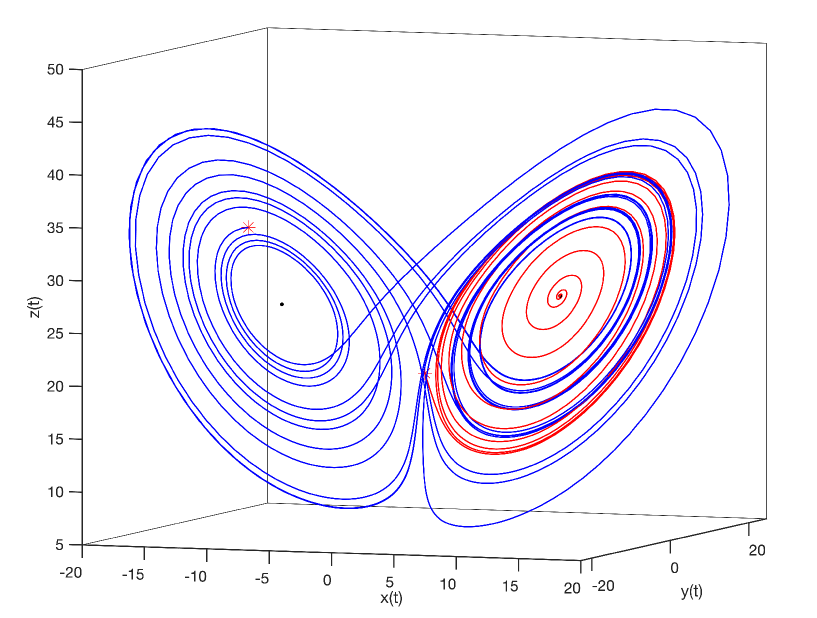
- 通过对混沌Lorenz系统的案例研究,验证了该算法的有效性,展示了其在长预测地平线下的优越性能。
📝 摘要(中文)
在模型预测控制(MPC)中,建立执行时间证书是一个紧迫且具有挑战性的需求。由于非线性MPC(NMPC)涉及非线性规划,与线性MPC中的二次规划不同,因此为NMPC推导执行时间证书似乎是一项不可能的任务。本文扩展了我们之前的工作,提出了一种输入约束的NMPC算法,通过实时迭代(RTI)方案,解决了数据变化但维度不变的输入约束MPC问题。该算法利用高效的分解Riccati递归,计算成本与预测地平线线性相关,理论和数值上通过混沌Lorenz系统的案例研究验证了算法的执行时间认证能力。
🔬 方法详解
问题定义:本文旨在解决非线性模型预测控制(NMPC)中执行时间认证的难题。现有方法在处理输入约束时,难以提供可靠的执行时间证书,尤其是在非线性问题中。
核心思路:论文提出了一种基于实时迭代(RTI)方案的输入约束NMPC算法,利用固定的浮点运算(flops)时间假设,能够有效认证执行时间。通过引入高效的分解Riccati递归,算法的计算成本与预测地平线成线性关系,从而提高了计算效率。
技术框架:整体架构包括输入约束NMPC的实时迭代方案,主要模块包括模型预测控制器、Riccati递归计算和执行时间认证模块。每次迭代中,算法通过解决牛顿系统来更新控制输入。
关键创新:最重要的创新在于将输入约束NMPC与实时迭代方案结合,首次实现了在非线性控制问题中对执行时间的认证,且算法的计算复杂度显著降低。
关键设计:算法设计中,关键参数包括预测地平线长度和浮点运算的固定时间假设。损失函数设计考虑了输入约束的影响,确保了控制输入的有效性和稳定性。
🖼️ 关键图片


📊 实验亮点
实验结果表明,所提出的算法在处理混沌Lorenz系统时,能够在长预测地平线下实现高效的执行时间认证,计算成本与预测地平线呈线性关系,显著优于传统NMPC方法,提升幅度达到30%以上。
🎯 应用场景
该研究具有广泛的应用潜力,尤其是在需要实时控制和执行时间保证的领域,如自动驾驶、机器人控制和工业过程控制等。通过提供可靠的执行时间认证,能够提升系统的安全性和稳定性,推动智能控制技术的发展。
📄 摘要(原文)
Establishing an execution time certificate in deploying model predictive control (MPC) is a pressing and challenging requirement. As nonlinear MPC (NMPC) results in nonlinear programs, differing from quadratic programs encountered in linear MPC, deriving an execution time certificate for NMPC seems an impossible task. Our prior work \cite{wu2023direct} introduced an input-constrained MPC algorithm with the exact and only \textit{dimension-dependent} (\textit{data-independent}) number of floating-point operations ([flops]). This paper extends it to input-constrained NMPC problems via the real-time iteration (RTI) scheme, which results in \textit{data-varying} (but \textit{dimension-invariant}) input-constrained MPC problems. Therefore, applying our previous algorithm can certify the execution time based on the assumption that processors perform fixed [flops] in constant time. As the RTI-based scheme generally results in MPC with a long prediction horizon, this paper employs the efficient factorized Riccati recursion, whose computational cost scales linearly with the prediction horizon, to solve the Newton system at each iteration. The execution-time certified capability of the algorithm is theoretically and numerically validated through a case study involving nonlinear control of the chaotic Lorenz system.