Iterative Linear Quadratic Regulator With Variational Equation-Based Discretization
作者: Katsuya Shigematsu, Hikaru Hoshino, Eiko Furutani
分类: eess.SY
发布日期: 2024-02-18
期刊: Nonlinear Theory and Its Applications, IEICE, Vol. 15, No. 4, pp. 920-937, 2024
DOI: 10.1587/nolta.15.920
💡 一句话要点
提出变分方程离散化方法以提升ILQR控制性能
🎯 匹配领域: 支柱一:机器人控制 (Robot Control)
关键词: 迭代线性二次调节器 变分方程 离散化方法 非线性控制 实时计算 控制性能提升
📋 核心要点
- 现有的离散化方法通常要求小时间步长以减少近似误差,限制了控制性能的提升。
- 本文提出利用变分方程推导离散系统的线性化,允许在较大时间步长下进行准确计算。
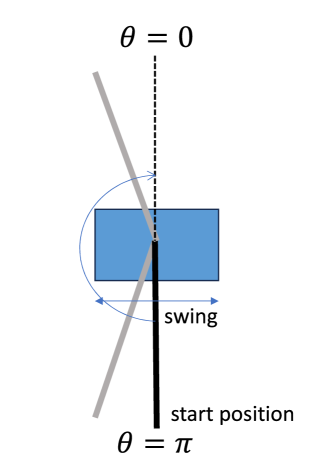
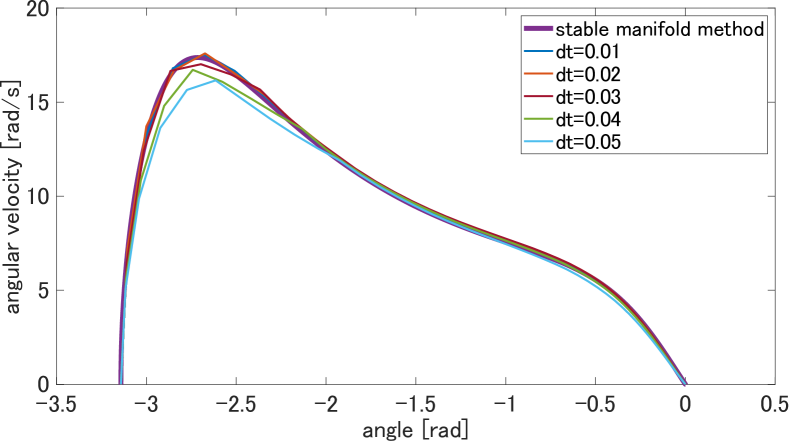
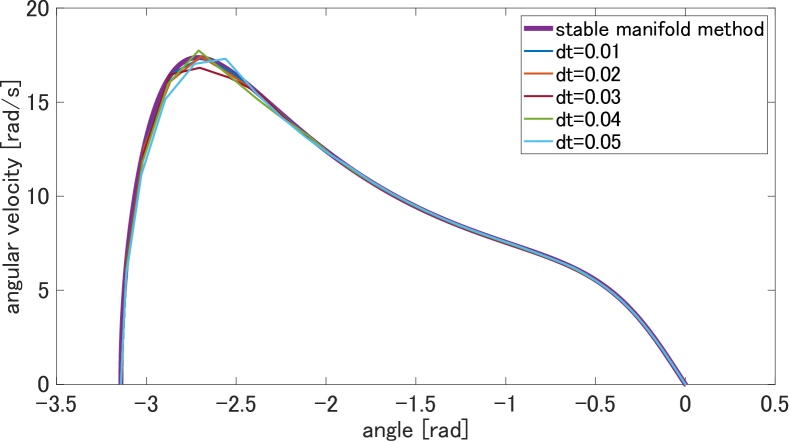
- 通过对倒立摆的控制仿真,验证了该方法在提升控制性能方面的有效性。
📝 摘要(中文)
本文探讨了使用迭代线性二次调节器(ILQR)实现非线性模型预测控制器的离散化方法。现有方法主要依赖有限差分近似来从连续时间模型推导离散时间状态方程,但这种方法要求离散化时间步长较小以抑制近似误差。本文提出使用变分方程来推导ILQR算法所需的离散系统线性化,从而实现与时间步长无关的准确计算。通过对倒立摆的摆动控制进行数值仿真,验证了该方法的有效性。该方法放宽了对时间步长大小的严格要求,能够在实时计算中增加ILQR迭代次数,从而提升控制性能。
🔬 方法详解
问题定义:本文旨在解决现有ILQR方法中离散化导致的近似误差问题,现有方法对时间步长的严格要求限制了控制性能的提升。
核心思路:论文提出使用变分方程来推导所需的线性化,从而实现与时间步长无关的准确计算。这种设计使得在较大时间步长下仍能保持高效的控制性能。
技术框架:整体方法包括以下几个主要模块:首先,利用变分方程推导离散化的线性化;其次,基于此线性化进行ILQR迭代;最后,通过数值仿真验证控制效果。
关键创新:最重要的创新在于引入变分方程进行线性化推导,这与传统的有限差分方法有本质区别,后者依赖于小时间步长。
关键设计:在实现过程中,关键参数包括时间步长的选择和ILQR迭代次数的设置,确保在较大时间步长下仍能保持控制精度。
🖼️ 关键图片
📊 实验亮点
实验结果表明,使用变分方程的离散化方法在倒立摆控制中显著提高了控制性能,相比传统方法,ILQR迭代次数增加,控制精度提升,验证了该方法的有效性。
🎯 应用场景
该研究的潜在应用领域包括机器人控制、自动驾驶、航空航天等需要实时控制的系统。通过提升ILQR的控制性能,可以在复杂环境中实现更高效的决策和控制,具有重要的实际价值和未来影响。
📄 摘要(原文)
This paper discusses discretization methods for implementing nonlinear model predictive controllers using Iterative Linear Quadratic Regulator (ILQR). Finite-difference approximations are mostly used to derive a discrete-time state equation from the original continuous-time model. However, the timestep of the discretization is sometimes restricted to be small to suppress the approximation error. In this paper, we propose to use the variational equation for deriving linearizations of the discretized system required in ILQR algorithms, which allows accurate computation regardless of the timestep. Numerical simulations of the swing-up control of an inverted pendulum demonstrate the effectiveness of this method. By the relaxing stringent requirement for the size of the timestep, the use of the variational equation can improve control performance by increasing the number of ILQR iterations possible at each timestep in the realtime computation.