Nash Soft Actor-Critic LEO Satellite Handover Management Algorithm for Flying Vehicles
作者: Jinxuan Chen, Mustafa Ozger, Cicek Cavdar
分类: eess.SY, cs.GT, cs.MA
发布日期: 2024-01-31
💡 一句话要点
提出Nash-SAC算法以解决LEO卫星飞行器切换管理问题
🎯 匹配领域: 支柱二:RL算法与架构 (RL & Architecture)
关键词: 低地球轨道卫星 多智能体强化学习 博弈论 切换管理 飞行器通信 网络效用 服务质量
📋 核心要点
- LEO卫星的快速移动导致频繁的切换,影响用户的服务质量和连接稳定性。
- 提出了一种基于多智能体强化学习和博弈论的Nash-SAC策略,旨在优化卫星切换决策和资源分配。
- 实验结果显示,Nash-SAC策略在切换次数和阻塞率上均有显著降低,网络效用提升显著。
📝 摘要(中文)
与地面网络相比,低地球轨道(LEO)卫星能够提供无缝的全球覆盖和高生存能力。然而,LEO卫星的快速移动导致频繁的切换,影响用户的服务质量(QoS)并造成连接中断。本文提出了一种基于多智能体强化学习(MARL)和博弈论的分布式卫星切换策略Nash-SAC,以应对这一挑战。模拟结果表明,Nash-SAC策略能够有效减少超过16%的切换次数和18%的阻塞率,且在网络效用上提升高达48%,为飞行器和地面终端提供了可靠的连接。
🔬 方法详解
问题定义:本文旨在解决LEO卫星在飞行器与地面终端共存时频繁切换的问题。现有方法无法有效管理切换,导致服务质量下降和连接中断。
核心思路:论文提出的Nash-SAC策略结合了多智能体强化学习和博弈论,通过分布式决策来优化切换过程,减少不必要的切换次数。
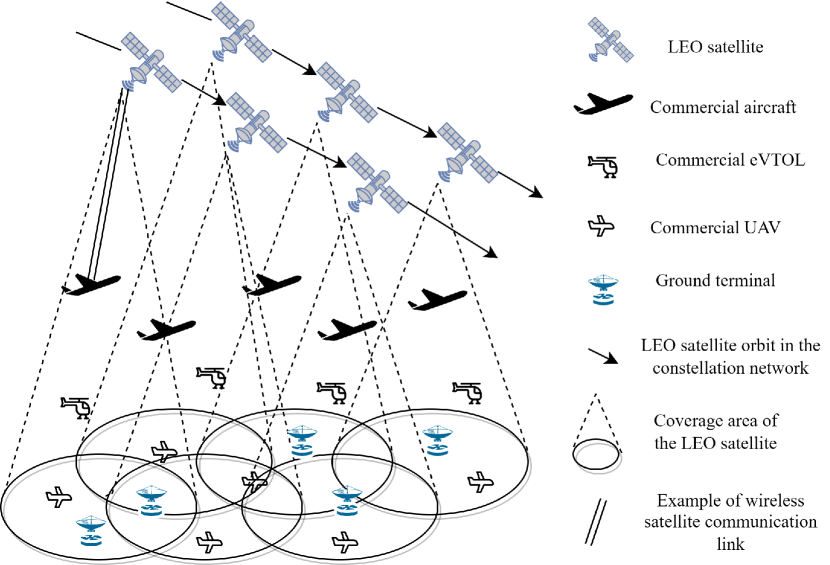
技术框架:Nash-SAC的整体架构包括多个智能体,每个智能体负责特定的切换决策。系统通过实时数据反馈和博弈理论模型进行学习和优化,确保资源分配符合用户需求。
关键创新:Nash-SAC的主要创新在于将博弈论与多智能体强化学习结合,形成了一种新的切换管理策略,显著优于传统的Q学习方法。
关键设计:在设计中,关键参数包括学习率、折扣因子等,损失函数采用了适应性调整机制,以提高学习效率和稳定性。
🖼️ 关键图片


📊 实验亮点
实验结果表明,Nash-SAC策略有效减少了超过16%的切换次数和18%的阻塞率,同时网络效用提升高达48%。与传统Q学习方法相比,Nash-SAC在性能上表现出显著优势,证明了其在实际应用中的有效性。
🎯 应用场景
该研究的潜在应用领域包括无人机、飞行汽车等新兴飞行器的通信管理,以及在紧急情况下的应急通信系统。通过优化LEO卫星的切换管理,可以提升飞行器的通信可靠性和用户体验,具有重要的实际价值和未来影响。
📄 摘要(原文)
Compared with the terrestrial networks (TN), which can only support limited coverage areas, low-earth orbit (LEO) satellites can provide seamless global coverage and high survivability in case of emergencies. Nevertheless, the swift movement of the LEO satellites poses a challenge: frequent handovers are inevitable, compromising the quality of service (QoS) of users and leading to discontinuous connectivity. Moreover, considering LEO satellite connectivity for different flying vehicles (FVs) when coexisting with ground terminals, an efficient satellite handover decision control and mobility management strategy is required to reduce the number of handovers and allocate resources that align with different users' requirements. In this paper, a novel distributed satellite handover strategy based on Multi-Agent Reinforcement Learning (MARL) and game theory named Nash-SAC has been proposed to solve these problems. From the simulation results, the Nash-SAC-based handover strategy can effectively reduce the handovers by over 16 percent and the blocking rate by over 18 percent, outperforming local benchmarks such as traditional Q-learning. It also greatly improves the network utility used to quantify the performance of the whole system by up to 48 percent and caters to different users requirements, providing reliable and robust connectivity for both FVs and ground terminals.