Congestion-aware Ride-pooling in Mixed Traffic for Autonomous Mobility-on-Demand Systems
作者: Fabio Paparella, Leonardo Pedroso, Theo Hofman, Mauro Salazar
分类: eess.SY, math.OC
发布日期: 2023-11-06
💡 一句话要点
提出拥堵感知的拼车优化框架以提升自动出行系统效率
🎯 匹配领域: 支柱四:生成式动作 (Generative Motion)
关键词: 自动驾驶 拼车系统 交通拥堵 优化算法 出行服务 城市交通 共享出行
📋 核心要点
- 现有的拼车系统在处理交通拥堵时缺乏有效的优化策略,导致效率低下。
- 本文提出了一种新的二次规划模型,能够同时考虑拼车分配和拥堵感知的路径规划,提升系统性能。
- 实验结果表明,当拼车用户比例达到40%时,AMoD系统能显著降低拥堵和旅行时间,反之则可能加剧拥堵。
📝 摘要(中文)
本文提出了一个建模与优化框架,用于研究拥堵感知的拼车自动出行系统,其中自动驾驶出租车为用户提供按需出行服务,用户在相同方向上共享同一车辆。首先,基于大规模出行请求的假设,本文将拼车分配与路径规划问题转化为一个不随需求数量变化的二次规划问题,能够使用现成的凸优化求解器进行求解。其次,通过与简化的解耦模型进行比较,发现拥堵感知的路径规划是影响结果的关键因素。最后,通过对纽约曼哈顿的案例研究,分析了用户中心的私家车用户对系统性能的影响,结果表明,只有当至少40%的用户愿意拼车时,AMoD系统才能显著减少拥堵和旅行时间。
🔬 方法详解
问题定义:本文旨在解决自动出行系统中拼车分配与路径规划的拥堵感知问题。现有方法往往忽视交通拥堵的影响,导致效率低下和用户体验不佳。
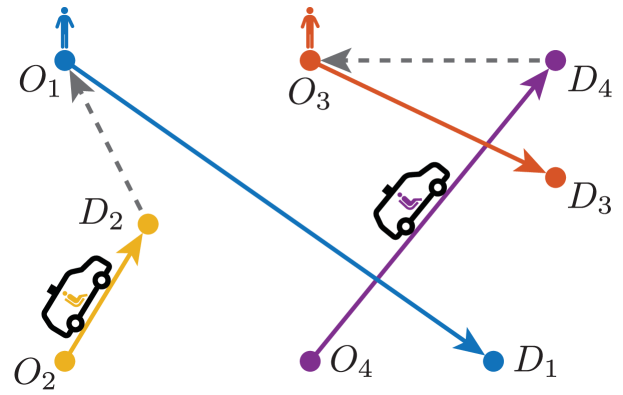
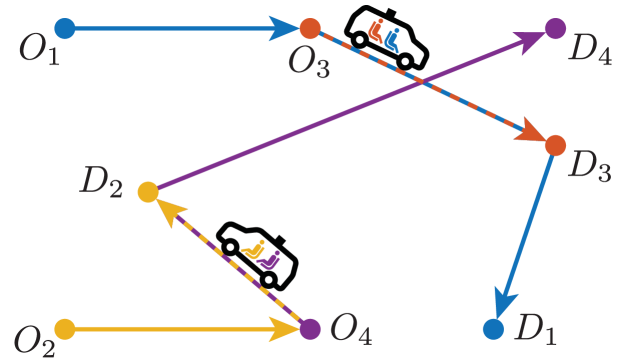
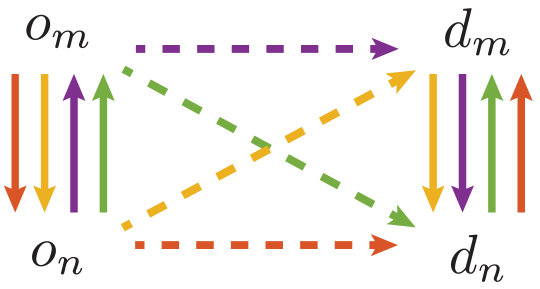
核心思路:论文提出的核心思路是将拼车分配与路径规划问题建模为一个二次规划问题,能够有效处理大规模出行请求,并且不随需求数量变化。
技术框架:整体框架包括两个主要模块:首先是拼车分配模块,其次是拥堵感知的路径规划模块。通过结合这两个模块,系统能够在拥堵情况下优化出行效率。
关键创新:最重要的技术创新在于提出了一个不依赖于需求数量的二次规划模型,与传统的解耦方法相比,能够更好地应对交通拥堵问题。
关键设计:在模型设计中,采用了标准的凸优化求解器,并设置了适当的损失函数以平衡拼车效率与用户体验,同时考虑了用户中心的私家车用户对系统性能的影响。
🖼️ 关键图片
📊 实验亮点
实验结果显示,当拼车用户比例达到40%时,AMoD系统能够显著减少拥堵和旅行时间,反之则可能导致高达15%的平均旅行时间增加。这表明拥堵感知的路径规划在提升系统性能方面至关重要。
🎯 应用场景
该研究的潜在应用领域包括城市交通管理、自动驾驶出租车调度和共享出行服务。通过优化拼车和路径规划,能够有效提升城市交通的整体效率,减少拥堵,改善用户出行体验。未来,该框架可扩展至更复杂的交通场景和多种出行模式的整合。
📄 摘要(原文)
This paper presents a modeling and optimization framework to study congestion-aware ride-pooling Autonomous Mobility-on-Demand (AMoD) systems, whereby self-driving robotaxis are providing on-demand mobility, and users headed in the same direction share the same vehicle for part of their journey. Specifically, taking a mesoscopic time-invariant perspective and on the assumption of a large number of travel requests, we first cast the joint ride-pooling assignment and routing problem as a quadratic program that does not scale with the number of demands and can be solved with off-the-shelf convex solvers. Second, we compare the proposed approach with a significantly simpler decoupled formulation, whereby only the routing is performed in a congestion-aware fashion, whilst the ride-pooling assignment part is congestion-unaware. A case study of Sioux Falls reveals that such a simplification does not significantly alter the solution and that the decisive factor is indeed the congestion-aware routing. Finally, we solve the latter problem accounting for the presence of user-centered private vehicle users in a case study of Manhattan, NYC, characterizing the performance of the car-network as a function of AMoD penetration rate and percentage of pooled rides within it. Our results show that AMoD can significantly reduce congestion and travel times, but only if at least 40% of the users are willing to be pooled together. Otherwise, for higher AMoD penetration rates and low percentage of pooled rides, the effect of the additional rebalancing empty-vehicle trips can be even more detrimental than the benefits stemming from a centralized routing, worsening congestion and leading to an up to 15% higher average travel time.