Safety Case Patterns for VLA-based driving systems: Insights from SimLingo
作者: Gerhard Yu, Fuyuki Ishikawa, Oluwafemi Odu, Alvine Boaye Belle
分类: cs.RO, cs.SE
发布日期: 2026-06-12
💡 一句话要点
提出RAISE方法以确保VLA驾驶系统的安全性
🎯 匹配领域: 支柱三:空间感知与语义 (Perception & Semantics) 支柱九:具身大模型 (Embodied Foundation Models)
关键词: 视觉-语言-动作 自动驾驶 安全案例设计 危险分析 风险评估 多模态控制 人机交互
📋 核心要点
- 现有的VLA驾驶系统在处理开放式自然语言输入时,可能导致不可预测和危险的驾驶行为,亟需解决安全性问题。
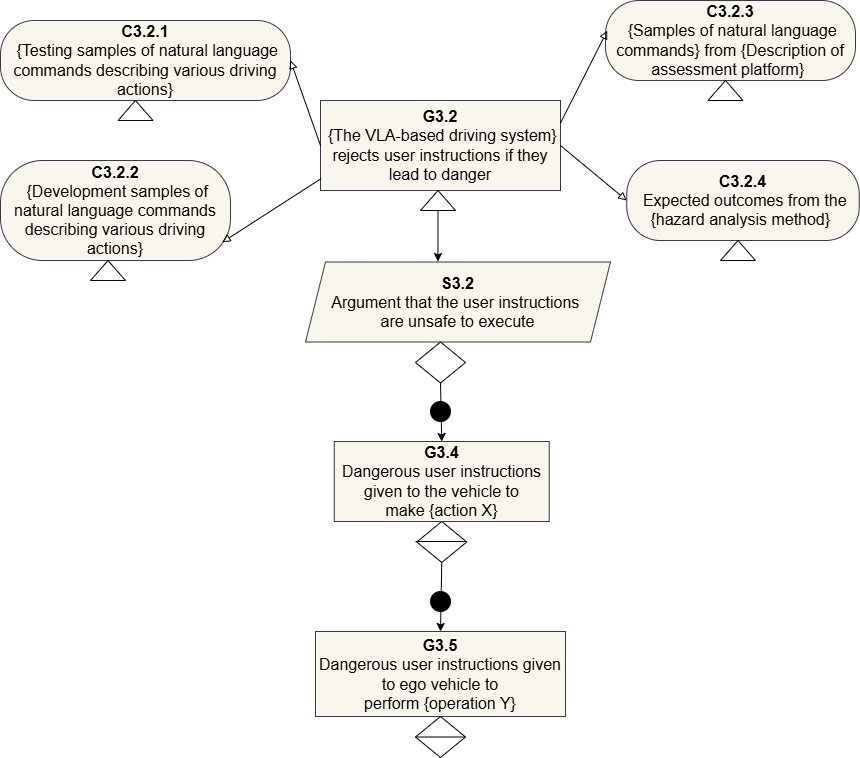
- 本文提出的RAISE方法为VLA驾驶系统设计了新的安全案例模式,扩展了危险分析与风险评估(HARA),以确保安全场景及其结果的详细描述。
- 通过对SimLingo的案例研究,展示了RAISE方法如何构建基于证据的安全声明,提升了VLA驾驶系统的安全性和可靠性。
📝 摘要(中文)
基于视觉-语言-动作(VLA)的驾驶系统在自动驾驶领域代表了一种重要的范式转变。通过结合交通场景理解、语言解释和动作生成,这些系统能够实现更灵活、适应性强且响应指令的驾驶行为。然而,VLA系统可能会出现新的危险行为,尤其是在将开放式自然语言输入整合到多模态控制环路中时,可能导致不可预测和不安全的行为。因此,确保这些系统的安全性至关重要。为此,本文提出了一种新颖的安全案例设计方法RAISE,旨在为VLA驾驶系统构建严格的基于证据的安全声明。
🔬 方法详解
问题定义:本文旨在解决VLA驾驶系统在处理自然语言输入时可能出现的安全隐患,现有方法未能有效应对这些新型危险行为。
核心思路:RAISE方法通过设计专门的安全案例模式,结合HARA的扩展,系统性地分析和描述安全场景,确保VLA系统的安全性。
技术框架:RAISE方法包括几个主要模块:安全案例模式设计、危险分析与风险评估的扩展、以及安全声明的构建。这些模块协同工作,形成一个完整的安全保障体系。
关键创新:RAISE方法的核心创新在于其针对VLA系统的安全案例模式设计,区别于传统方法,能够更好地应对开放式自然语言输入带来的复杂性和不确定性。
关键设计:在设计过程中,RAISE方法考虑了多种参数设置和损失函数,确保安全场景的准确性和可靠性,同时采用了适应性强的网络结构以支持多模态输入的处理。
🖼️ 关键图片


📊 实验亮点
在SimLingo的案例研究中,RAISE方法成功构建了基于证据的安全声明,显著提升了VLA驾驶系统的安全性。与传统方法相比,RAISE在处理开放式自然语言输入时表现出更高的安全保障能力,具体性能提升幅度未知。
🎯 应用场景
该研究的潜在应用领域包括自动驾驶汽车、智能交通系统和人机交互等。通过确保VLA驾驶系统的安全性,能够增强公众对自动驾驶技术的信任,推动其在实际场景中的应用与普及,最终实现更安全的交通环境。
📄 摘要(原文)
Vision-Language-Action (VLA)-based driving systems represent a significant paradigm shift in autonomous driving since, by combining traffic scene understanding, linguistic interpretation, and action generation, these systems enable more flexible, adaptive, and instruction-responsive driving behaviors. However, despite their growing adoption and potential to support socially responsible autonomous driving as well as understanding high-level human instructions, VLA-based driving systems may exhibit new types of hazardous behaviors. For instance, the integration of open-ended natural language inputs (e.g., user or navigation instructions) into the multimodal control loop may lead to unpredictable and unsafe behaviors that could endanger vehicle occupants and pedestrians. Hence, assuring the safety of these systems is crucial to help build trust in their operations. To support this, we propose a novel safety case design approach called RAISE. Our approach introduces novel patterns tailored to instruction-based driving systems such as VLA-based driving systems, an extension of Hazard Analysis and Risk Assessment (HARA) detailing safe scenarios and their outcomes, and a design technique to create the safety cases of VLA-based driving systems. A case study on SimLingo illustrates how our approach can be used to construct rigorous, evidence-based safety claims for this emerging class of autonomous driving systems.