Motion planning for off-road autonomous driving based on human-like cognition and weight adaptation
作者: Yuchun Wang, Cheng Gong, Jianwei Gong, Peng Jia
分类: cs.RO, cs.AI, cs.LG
发布日期: 2024-04-27
期刊: Journal of Field Robotics,2024,1-22
DOI: 10.1002/rob.22345
💡 一句话要点
提出基于人类认知和权重适应的越野自动驾驶运动规划方法
🎯 匹配领域: 支柱一:机器人控制 (Robot Control)
关键词: 越野自动驾驶 运动规划 人类认知 深度学习 轨迹优化 自适应系统 复杂环境
📋 核心要点
- 现有的运动规划方法在复杂的越野环境中难以适应不同的驾驶策略,固定的成本函数限制了轨迹优化的灵活性。
- 本文提出了一种基于人类认知的自适应运动规划器,通过学习人类驾驶轨迹来生成符合越野车辆动态的轨迹。
- 实验结果显示,该方法在沙漠越野环境中表现出色,具有实时操作能力和更高的稳定性,适应不同的越野条件。
📝 摘要(中文)
在越野环境中,自动驾驶车辆面临复杂多变的地形挑战。为了确保稳定高效的行驶,车辆需要综合考虑地形起伏、粗糙度和障碍物等环境因素,以生成适应变化场景的最佳轨迹。然而,传统的运动规划方法通常使用固定的成本函数进行轨迹优化,难以适应不同的驾驶策略。为了解决这些问题,本文提出了一种基于人类认知和成本评估的自适应运动规划器。通过构建多层次地图描述越野地形特征,并利用CNN-LSTM网络学习人类驾驶员在不同场景下规划的轨迹,设计了一种模仿人类轨迹的原始轨迹规划器。实验结果表明,该方法在复杂地形和变化路况下具有良好的适应性和稳定性。
🔬 方法详解
问题定义:论文旨在解决越野自动驾驶中运动规划的适应性不足问题。现有方法往往依赖于固定成本函数,无法有效应对复杂地形和不常见场景的变化。
核心思路:提出一种基于人类驾驶认知的自适应运动规划器,通过学习人类驾驶员在多种越野场景下的轨迹,生成更符合实际驾驶需求的轨迹。
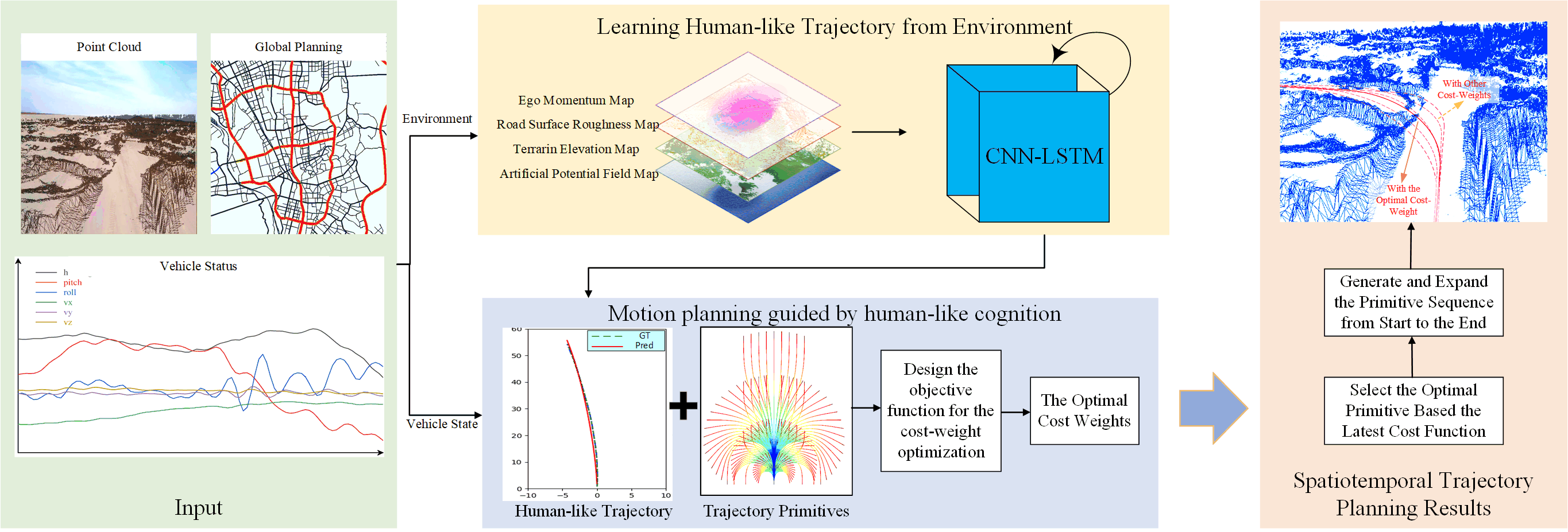
技术框架:整体架构包括多层次地图构建、CNN-LSTM网络学习和原始轨迹规划器设计三个主要模块。首先构建描述越野地形特征的地图,然后利用深度学习模型学习人类轨迹,最后设计轨迹规划器生成适应性轨迹。
关键创新:最重要的创新在于结合人类认知与动态权重调整,生成的轨迹不仅模仿人类驾驶行为,还能根据环境变化实时调整成本权重,提升了规划的灵活性和稳定性。
关键设计:在网络结构上,采用CNN-LSTM结合的方式进行轨迹学习,损失函数设计考虑了轨迹的平滑性和稳定性,确保生成的轨迹符合越野车辆的动态特性。通过对行为原语的选择和扩展,进一步增强了轨迹的适应性。
🖼️ 关键图片


📊 实验亮点
实验结果表明,提出的运动规划方法在沙漠越野环境中表现出色,具有实时操作能力和更高的稳定性。与传统方法相比,适应性提升显著,能够有效应对复杂地形和变化路况,展现出更人性化的规划能力。
🎯 应用场景
该研究的潜在应用领域包括越野自动驾驶、无人驾驶车辆的导航系统以及复杂环境下的机器人运动规划。其实际价值在于提高自动驾驶系统在多变地形中的适应能力,未来可能推动无人驾驶技术在更广泛场景中的应用。
📄 摘要(原文)
Driving in an off-road environment is challenging for autonomous vehicles due to the complex and varied terrain. To ensure stable and efficient travel, the vehicle requires consideration and balancing of environmental factors, such as undulations, roughness, and obstacles, to generate optimal trajectories that can adapt to changing scenarios. However, traditional motion planners often utilize a fixed cost function for trajectory optimization, making it difficult to adapt to different driving strategies in challenging irregular terrains and uncommon scenarios. To address these issues, we propose an adaptive motion planner based on human-like cognition and cost evaluation for off-road driving. First, we construct a multi-layer map describing different features of off-road terrains, including terrain elevation, roughness, obstacle, and artificial potential field map. Subsequently, we employ a CNN-LSTM network to learn the trajectories planned by human drivers in various off-road scenarios. Then, based on human-like generated trajectories in different environments, we design a primitive-based trajectory planner that aims to mimic human trajectories and cost weight selection, generating trajectories that are consistent with the dynamics of off-road vehicles. Finally, we compute optimal cost weights and select and extend behavioral primitives to generate highly adaptive, stable, and efficient trajectories. We validate the effectiveness of the proposed method through experiments in a desert off-road environment with complex terrain and varying road conditions. The experimental results show that the proposed human-like motion planner has excellent adaptability to different off-road conditions. It shows real-time operation, greater stability, and more human-like planning ability in diverse and challenging scenarios.