Hierarchical place recognition with omnidirectional images and curriculum learning-based loss functions
作者: Marcos Alfaro, Juan José Cabrera, María Flores, Óscar Reinoso, Luis Payá
分类: cs.RO, cs.AI, cs.CV
发布日期: 2024-04-22 (更新: 2025-10-01)
🔗 代码/项目: GITHUB
💡 一句话要点
提出基于课程学习的三元组损失函数以解决视觉位置识别问题
🎯 匹配领域: 支柱二:RL算法与架构 (RL & Architecture)
关键词: 视觉位置识别 深度学习 课程学习 三元组损失 全景图像 移动机器人 鲁棒性
📋 核心要点
- 核心问题:现有的视觉位置识别方法在复杂环境下的鲁棒性不足,尤其是在光照变化和动态视觉效果影响下表现不佳。
- 方法要点:提出利用全景图像和课程学习策略优化三元组损失函数,逐步提高训练样本的难度,以增强模型的特征学习能力。
- 实验或效果:在多种室内外环境中进行评估,结果显示该方法在各种挑战条件下均表现出色,具有高识别准确率。
📝 摘要(中文)
本文针对视觉位置识别(VPR)问题,提出了一种利用全景图像和深度学习模型的解决方案。该方案通过课程学习策略对三元组损失函数进行微调,逐步呈现更具挑战性的样本,从而使模型学习到更具区分性和鲁棒性的特征表示,克服了传统对比损失函数的局限性。经过训练后,VPR分为粗略(房间检索)和精细(位置估计)两个步骤。结果表明,基于课程的三元组损失在各种复杂感知条件下均优于标准对比损失函数,展示了其在真实机器人应用中的潜力。
🔬 方法详解
问题定义:本文旨在解决视觉位置识别(VPR)中的鲁棒性问题,尤其是在光照变化、动态视觉效果及有限训练数据等复杂环境下,现有方法往往难以有效识别。
核心思路:通过引入课程学习策略,逐步呈现更具挑战性的样本,优化三元组损失函数,使模型能够学习到更具区分性和鲁棒性的特征表示,从而提升识别性能。
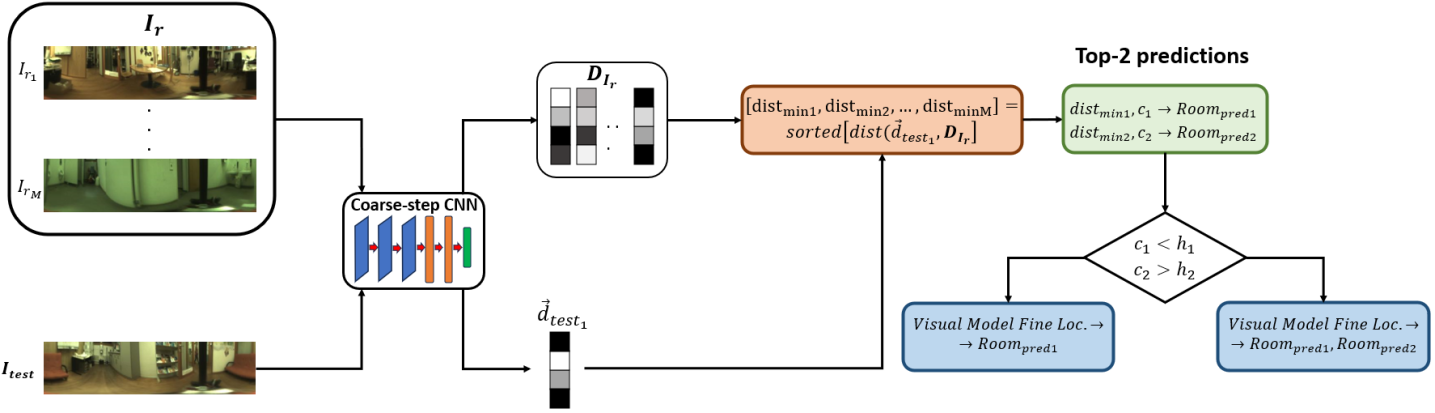
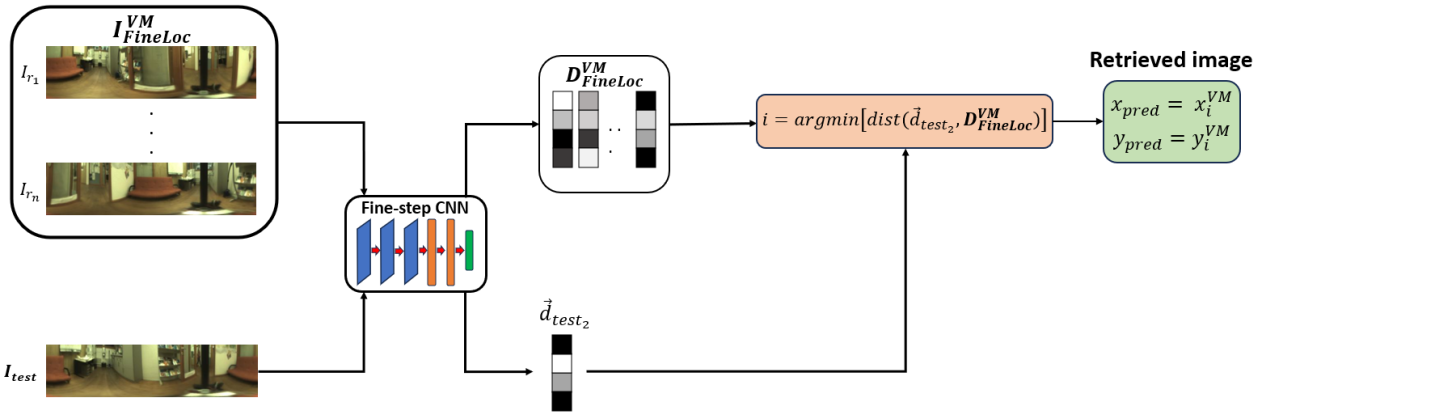
技术框架:整体架构分为两个主要阶段:粗略阶段进行房间检索,精细阶段进行位置估计。模型通过全景图像输入,结合优化后的损失函数进行训练。
关键创新:最重要的创新在于将课程学习策略与三元组损失函数结合,克服了传统对比损失函数在复杂环境下的局限性,显著提升了模型的特征学习能力。
关键设计:在损失函数设计上,采用课程学习策略,逐步增加样本难度;在网络结构上,利用深度学习模型处理全景图像,确保模型能够有效提取多样化的特征。
🖼️ 关键图片

📊 实验亮点
实验结果表明,基于课程学习的三元组损失函数在各种复杂条件下的表现优于传统对比损失函数,尤其在光照变化和动态视觉效果下,识别准确率显著提高,展示了该方法的有效性和可靠性。
🎯 应用场景
该研究的潜在应用领域包括移动机器人导航、自动驾驶、智能监控等。通过提高视觉位置识别的鲁棒性,该方法能够在复杂环境中实现更安全、更可靠的导航,具有重要的实际价值和广泛的应用前景。
📄 摘要(原文)
This paper addresses Visual Place Recognition (VPR), which is essential for the safe navigation of mobile robots. The solution we propose employs panoramic images and deep learning models, which are fine-tuned with triplet loss functions that integrate curriculum learning strategies. By progressively presenting more challenging examples during training, these loss functions enable the model to learn more discriminative and robust feature representations, overcoming the limitations of conventional contrastive loss functions. After training, VPR is tackled in two steps: coarse (room retrieval) and fine (position estimation). The results demonstrate that the curriculum-based triplet losses consistently outperform standard contrastive loss functions, particularly under challenging perceptual conditions. To thoroughly assess the robustness and generalization capabilities of the proposed method, it is evaluated in a variety of indoor and outdoor environments. The approach is tested against common challenges in real operation conditions, including severe illumination changes, the presence of dynamic visual effects such as noise and occlusions, and scenarios with limited training data. The results show that the proposed framework performs competitively in all these situations, achieving high recognition accuracy and demonstrating its potential as a reliable solution for real-world robotic applications. The code used in the experiments is available at https://github.com/MarcosAlfaro/TripletNetworksIndoorLocalization.git.