ControlMTR: Control-Guided Motion Transformer with Scene-Compliant Intention Points for Feasible Motion Prediction
作者: Jiawei Sun, Chengran Yuan, Shuo Sun, Shanze Wang, Yuhang Han, Shuailei Ma, Zefan Huang, Anthony Wong, Keng Peng Tee, Marcelo H. Ang
分类: cs.RO
发布日期: 2024-04-16 (更新: 2024-04-17)
期刊: 2024 IEEE 27th International Conference on Intelligent Transportation Systems (ITSC)
DOI: 10.1109/ITSC58415.2024.10919900
💡 一句话要点
提出ControlMTR以解决多模态运动预测中的不合理意图点问题
🎯 匹配领域: 支柱七:动作重定向 (Motion Retargeting) 支柱八:物理动画 (Physics-based Animation) 支柱九:具身大模型 (Embodied Foundation Models)
关键词: 运动预测 多模态学习 自动驾驶 控制命令 意图点生成 场景理解 轨迹生成
📋 核心要点
- 现有的运动预测方法在多模态预测分布上存在过于分散的问题,导致在某些场景下的预测不切实际。
- ControlMTR框架通过生成符合场景的意图点和预测驾驶控制命令,解决了固定意图点带来的局限性。
- 实验结果表明,ControlMTR在各项性能指标上均优于基线MTR模型,显著提升了预测的准确性和合理性。
📝 摘要(中文)
准确预测周围交通参与者的可行多模态未来轨迹对于自动驾驶车辆的行为规划至关重要。现有的运动变换器(MTR)通过用固定的运动意图点替代传统的密集未来端点,缓解了训练过程中的模式崩溃和不稳定性。然而,固定的意图点使得MTR的多模态预测分布在许多场景中过于分散且不切实际。为了解决这些问题,本文提出了ControlMTR框架,通过生成符合场景的意图点并预测驾驶控制命令,进一步将其转化为通过简单运动模型生成的轨迹。这些控制生成的轨迹将通过辅助损失函数引导直接预测的轨迹,从而有效限制预测分布在道路边界内,抑制不合理的越界预测,同时提升预测性能。我们的方案在所有性能指标上均超越了基线MTR模型,SoftmAP提升了5.22%,MissRate降低了4.15%,并有效减少了41.85%的越界率。
🔬 方法详解
问题定义:本文旨在解决现有运动预测方法中固定意图点导致的多模态预测分布过于分散和不切实际的问题。现有的MTR方法在训练过程中容易出现模式崩溃和不稳定性,影响预测性能。
核心思路:ControlMTR框架的核心思想是生成符合场景的意图点,并通过预测驾驶控制命令来引导轨迹生成。这样的设计使得预测轨迹能够更好地符合实际道路条件,避免不合理的越界预测。
技术框架:ControlMTR的整体架构包括意图点生成模块、控制命令预测模块和轨迹生成模块。意图点生成模块负责根据场景信息生成合适的意图点,控制命令预测模块则基于这些意图点预测驾驶控制命令,最后通过简单的运动模型将控制命令转化为轨迹。
关键创新:ControlMTR的主要创新在于引入了场景符合的意图点和控制生成的轨迹,这与传统的固定意图点方法形成了鲜明对比。通过这种方式,ControlMTR能够有效限制预测分布在可行的道路范围内。
关键设计:在设计上,ControlMTR采用了辅助损失函数来引导直接预测的轨迹,同时在网络结构上进行了优化,以提高模型的稳定性和预测性能。
🖼️ 关键图片
📊 实验亮点
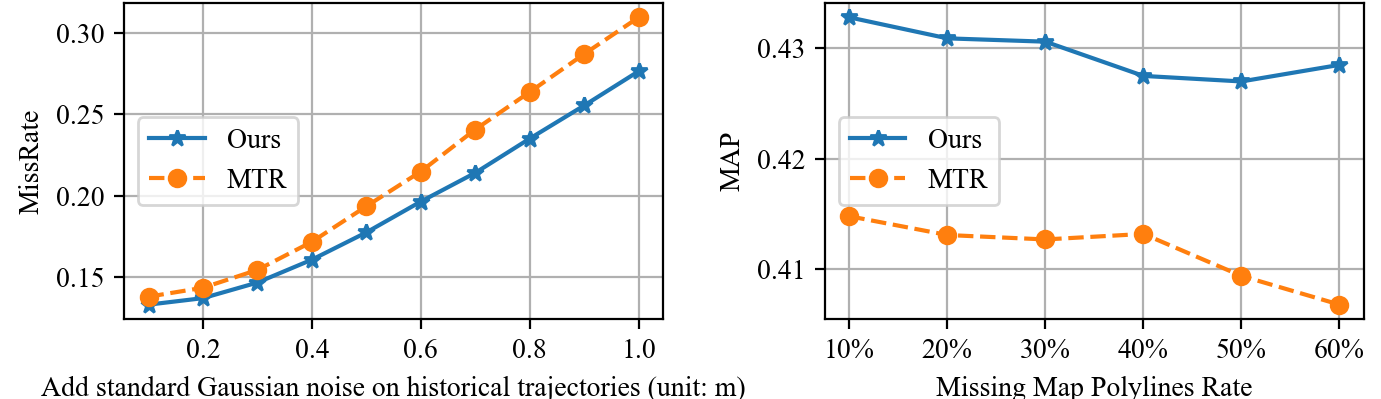
实验结果显示,ControlMTR在所有性能指标上均超越了基线MTR模型,SoftmAP提升了5.22%,MissRate降低了4.15%。此外,ControlMTR有效减少了41.85%的越界率,确保预测分布限制在可行的驾驶区域内。
🎯 应用场景
该研究的潜在应用领域包括自动驾驶汽车的行为规划、交通管理系统以及智能交通信号控制等。通过提高运动预测的准确性和合理性,ControlMTR能够有效提升自动驾驶系统的安全性和可靠性,推动智能交通的发展。
📄 摘要(原文)
The ability to accurately predict feasible multimodal future trajectories of surrounding traffic participants is crucial for behavior planning in autonomous vehicles. The Motion Transformer (MTR), a state-of-the-art motion prediction method, alleviated mode collapse and instability during training and enhanced overall prediction performance by replacing conventional dense future endpoints with a small set of fixed prior motion intention points. However, the fixed prior intention points make the MTR multi-modal prediction distribution over-scattered and infeasible in many scenarios. In this paper, we propose the ControlMTR framework to tackle the aforementioned issues by generating scene-compliant intention points and additionally predicting driving control commands, which are then converted into trajectories by a simple kinematic model with soft constraints. These control-generated trajectories will guide the directly predicted trajectories by an auxiliary loss function. Together with our proposed scene-compliant intention points, they can effectively restrict the prediction distribution within the road boundaries and suppress infeasible off-road predictions while enhancing prediction performance. Remarkably, without resorting to additional model ensemble techniques, our method surpasses the baseline MTR model across all performance metrics, achieving notable improvements of 5.22% in SoftmAP and a 4.15% reduction in MissRate. Our approach notably results in a 41.85% reduction in the cross-boundary rate of the MTR, effectively ensuring that the prediction distribution is confined within the drivable area.