QuasiSim: Parameterized Quasi-Physical Simulators for Dexterous Manipulations Transfer
作者: Xueyi Liu, Kangbo Lyu, Jieqiong Zhang, Tao Du, Li Yi
分类: cs.RO, cs.CV, cs.GR
发布日期: 2024-04-11 (更新: 2024-07-21)
备注: Accepted to ECCV 2024. Project website: https://meowuu7.github.io/QuasiSim/ Code: https://github.com/Meowuu7/QuasiSim Hugging Face Demo: https://huggingface.co/spaces/xymeow7/quasi-physical-sims
🔗 代码/项目: PROJECT_PAGE
💡 一句话要点
提出参数化准物理模拟器以解决灵巧操作转移问题
🎯 匹配领域: 支柱一:机器人控制 (Robot Control)
关键词: 灵巧操作 机器人手 物理模拟 参数化模型 操作转移 高保真模拟 优化算法
📋 核心要点
- 灵巧操作转移问题具有挑战性,现有方法在高保真模拟器中优化能力有限,导致操作复制效果不佳。
- 本文提出参数化准物理模拟器和物理课程,通过平衡模拟的保真度和可优化性来解决上述问题。
- 实验结果显示,灵巧手在高保真模拟环境中成功跟踪复杂操作,成功率提升超过11%。
📝 摘要(中文)
本文探讨了灵巧操作转移问题,通过设计模拟器来实现人类操作在灵巧机器人手模拟中的转移。由于灵巧手的高自由度和复杂的动态特性,现有方法在高保真黑箱模拟器中优化的能力有限。为此,本文引入了参数化准物理模拟器和物理课程,旨在平衡模拟的保真度和可优化性,从而在高保真模拟环境中成功实现灵巧手对复杂操作的跟踪,提升成功率超过11%。
🔬 方法详解
问题定义:本文旨在解决灵巧操作转移问题,现有方法在高保真黑箱模拟器中优化能力有限,导致无法准确复制人类操作。
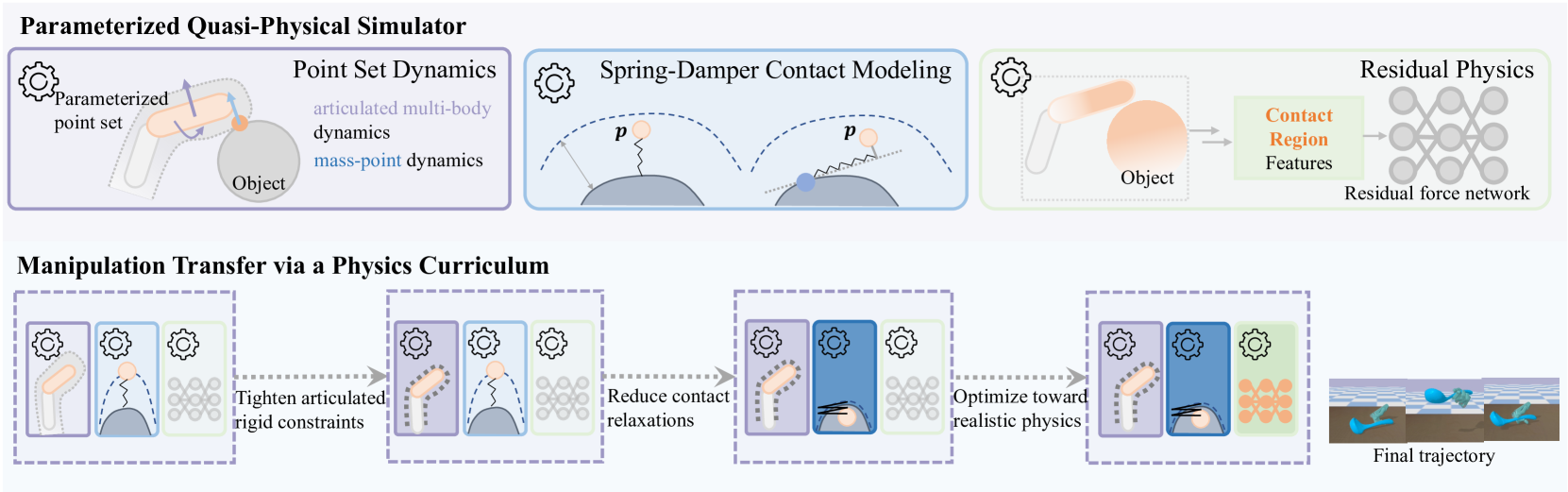
核心思路:论文提出参数化准物理模拟器和物理课程,通过设计不同保真度和可优化性的模拟器,逐步解决灵巧手操作的复杂性。
技术框架:整体架构包括参数化模拟器的设计和物理课程的实施,模拟器从高任务可优化性到高保真度逐步过渡,确保灵巧手能够适应不同操作场景。
关键创新:最重要的创新在于引入了参数化准物理模拟器和物理课程的概念,显著提升了灵巧手在复杂操作中的表现,与传统方法相比,提供了更高的灵活性和适应性。
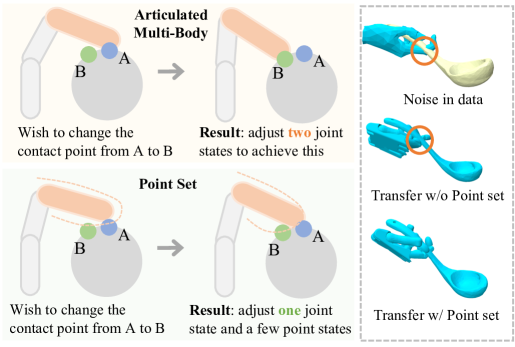
关键设计:在参数设置上,模拟器的参数化设计允许在不同的操作条件下进行调整,损失函数则针对任务的特定需求进行优化,确保灵巧手的操作精度和稳定性。
🖼️ 关键图片
📊 实验亮点
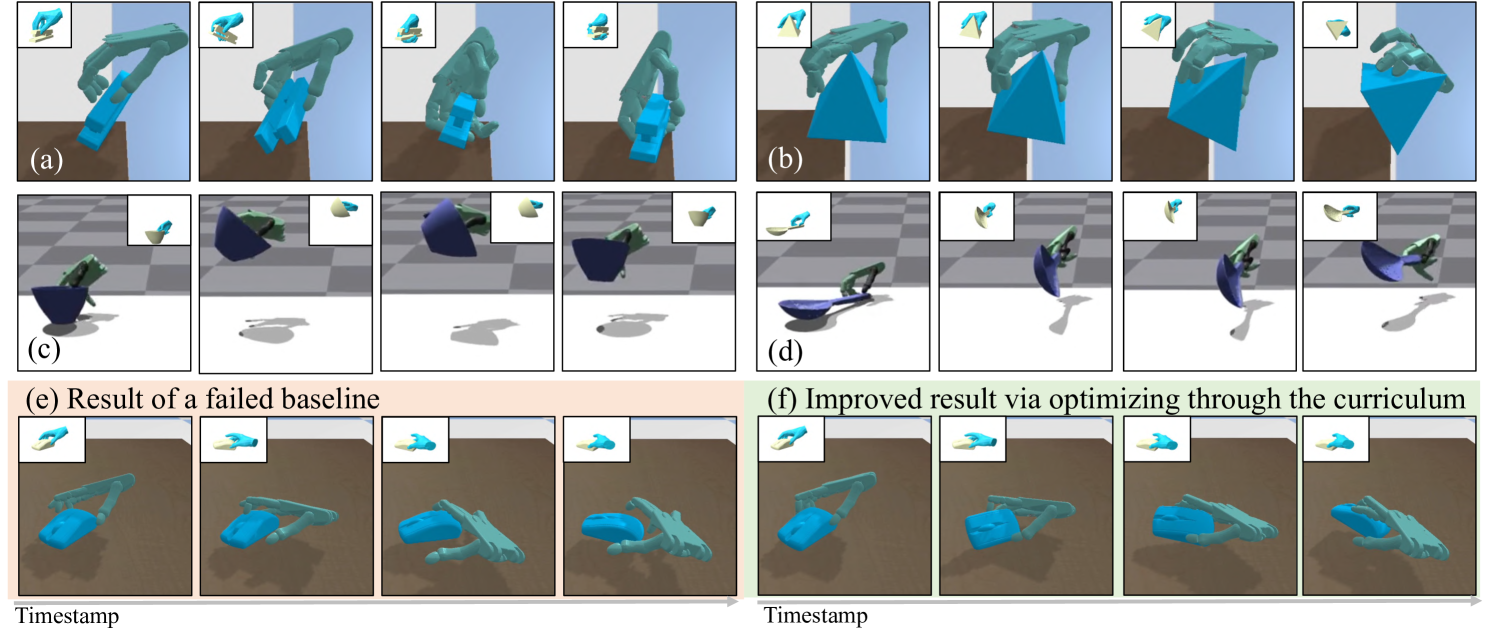
实验结果表明,灵巧手在高保真模拟环境中成功跟踪复杂操作,成功率提升超过11%,显著优于最佳基线表现,验证了所提方法的有效性。
🎯 应用场景
该研究的潜在应用领域包括人机协作、自动化装配、医疗机器人等,能够提高机器人在复杂环境中的操作能力,具有重要的实际价值和未来影响。
📄 摘要(原文)
We explore the dexterous manipulation transfer problem by designing simulators. The task wishes to transfer human manipulations to dexterous robot hand simulations and is inherently difficult due to its intricate, highly-constrained, and discontinuous dynamics and the need to control a dexterous hand with a DoF to accurately replicate human manipulations. Previous approaches that optimize in high-fidelity black-box simulators or a modified one with relaxed constraints only demonstrate limited capabilities or are restricted by insufficient simulation fidelity. We introduce parameterized quasi-physical simulators and a physics curriculum to overcome these limitations. The key ideas are 1) balancing between fidelity and optimizability of the simulation via a curriculum of parameterized simulators, and 2) solving the problem in each of the simulators from the curriculum, with properties ranging from high task optimizability to high fidelity. We successfully enable a dexterous hand to track complex and diverse manipulations in high-fidelity simulated environments, boosting the success rate by 11\%+ from the best-performed baseline. The project website is available at https://meowuu7.github.io/QuasiSim/.