One-Shot Transfer of Long-Horizon Extrinsic Manipulation Through Contact Retargeting
作者: Albert Wu, Ruocheng Wang, Sirui Chen, Clemens Eppner, C. Karen Liu
分类: cs.RO
发布日期: 2024-04-11
备注: 8 pages, 6 figures
💡 一句话要点
提出一种通过接触重定向实现长时间外部操作的一次性迁移方法
🎯 匹配领域: 支柱一:机器人控制 (Robot Control)
关键词: 外部操作 接触重定向 机器人操作 长时间任务 短时间原语 逆向运动学 状态约束
📋 核心要点
- 长时间外部操作的协调因场景多样性和复杂的接触动态而极具挑战,现有方法难以有效应对。
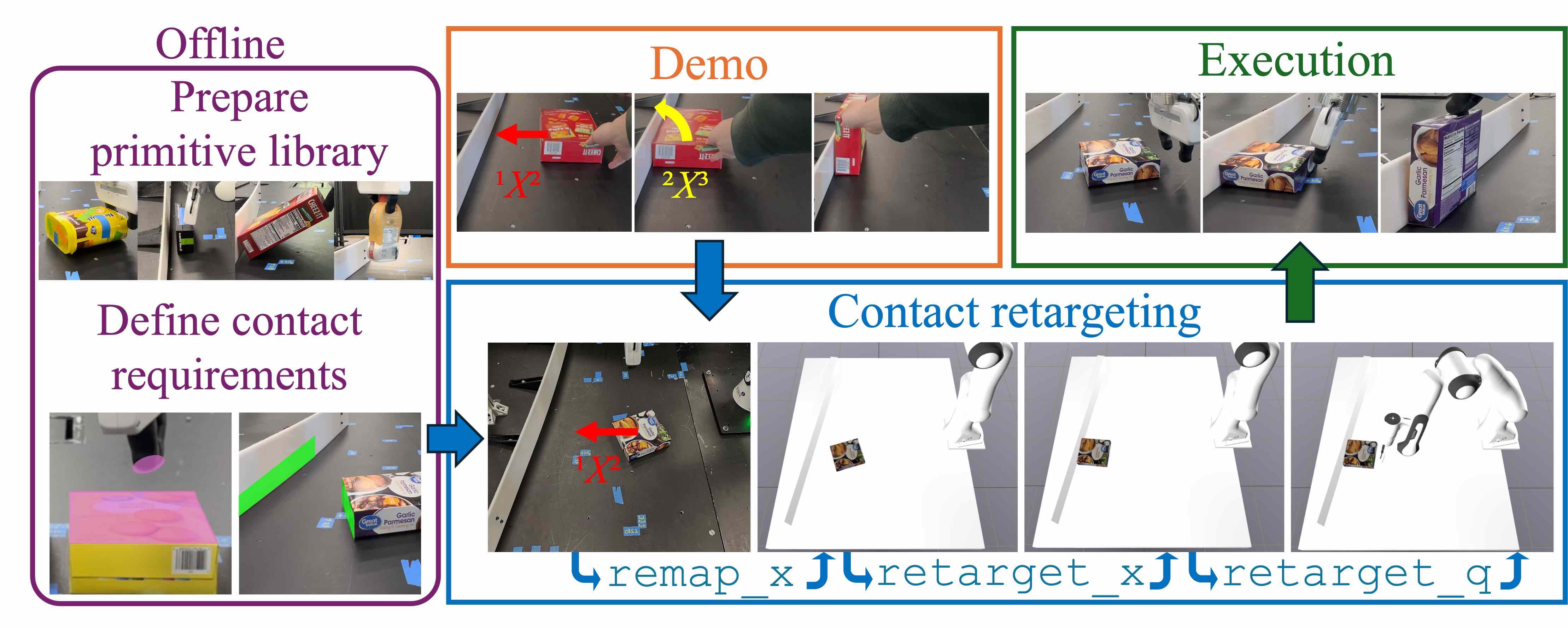
- 提出通过重定向接触要求,将一次性外部操作轨迹推广到多样对象和环境,利用短时间原语策略库进行组合。
- 在7+1自由度的机器人手臂系统上,实验显示该方法在四个长时间外部操作任务中成功率达到80.5%。
📝 摘要(中文)
外部操作利用环境接触实现操作目标,但由于场景多样性和复杂的接触动态,长时间接触交互的协调极具挑战性。本文提出了一种通过重定向接触要求来将一次性外部操作轨迹推广到不同对象和环境的方法。我们构建了一个包含稳健的短时间、目标条件原语策略的库,并设计了一个框架来组合每个原语的接触规范所产生的状态约束。通过在测试场景中施加这些约束,我们能够找到中间目标状态并使用逆向运动学进行跟踪。实验结果表明,该方法在四个长时间外部操作任务中达到了80.5%的成功率。
🔬 方法详解
问题定义:本文旨在解决长时间外部操作中,如何有效协调机器人、物体与环境之间的接触交互。现有方法在面对多样化场景和复杂接触动态时,往往难以实现预期的操作效果。
核心思路:我们观察到大多数外部操作可以视为短时间原语的组合,而这些原语的成功执行依赖于良好的接触配置。因此,提出通过重定向接触要求来实现一次性外部操作轨迹的泛化。
技术框架:整体框架包括构建一个短时间目标条件原语策略库,并设计一个组合状态约束的机制。给定测试场景和原语序列演示,方法通过施加状态约束并使用逆向运动学找到中间目标状态。
关键创新:最重要的创新在于接触重定向的概念,使得短时间原语能够在不同对象和环境中有效组合,从而实现长时间外部操作的成功。与现有方法相比,该方法在多样性和适应性上具有显著优势。
关键设计:在设计中,采用了稳健的短时间原语策略库,结合状态约束的组合机制,并通过逆向运动学实现目标状态的跟踪。具体的参数设置和损失函数设计在实验中经过优化,以确保高效的操作执行。
🖼️ 关键图片


📊 实验亮点
实验结果显示,在四个长时间外部操作任务中,采用该方法的成功率达到了80.5%。相比于传统方法,该方法在处理多样对象和环境配置时,展现了更高的灵活性和适应性,验证了接触重定向的有效性。
🎯 应用场景
该研究的潜在应用领域包括工业自动化、服务机器人以及人机协作等场景。通过提高机器人在复杂环境中的操作能力,能够显著提升生产效率和安全性,未来可能对智能制造和智能家居等领域产生深远影响。
📄 摘要(原文)
Extrinsic manipulation, the use of environment contacts to achieve manipulation objectives, enables strategies that are otherwise impossible with a parallel jaw gripper. However, orchestrating a long-horizon sequence of contact interactions between the robot, object, and environment is notoriously challenging due to the scene diversity, large action space, and difficult contact dynamics. We observe that most extrinsic manipulation are combinations of short-horizon primitives, each of which depend strongly on initializing from a desirable contact configuration to succeed. Therefore, we propose to generalize one extrinsic manipulation trajectory to diverse objects and environments by retargeting contact requirements. We prepare a single library of robust short-horizon, goal-conditioned primitive policies, and design a framework to compose state constraints stemming from contacts specifications of each primitive. Given a test scene and a single demo prescribing the primitive sequence, our method enforces the state constraints on the test scene and find intermediate goal states using inverse kinematics. The goals are then tracked by the primitive policies. Using a 7+1 DoF robotic arm-gripper system, we achieved an overall success rate of 80.5% on hardware over 4 long-horizon extrinsic manipulation tasks, each with up to 4 primitives. Our experiments cover 10 objects and 6 environment configurations. We further show empirically that our method admits a wide range of demonstrations, and that contact retargeting is indeed the key to successfully combining primitives for long-horizon extrinsic manipulation. Code and additional details are available at stanford-tml.github.io/extrinsic-manipulation.