Interactive-FAR:Interactive, Fast and Adaptable Routing for Navigation Among Movable Obstacles in Complex Unknown Environments
作者: Botao He, Guofei Chen, Wenshan Wang, Ji Zhang, Cornelia Fermuller, Yiannis Aloimonos
分类: cs.RO
发布日期: 2024-04-11
备注: Project website: https://www.far-planner.com/interactive-far-planner. 8 pages, 8 figures
💡 一句话要点
提出Interactive-FAR以解决复杂未知环境中的导航问题
🎯 匹配领域: 支柱三:空间感知与语义 (Perception & Semantics)
关键词: 实时路径规划 动态障碍物 复杂环境 交互式导航 机器人技术 智能交通 算法优化
📋 核心要点
- 现有方法在复杂未知环境中导航时,难以有效处理可移动障碍物,导致路径规划效率低下。
- 本文提出了一种实时交互式路径规划算法,能够在规划过程中动态操控障碍物并实时调整路径。
- 实验结果显示,该算法在复杂环境中旅行时间减少33%,路径效率提高49%,且速度显著快于传统方法。
📝 摘要(中文)
本文介绍了一种实时算法,用于在复杂未知环境中导航,环境中存在可移动障碍物。该算法通过在路径规划过程中主动尝试操控障碍物,并根据传感器反馈调整全局规划,实现快速且适应性强的路径规划。主要贡献包括改进的动态有向可见图(DV-graph)以快速进行全局路径搜索、实时交互规划方法能够在线适应新的感知信息,以及为复杂未知或部分已知环境设计的综合框架。实验结果表明,该算法在复杂环境中能将旅行时间减少33%,路径效率提高49%,且运行速度比传统方法快几个数量级。我们还开源了代码以促进未来研究。
🔬 方法详解
问题定义:本文旨在解决在复杂未知环境中导航时,如何有效应对可移动障碍物的问题。现有方法在动态环境中往往无法实时调整路径,导致效率低下。
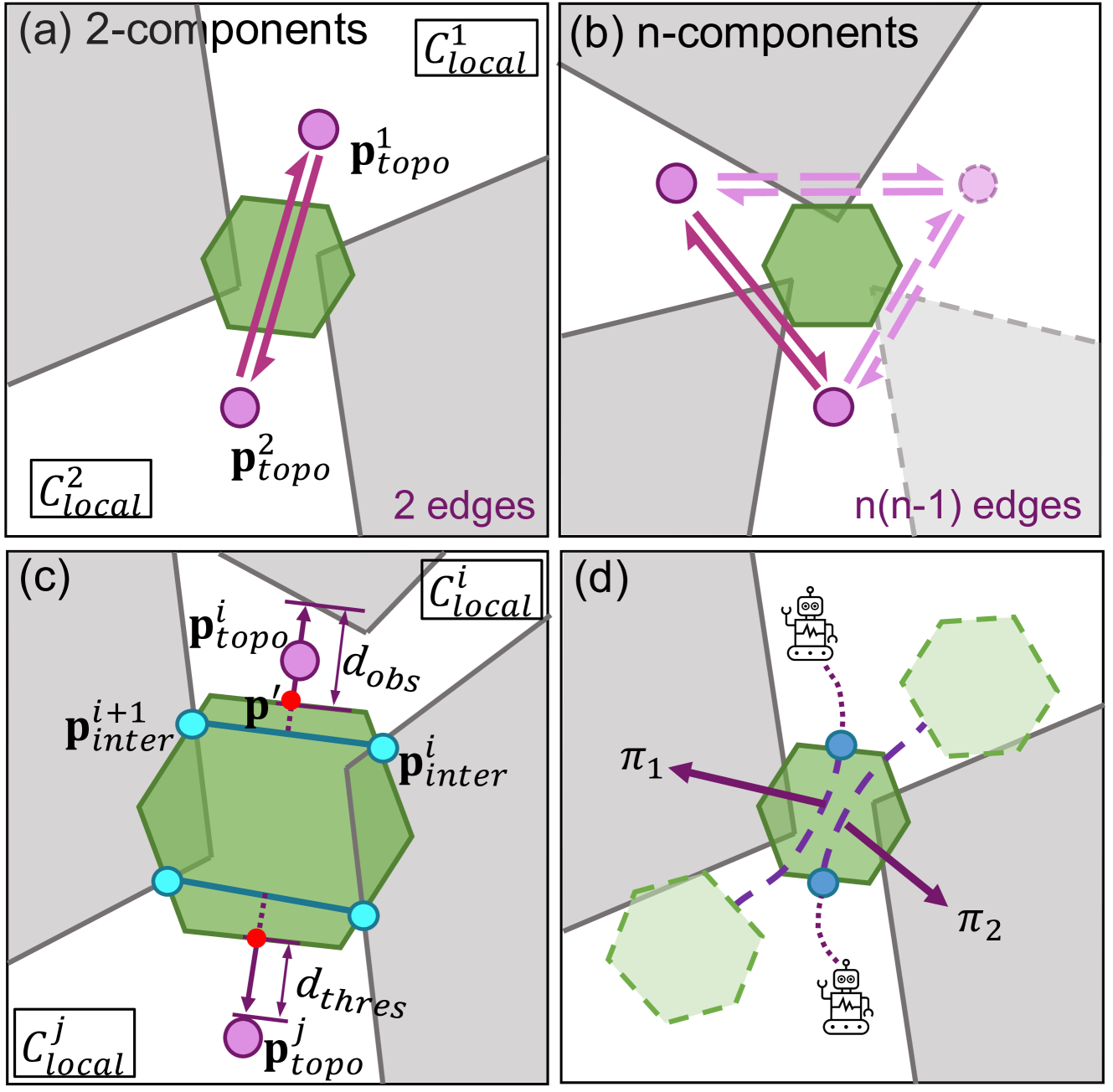
核心思路:论文提出的核心思路是通过实时操控障碍物来优化路径规划,结合传感器反馈动态调整全局路径,从而提高导航效率和灵活性。
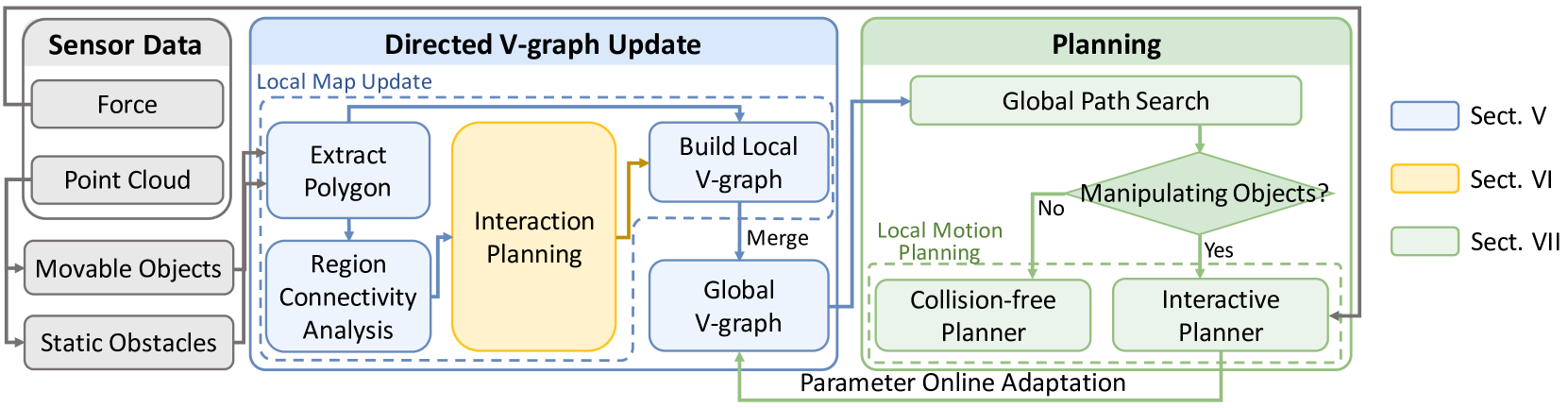
技术框架:整体架构包括三个主要模块:动态有向可见图(DV-graph)用于快速全局路径搜索,实时交互规划模块用于根据新感知信息调整路径,以及综合框架用于协调各模块的交互与反馈。
关键创新:最重要的技术创新在于引入了动态DV-graph和实时交互规划方法,使得算法能够在复杂环境中快速适应变化,与传统静态路径规划方法本质上不同。
关键设计:在设计中,算法采用了高效的图搜索策略,结合了障碍物的可移动性和环境感知信息,确保路径规划的实时性和适应性。
🖼️ 关键图片

📊 实验亮点
实验结果表明,Interactive-FAR算法在复杂环境中将旅行时间减少了33%,路径效率提高了49%,且在速度上比传统方法快几个数量级,展示了其在交互式导航中的优越性。
🎯 应用场景
该研究的潜在应用领域包括自动驾驶、机器人导航和智能物流等场景,能够显著提升在动态和复杂环境中的导航效率。未来,该算法有望推动智能交通系统和自主机器人技术的发展,提升其在真实世界中的应用价值。
📄 摘要(原文)
This paper introduces a real-time algorithm for navigating complex unknown environments cluttered with movable obstacles. Our algorithm achieves fast, adaptable routing by actively attempting to manipulate obstacles during path planning and adjusting the global plan from sensor feedback. The main contributions include an improved dynamic Directed Visibility Graph (DV-graph) for rapid global path searching, a real-time interaction planning method that adapts online from new sensory perceptions, and a comprehensive framework designed for interactive navigation in complex unknown or partially known environments. Our algorithm is capable of replanning the global path in several milliseconds. It can also attempt to move obstacles, update their affordances, and adapt strategies accordingly. Extensive experiments validate that our algorithm reduces the travel time by 33%, achieves up to 49% higher path efficiency, and runs faster than traditional methods by orders of magnitude in complex environments. It has been demonstrated to be the most efficient solution in terms of speed and efficiency for interactive navigation in environments of such complexity. We also open-source our code in the docker demo to facilitate future research.