Learning Visual Quadrupedal Loco-Manipulation from Demonstrations
作者: Zhengmao He, Kun Lei, Yanjie Ze, Koushil Sreenath, Zhongyu Li, Huazhe Xu
分类: cs.RO, cs.LG
发布日期: 2024-03-29 (更新: 2024-08-02)
备注: Published at IROS 2024. Project website: https://zhengmaohe.github.io/leg-manip
🔗 代码/项目: PROJECT_PAGE
💡 一句话要点
提出基于示范的四足机器人视觉运动操控方法以解决物体交互问题
🎯 匹配领域: 支柱一:机器人控制 (Robot Control) 支柱二:RL算法与架构 (RL & Architecture)
关键词: 四足机器人 运动操控 强化学习 行为克隆 物体交互 机器人技术 智能控制
📋 核心要点
- 现有四足机器人在与物体交互方面能力有限,尤其是在复杂的现实场景中。
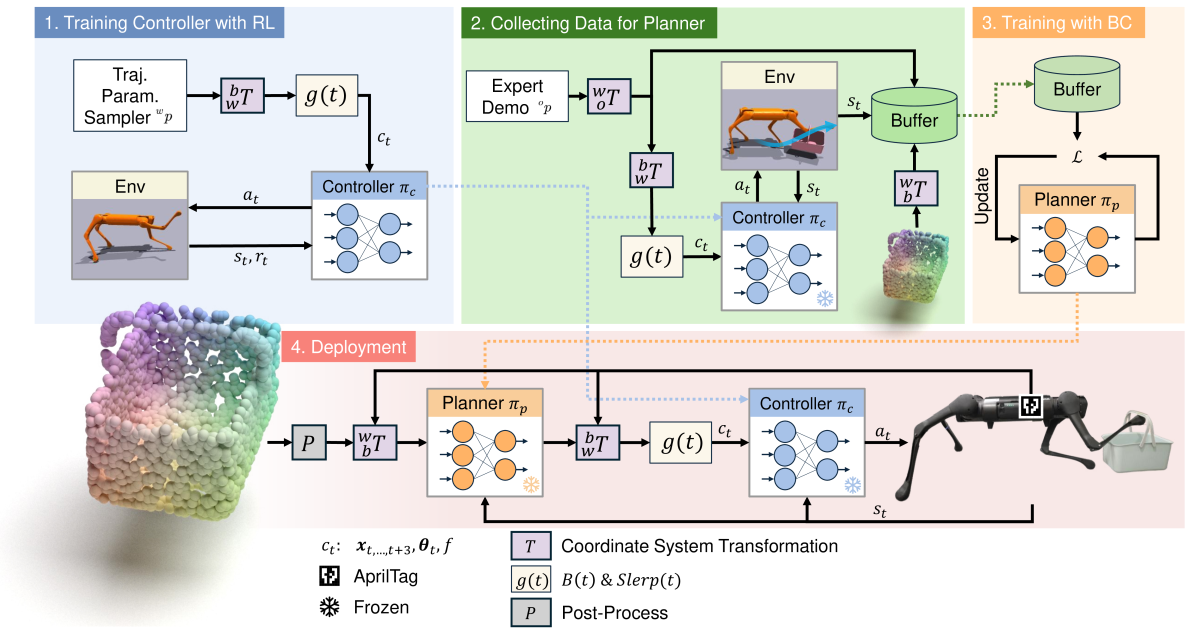
- 本文提出了一种将运动操控分解为低层次强化学习控制和高层次行为克隆规划的方法,旨在提高操控能力。
- 通过仿真和实际实验验证,机器人能够在移动中完成多种高精度任务,展示了其操控能力的提升。
📝 摘要(中文)
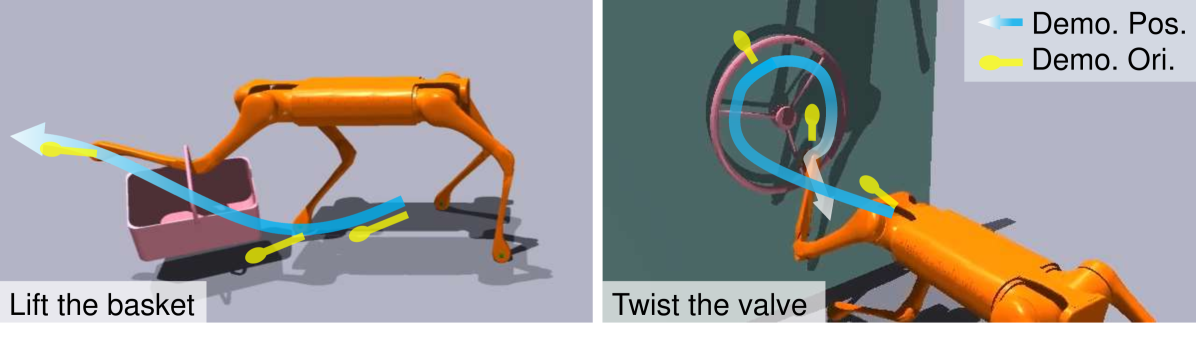
四足机器人逐渐被集成到人类环境中,尽管其运动能力不断提升,但在现实场景中与物体的交互仍然有限。本文旨在使四足机器人仅通过其腿部执行真实世界的操控任务。我们将运动操控过程分解为低层次的基于强化学习的控制器和高层次的基于行为克隆的规划器。通过参数化操控轨迹,我们同步上下层的努力,从而充分利用强化学习和行为克隆的优势。实验结果表明,机器人能够在移动的同时完成高精度的任务,如从地面提起篮子、关闭洗碗机、按按钮和推门等。
🔬 方法详解
问题定义:本文解决的是四足机器人在复杂环境中进行物体操控的能力不足问题。现有方法往往依赖于额外的机械臂,导致冗余和复杂性。
核心思路:我们通过将运动操控过程分为低层次的强化学习控制和高层次的行为克隆规划,旨在利用四足机器人的四肢灵活性,减少对额外机械臂的依赖。
技术框架:整体架构包括两个主要模块:低层次的强化学习控制器负责实时运动控制,高层次的行为克隆规划器负责生成操控轨迹。两者通过参数化的操控轨迹进行同步。
关键创新:本研究的创新在于将强化学习与行为克隆相结合,形成了一种新的运动操控策略,能够在不依赖额外机械臂的情况下实现复杂的操控任务。
关键设计:在设计中,我们设置了适应性的损失函数,以平衡强化学习和行为克隆的贡献,同时优化了网络结构以提高学习效率。
🖼️ 关键图片

📊 实验亮点
实验结果显示,机器人在执行任务时的成功率显著提高,能够在移动的同时完成如提起篮子、关闭洗碗机等高精度操作,展示了与传统方法相比的明显性能提升。
🎯 应用场景
该研究的潜在应用领域包括服务机器人、救援机器人及家庭自动化等。通过提升四足机器人的操控能力,可以更好地适应人类环境,执行复杂的任务,具有重要的实际价值和未来影响。
📄 摘要(原文)
Quadruped robots are progressively being integrated into human environments. Despite the growing locomotion capabilities of quadrupedal robots, their interaction with objects in realistic scenes is still limited. While additional robotic arms on quadrupedal robots enable manipulating objects, they are sometimes redundant given that a quadruped robot is essentially a mobile unit equipped with four limbs, each possessing 3 degrees of freedom (DoFs). Hence, we aim to empower a quadruped robot to execute real-world manipulation tasks using only its legs. We decompose the loco-manipulation process into a low-level reinforcement learning (RL)-based controller and a high-level Behavior Cloning (BC)-based planner. By parameterizing the manipulation trajectory, we synchronize the efforts of the upper and lower layers, thereby leveraging the advantages of both RL and BC. Our approach is validated through simulations and real-world experiments, demonstrating the robot's ability to perform tasks that demand mobility and high precision, such as lifting a basket from the ground while moving, closing a dishwasher, pressing a button, and pushing a door. Project website: https://zhengmaohe.github.io/leg-manip