RiEMann: Near Real-Time SE(3)-Equivariant Robot Manipulation without Point Cloud Segmentation
作者: Chongkai Gao, Zhengrong Xue, Shuying Deng, Tianhai Liang, Siqi Yang, Lin Shao, Huazhe Xu
分类: cs.RO, cs.AI
发布日期: 2024-03-28 (更新: 2024-10-03)
🔗 代码/项目: PROJECT_PAGE
💡 一句话要点
提出RiEMann框架以解决无点云分割的机器人操作问题
🎯 匹配领域: 支柱一:机器人控制 (Robot Control) 支柱二:RL算法与架构 (RL & Architecture)
关键词: 机器人操作 模仿学习 点云处理 SE(3)-等变 实时推理 深度学习 动作预测
📋 核心要点
- 现有方法依赖于描述符场匹配,无法有效处理无物体分割的机器人操作任务。
- RiEMann框架通过直接预测物体的目标姿态,简化了操作过程,提升了学习效率。
- 实验结果表明,RiEMann在多种操作任务中表现优异,成功率和姿态预测精度显著提高。
📝 摘要(中文)
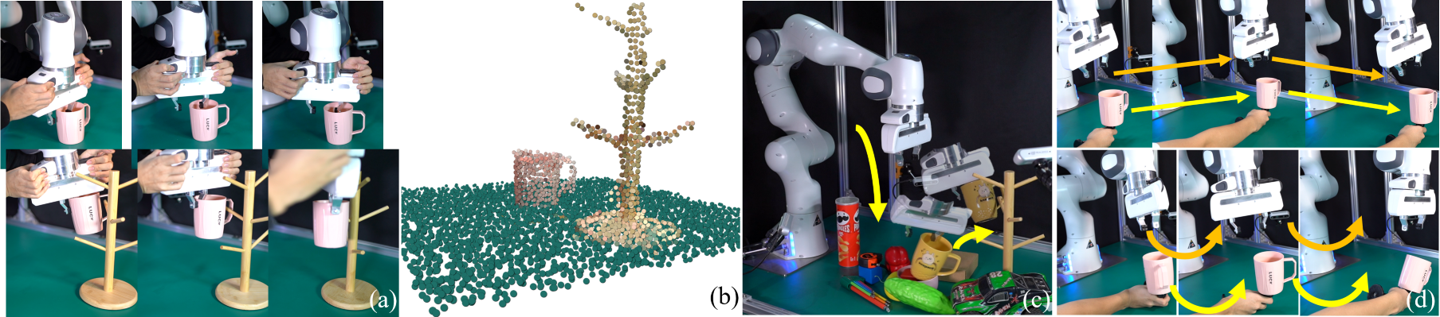
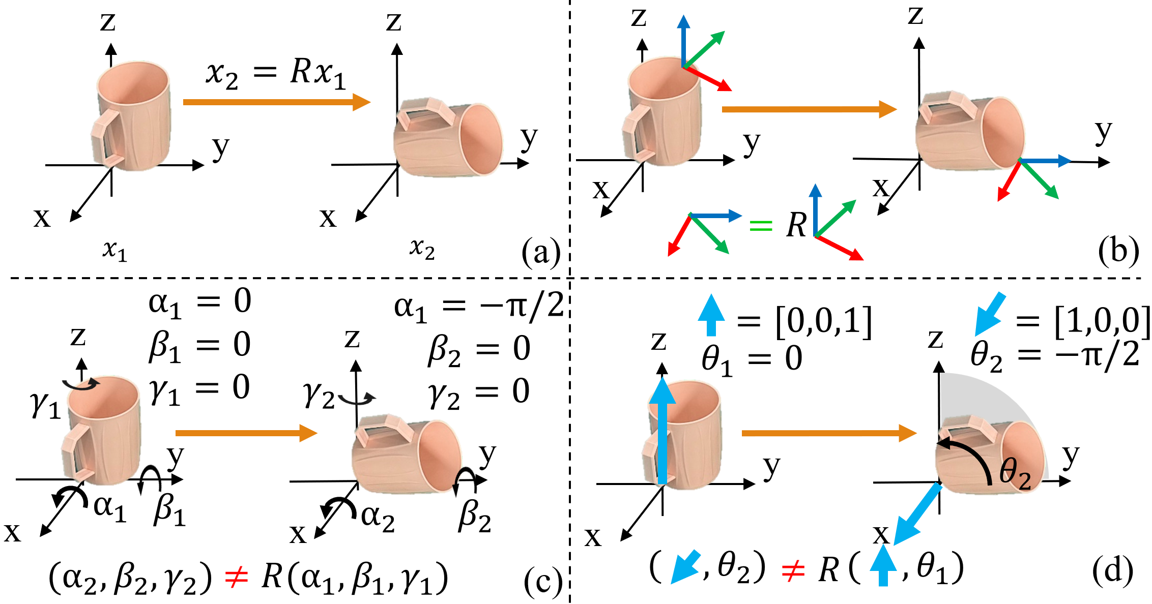
我们提出了RiEMann,一个端到端的近实时SE(3)-等变机器人操作模仿学习框架,直接从场景点云输入中预测操作目标姿态,而无需进行物体分割。RiEMann通过5到10个示例从零学习操作任务,能够推广到未见的SE(3)变换和目标物体实例,抵抗干扰物体的视觉干扰,并实时跟踪目标物体的姿态变化。RiEMann的可扩展动作空间支持自定义等变动作,使得关节物体操作成为可能。在仿真和真实世界的6自由度机器人操作实验中,我们在5类操作任务的25个变体上测试RiEMann,结果显示其在任务成功率和预测姿态的SE(3)测地距离误差上均优于基线方法,后者误差减少了68.6%,网络推理速度达到每秒5.4帧。
🔬 方法详解
问题定义:本论文旨在解决机器人操作中对点云分割的依赖问题,现有方法在处理复杂场景时效率低下且易受干扰。
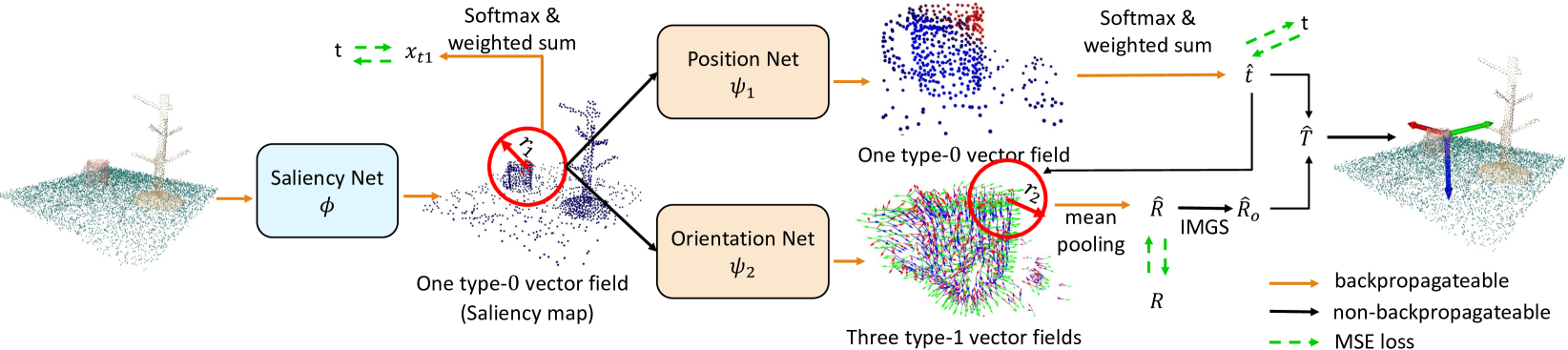
核心思路:RiEMann通过直接从点云输入中预测目标物体的操作姿态,避免了传统方法的分割步骤,从而提高了操作的实时性和准确性。
技术框架:RiEMann的整体架构包括输入点云处理、目标姿态预测和动作执行模块。输入模块负责处理场景点云,预测模块利用深度学习模型直接输出目标姿态,执行模块则将预测结果转化为机器人操作指令。
关键创新:RiEMann的主要创新在于其无需物体分割的操作方式,直接预测目标姿态,这与传统依赖分割的机器人操作方法有本质区别。
关键设计:RiEMann采用了特定的损失函数来优化姿态预测的准确性,并设计了高效的网络结构以实现近实时推理,确保在复杂场景中也能快速响应。
🖼️ 关键图片
📊 实验亮点
RiEMann在5类操作任务的25个变体中表现优异,任务成功率和姿态预测的SE(3)测地距离误差分别减少了68.6%。此外,其网络推理速度达到每秒5.4帧,显著优于现有基线方法。
🎯 应用场景
RiEMann框架具有广泛的应用潜力,特别是在复杂环境中的机器人操作任务,如家庭服务机器人、工业自动化和医疗辅助等领域。其高效的操作能力和实时反应能力将显著提升机器人在动态环境中的适应性和实用性。
📄 摘要(原文)
We present RiEMann, an end-to-end near Real-time SE(3)-Equivariant Robot Manipulation imitation learning framework from scene point cloud input. Compared to previous methods that rely on descriptor field matching, RiEMann directly predicts the target poses of objects for manipulation without any object segmentation. RiEMann learns a manipulation task from scratch with 5 to 10 demonstrations, generalizes to unseen SE(3) transformations and instances of target objects, resists visual interference of distracting objects, and follows the near real-time pose change of the target object. The scalable action space of RiEMann facilitates the addition of custom equivariant actions such as the direction of turning the faucet, which makes articulated object manipulation possible for RiEMann. In simulation and real-world 6-DOF robot manipulation experiments, we test RiEMann on 5 categories of manipulation tasks with a total of 25 variants and show that RiEMann outperforms baselines in both task success rates and SE(3) geodesic distance errors on predicted poses (reduced by 68.6%), and achieves a 5.4 frames per second (FPS) network inference speed. Code and video results are available at https://riemann-web.github.io/.