PseudoTouch: Efficiently Imaging the Surface Feel of Objects for Robotic Manipulation
作者: Adrian Röfer, Nick Heppert, Abdallah Ayad, Eugenio Chisari, Abhinav Valada
分类: cs.RO, cs.CV
发布日期: 2024-03-22 (更新: 2025-03-07)
备注: 7 pages, 5 figures, 2 tables, accepted at ICRA 2025
💡 一句话要点
提出PseudoTouch以解决机器人触觉感知不足问题
🎯 匹配领域: 支柱一:机器人控制 (Robot Control)
关键词: 触觉感知 机器人操作 视觉-触觉嵌入 物体识别 抓取稳定性预测 深度学习 低维信号处理
📋 核心要点
- 现有的触觉传感器在高保真任务中表现不佳,主要由于信号维度低和缺乏有效的模拟模型。
- 论文提出的PseudoTouch通过学习低维视觉-触觉嵌入,将高维结构信息与低维传感器信号有效关联。
- 在物体识别任务中,使用PseudoTouch实现了84%的识别准确率,相较于基线方法有显著提升。
📝 摘要(中文)
触觉感知对于人类灵巧操作至关重要,但在机器人领域尚未得到广泛应用。紧凑、低成本的传感平台可以促进这一变化,但由于信号维度低和缺乏模拟模型,难以在高保真任务中部署。为了解决这些挑战,我们提出了PseudoTouch,它将高维结构信息与低维传感器信号关联。通过学习低维视觉-触觉嵌入,我们从深度图像中编码并解码触觉信号。我们在一个包含八种基本几何形状的对齐触觉和视觉数据对的数据集上收集并训练PseudoTouch。我们展示了训练后的PseudoTouch模型在物体识别和抓取稳定性预测两个下游任务中的实用性。
🔬 方法详解
问题定义:本论文旨在解决机器人触觉感知在高保真任务中的应用不足,现有方法由于信号维度低和缺乏模拟模型,导致性能受限。
核心思路:论文的核心思路是通过学习低维视觉-触觉嵌入,将高维的结构信息与低维的传感器信号相结合,从而提升触觉感知的有效性和准确性。
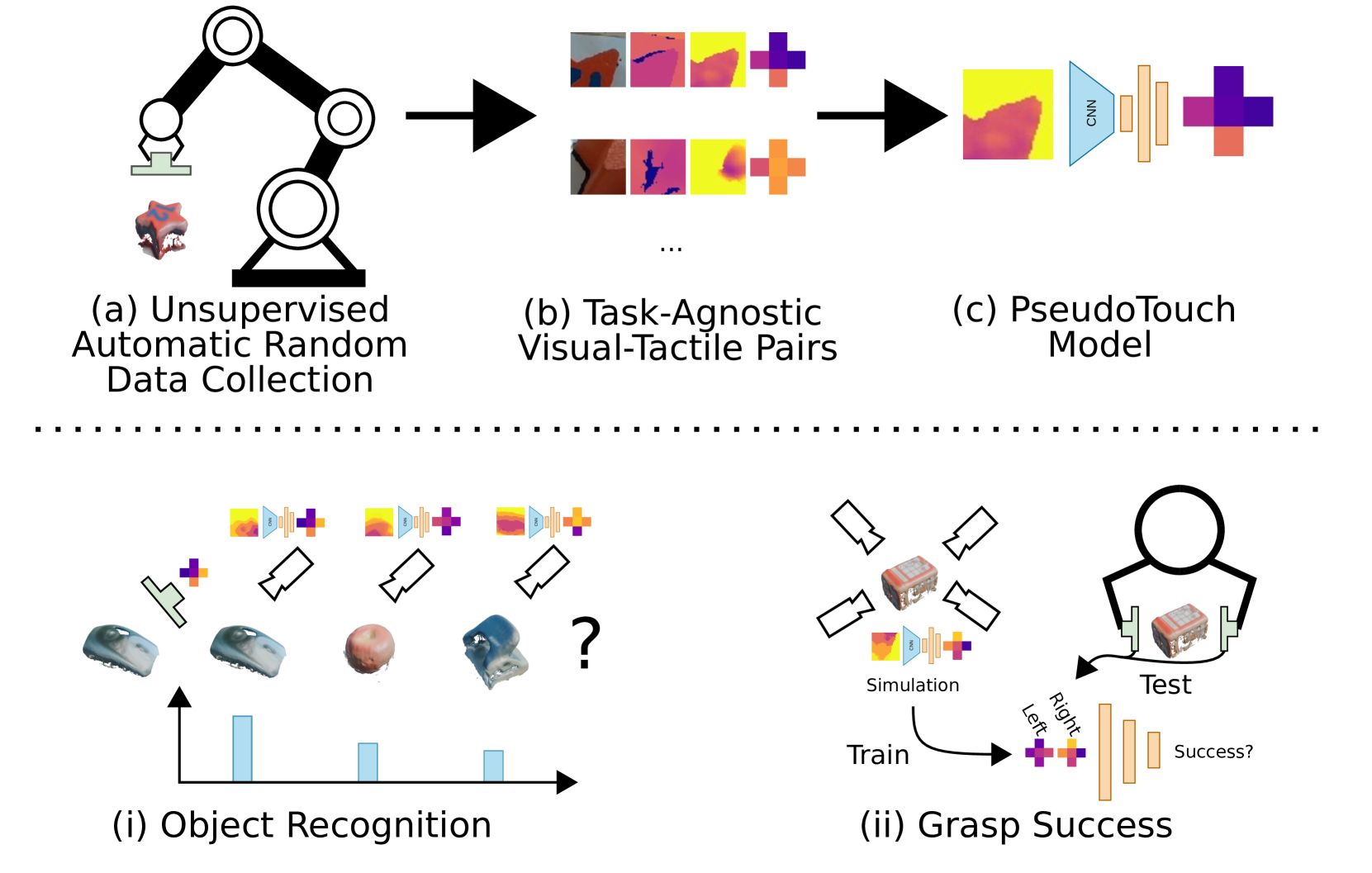
技术框架:整体架构包括数据收集、模型训练和下游任务评估三个主要阶段。首先,通过随机触摸八种几何形状收集对齐的触觉和视觉数据;然后,训练PseudoTouch模型以学习视觉-触觉嵌入;最后,利用训练好的模型进行物体识别和抓取稳定性预测。
关键创新:最重要的技术创新在于提出了视觉-触觉嵌入的学习方法,使得低维传感器信号能够有效地表示高维结构信息,这一方法与传统的触觉感知方法有本质区别。
关键设计:在模型设计中,采用了特定的损失函数来优化嵌入的学习效果,并使用深度学习网络结构来处理输入的深度图像,确保了模型的高效性和准确性。
🖼️ 关键图片

📊 实验亮点
在物体识别任务中,使用PseudoTouch实现了84%的识别准确率,仅需十次触摸,超越了基于本体感知的基线方法。在抓取稳定性预测任务中,相较于依赖部分点云数据的基线方法,准确率提升了32%。
🎯 应用场景
该研究的潜在应用领域包括机器人抓取、物体识别和人机交互等。通过提升机器人对物体表面触觉的感知能力,能够显著改善机器人在复杂环境中的操作能力,推动智能制造和服务机器人等领域的发展。
📄 摘要(原文)
Tactile sensing is vital for human dexterous manipulation, however, it has not been widely used in robotics. Compact, low-cost sensing platforms can facilitate a change, but unlike their popular optical counterparts, they are difficult to deploy in high-fidelity tasks due to their low signal dimensionality and lack of a simulation model. To overcome these challenges, we introduce PseudoTouch which links high-dimensional structural information to low-dimensional sensor signals. It does so by learning a low-dimensional visual-tactile embedding, wherein we encode a depth patch from which we decode the tactile signal. We collect and train PseudoTouch on a dataset comprising aligned tactile and visual data pairs obtained through random touching of eight basic geometric shapes. We demonstrate the utility of our trained PseudoTouch model in two downstream tasks: object recognition and grasp stability prediction. In the object recognition task, we evaluate the learned embedding's performance on a set of five basic geometric shapes and five household objects. Using PseudoTouch, we achieve an object recognition accuracy 84% after just ten touches, surpassing a proprioception baseline. For the grasp stability task, we use ACRONYM labels to train and evaluate a grasp success predictor using PseudoTouch's predictions derived from virtual depth information. Our approach yields a 32% absolute improvement in accuracy compared to the baseline relying on partial point cloud data. We make the data, code, and trained models publicly available at https://pseudotouch.cs.uni-freiburg.de.