Centroidal State Estimation based on the Koopman Embedding for Dynamic Legged Locomotion
作者: Shahram Khorshidi, Murad Dawood, Maren Bennewitz
分类: cs.RO
发布日期: 2024-03-20 (更新: 2024-10-07)
备注: Accepted in IROS 2024
💡 一句话要点
基于Koopman嵌入的质心状态估计方法解决动态腿部运动问题
🎯 匹配领域: 支柱一:机器人控制 (Robot Control) 支柱二:RL算法与架构 (RL & Architecture)
关键词: 质心状态估计 Koopman算子 动态腿部运动 深度学习 动态模式分解 机器人控制 扩展卡尔曼滤波 实时估计
📋 核心要点
- 现有方法在动态腿部运动的质心状态估计中面临非线性动态建模的挑战,导致估计精度不足。
- 论文提出利用Koopman算子理论将复杂非线性动态转化为线性系统,结合动态模式分解和深度学习进行模型构建。
- 实验结果表明,所提方法在四足机器人执行多种动态步态时,优于传统的扩展卡尔曼滤波,能够有效应对测量噪声。
📝 摘要(中文)
本文提出了一种新颖的质心状态估计方法,该方法在动态腿部运动的预测模型控制策略中至关重要。我们利用Koopman算子理论将机器人的复杂非线性动态转化为线性系统,结合动态模式分解和深度学习进行模型构建。通过对不同模型的线性化精度和动态系统响应能力进行评估,我们选择了最合适的模型并将其集成到移动视界估计器中。该估计器被构建为一个凸二次规划,以便实现稳健的实时质心状态估计。通过对四足机器人执行多种动态步态的广泛仿真实验,我们的数据驱动框架在性能上优于基于非线性动态的传统扩展卡尔曼滤波技术。我们的估计器有效应对了在高度动态运动中力/扭矩测量噪声带来的挑战,准确恢复质心状态,展示了基于Koopman的线性表示在复杂运动行为中的适应性和有效性。
🔬 方法详解
问题定义:本文旨在解决动态腿部运动中的质心状态估计问题,现有方法在处理非线性动态时存在精度不足和对噪声敏感的痛点。
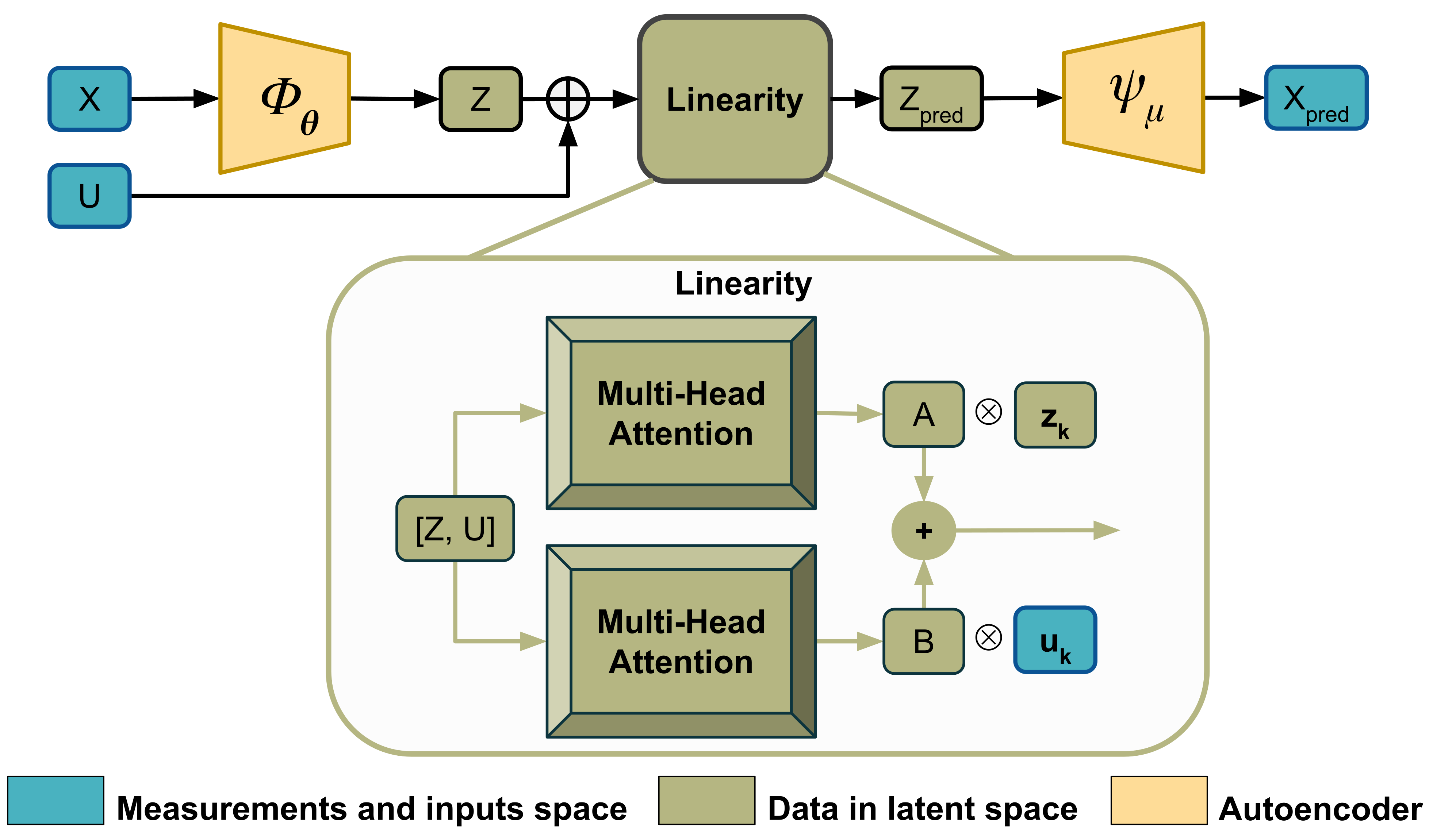
核心思路:通过引入Koopman算子理论,将复杂的非线性动态转化为线性系统,从而简化模型的构建和状态估计过程。利用动态模式分解和深度学习相结合的方法,增强模型的表达能力和适应性。
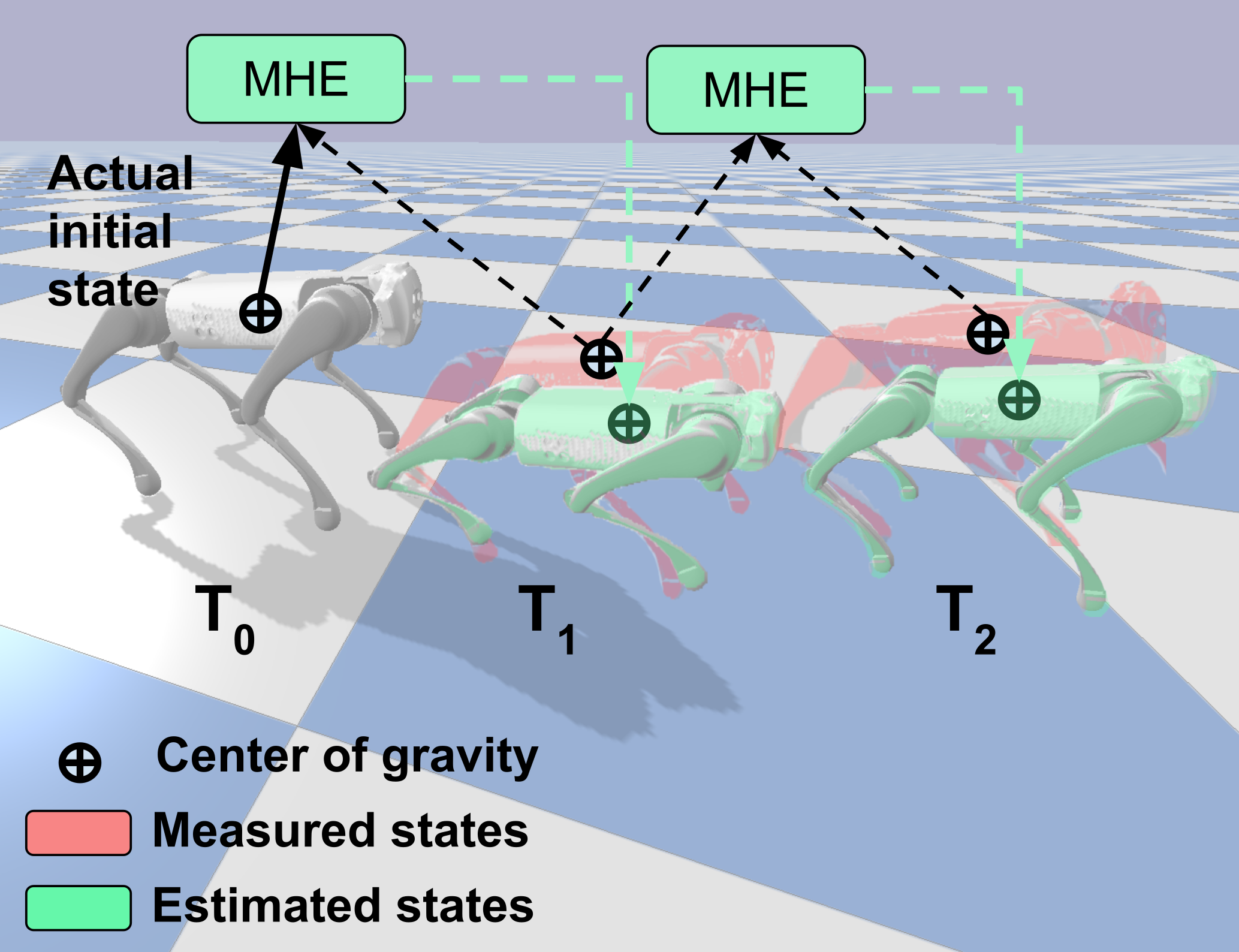
技术框架:整体架构包括模型构建、线性化精度评估、模型选择和移动视界估计器的集成。首先,通过动态模式分解提取动态特征,然后利用深度学习构建线性模型,最后将选定模型集成到凸二次规划的估计器中。
关键创新:本研究的创新点在于将Koopman算子与动态模式分解结合,成功实现了复杂非线性动态的线性化,显著提高了质心状态估计的准确性和鲁棒性。与传统方法相比,能够在不同运动模式下保持高效的状态估计。
关键设计:模型训练时使用了两种步态(跑步和跳跃),并在不重新训练的情况下成功估计了另一种运动(弹跳)的质心状态。损失函数设计为最小化估计误差,网络结构采用深度神经网络以增强模型的学习能力。
🖼️ 关键图片
📊 实验亮点
实验结果显示,所提方法在四足机器人执行动态步态时,相较于传统扩展卡尔曼滤波技术,质心状态估计的准确性提高了显著,尤其在处理高噪声环境下表现出更强的鲁棒性,验证了Koopman线性化方法的有效性。
🎯 应用场景
该研究的潜在应用领域包括机器人控制、自动驾驶、以及人机交互等动态系统。通过提高质心状态估计的准确性,可以显著提升机器人在复杂环境中的运动能力和适应性,推动智能机器人技术的发展。
📄 摘要(原文)
In this paper, we introduce a novel approach to centroidal state estimation, which plays a crucial role in predictive model-based control strategies for dynamic legged locomotion. Our approach uses the Koopman operator theory to transform the robot's complex nonlinear dynamics into a linear system, by employing dynamic mode decomposition and deep learning for model construction. We evaluate both models on their linearization accuracy and capability to capture both fast and slow dynamic system responses. We then select the most suitable model for estimation purposes, and integrate it within a moving horizon estimator. This estimator is formulated as a convex quadratic program to facilitate robust, real-time centroidal state estimation. Through extensive simulation experiments on a quadruped robot executing various dynamic gaits, our data-driven framework outperforms conventional Extended Kalman Filtering technique based on nonlinear dynamics. Our estimator addresses challenges posed by force/torque measurement noise in highly dynamic motions and accurately recovers the centroidal states, demonstrating the adaptability and effectiveness of the Koopman-based linear representation for complex locomotive behaviors. Importantly, our model based on dynamic mode decomposition, trained with two locomotion patterns (trot and jump), successfully estimates the centroidal states for a different motion (bound) without retraining.