UNO Push: Unified Nonprehensile Object Pushing via Non-Parametric Estimation and Model Predictive Control
作者: Gaotian Wang, Kejia Ren, Kaiyu Hang
分类: cs.RO
发布日期: 2024-03-20
💡 一句话要点
提出统一框架以解决非抓取物体推送问题
🎯 匹配领域: 支柱一:机器人控制 (Robot Control)
关键词: 非抓取操作 物体推送 模型预测控制 非参数学习 机器人操作
📋 核心要点
- 现有方法在非抓取操作中常常依赖大量先验信息或数据,导致灵活性不足和适应性差。
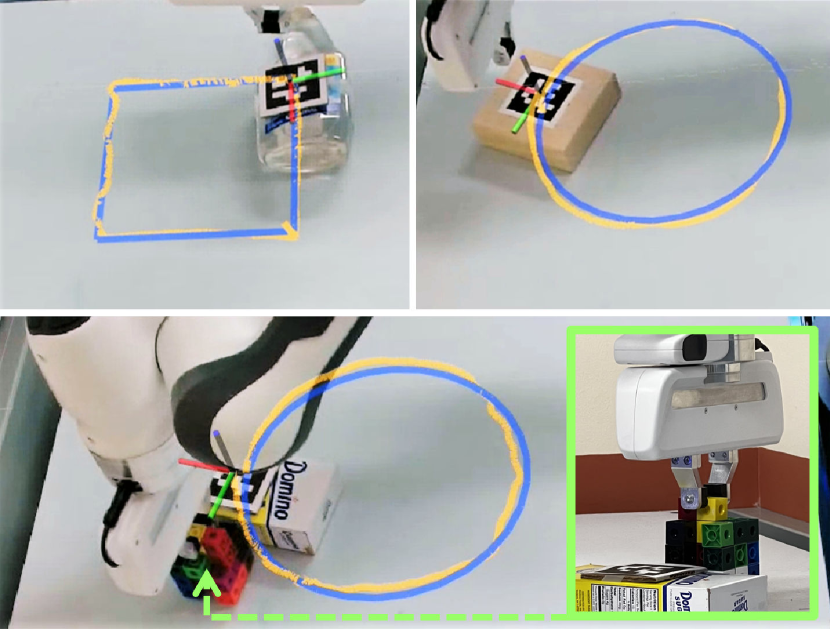
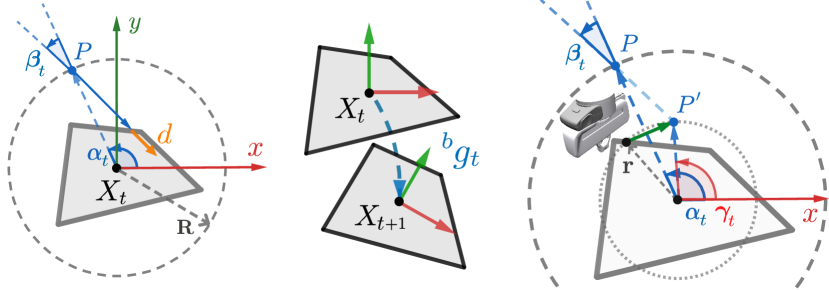
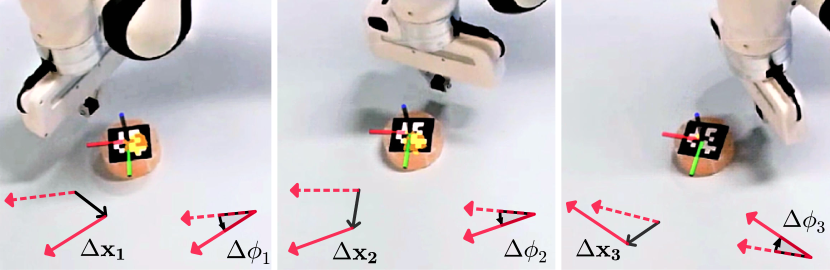
- 本文提出的框架通过非参数学习,仅需少量探索性动作即可近似系统转移函数,并结合模型预测控制实现精确推送。
- 实验结果显示,该方法在新物体上也能保持毫米级精度,相较于现有基线方法有显著提升。
📝 摘要(中文)
非抓取操作通过精确推送是机器人操作中的一项重要技能,但常常受到感知和物理不确定性的挑战,例如接触、物体几何形状和物理属性等。为此,本文提出了一个统一框架,联合解决系统建模、动作生成和控制问题。与现有方法依赖于先验系统信息或大量数据集学习动态模型不同,我们的框架通过非参数学习,仅使用少量探索性动作(约10个)来近似系统转移函数。该函数随后与模型预测控制相结合,实现精确的推送操作。此外,我们展示了近似的系统转移函数能够在新物体上稳健转移,并在线更新以持续提高操作精度。通过在真实机器人平台上的广泛实验,结果表明该框架是一种轻量且高效的精确推送操作方法。
🔬 方法详解
问题定义:本文旨在解决非抓取物体推送中的感知和物理不确定性问题。现有方法通常依赖于大量先验信息或数据,导致在新环境中的适应性不足。
核心思路:我们提出的框架通过非参数学习来近似系统转移函数,仅需少量探索性动作,从而减少对先验知识的依赖,并结合模型预测控制实现精确推送。
技术框架:整体架构包括三个主要模块:系统建模、动作生成和控制。首先,通过少量探索性动作进行系统建模;然后生成推送动作;最后利用模型预测控制进行精确操作。
关键创新:最重要的创新在于使用非参数学习来近似系统转移函数,这与传统方法依赖于复杂模型或大量数据的方式有本质区别。
关键设计:在参数设置上,我们使用了少量的探索性动作(约10个),并设计了适应性强的在线更新机制,以提高操作精度。
🖼️ 关键图片
📊 实验亮点
实验结果表明,所提出的框架在真实机器人平台上能够实现毫米级的推送精度,相较于现有最先进基线方法,提升幅度显著,展示了其在新物体上的稳健性和适应性。
🎯 应用场景
该研究的潜在应用领域包括智能家居、仓储物流和服务机器人等场景,能够有效提升机器人在复杂环境中的操作能力,具有重要的实际价值和广泛的未来影响。
📄 摘要(原文)
Nonprehensile manipulation through precise pushing is an essential skill that has been commonly challenged by perception and physical uncertainties, such as those associated with contacts, object geometries, and physical properties. For this, we propose a unified framework that jointly addresses system modeling, action generation, and control. While most existing approaches either heavily rely on a priori system information for analytic modeling, or leverage a large dataset to learn dynamic models, our framework approximates a system transition function via non-parametric learning only using a small number of exploratory actions (ca. 10). The approximated function is then integrated with model predictive control to provide precise pushing manipulation. Furthermore, we show that the approximated system transition functions can be robustly transferred across novel objects while being online updated to continuously improve the manipulation accuracy. Through extensive experiments on a real robot platform with a set of novel objects and comparing against a state-of-the-art baseline, we show that the proposed unified framework is a light-weight and highly effective approach to enable precise pushing manipulation all by itself. Our evaluation results illustrate that the system can robustly ensure millimeter-level precision and can straightforwardly work on any novel object.