Digital Twin-Driven Reinforcement Learning for Obstacle Avoidance in Robot Manipulators: A Self-Improving Online Training Framework
作者: Yuzhu Sun, Mien Van, Stephen McIlvanna, Nguyen Minh Nhat, Kabirat Olayemi, Jack Close, Seán McLoone
分类: cs.RO, eess.SY
发布日期: 2024-03-19
备注: 7 pages
💡 一句话要点
提出数字双胞胎驱动的强化学习框架以解决机器人避障问题
🎯 匹配领域: 支柱二:RL算法与架构 (RL & Architecture)
关键词: 数字双胞胎 强化学习 机器人避障 在线训练 协作机器人 自我改进 动态环境
📋 核心要点
- 现有工业机器人在面对复杂任务或工作环境变化时,通常需要重新编程,导致效率低下。
- 本文提出了一种结合数字双胞胎与强化学习的在线训练框架,旨在实时生成无碰撞轨迹,提升机器人适应性。
- 在Unfactory Xarm5协作机器人上的实验表明,该框架能够进行有效的在线策略训练,且有进一步改进的潜力。
📝 摘要(中文)
随着协作机器人技术的演进与自动化程度的提高,系统的复杂性和不可预测性也随之增加,迫切需要机器人具备适应性和灵活性以应对环境的变化。本文探讨了结合数字双胞胎与强化学习(RL)的潜力,使机器人能够实时生成自我改进的无碰撞轨迹。数字双胞胎作为物理系统的虚拟对应物,通过视频数据与物理系统进行双向通信,实时更新观察和策略。实验在Unfactory Xarm5协作机器人上进行,结果表明该框架能够实现在线策略训练,且仍有显著提升空间。
🔬 方法详解
问题定义:本文旨在解决协作机器人在复杂环境中避障的挑战,现有方法在面对环境变化时往往需要重新编程,效率低下。
核心思路:通过结合数字双胞胎与强化学习,创建一个在线训练框架,使机器人能够实时生成自我改进的无碰撞轨迹,从而提高适应性和灵活性。
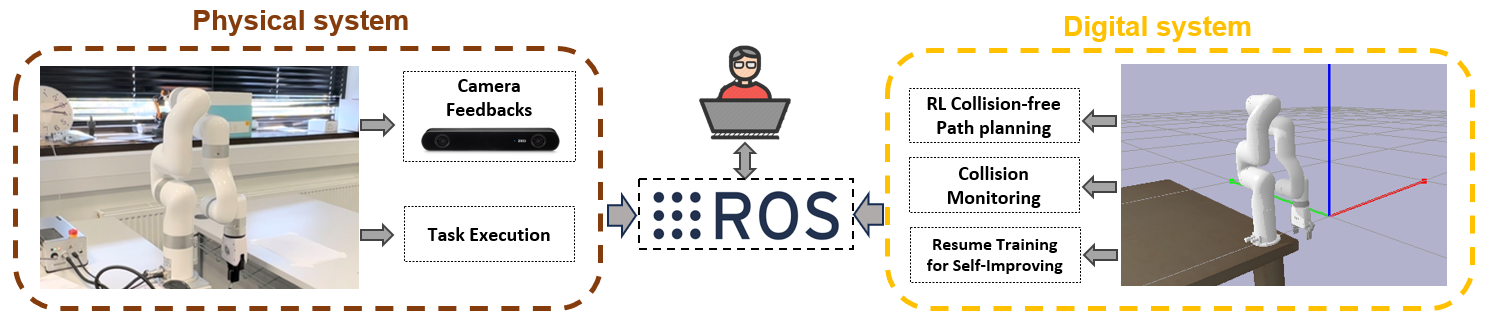
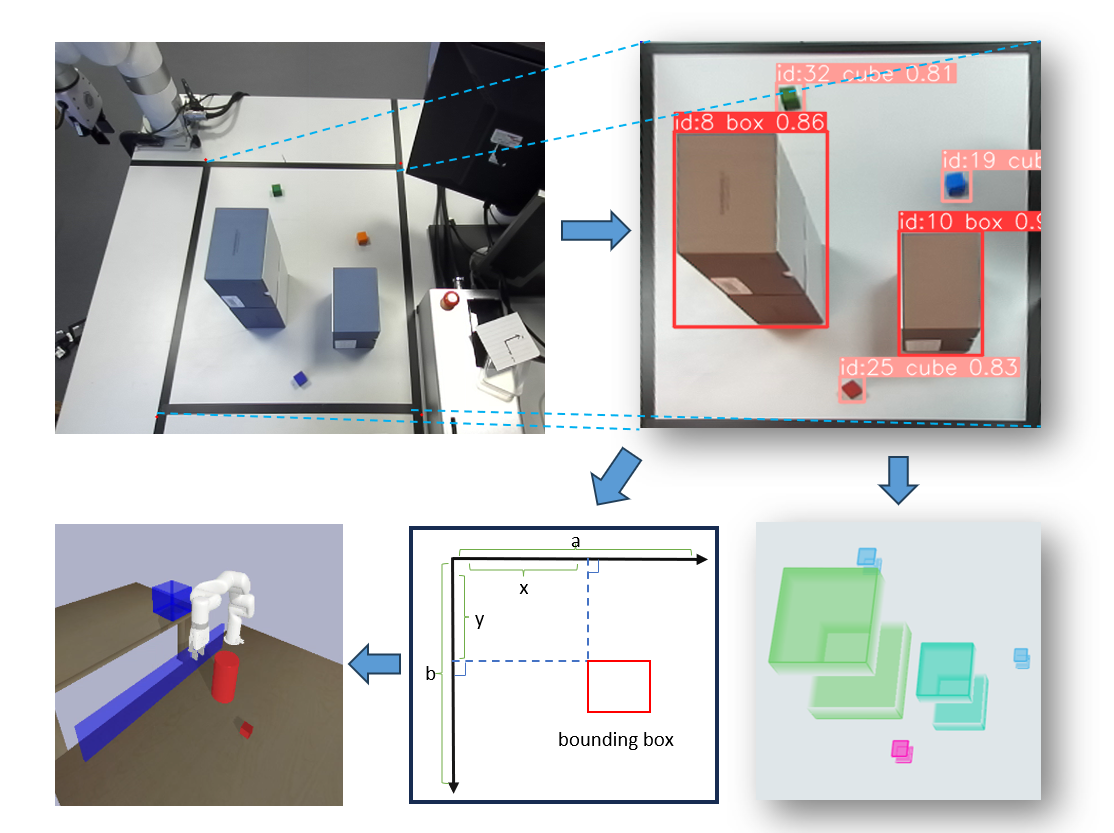
技术框架:整体架构包括物理系统与数字双胞胎之间的双向通信,物理系统通过摄像头视频数据同步信息,数字双胞胎实时更新观察和策略,形成一个硬件在环的强化学习训练平台。
关键创新:最重要的创新在于利用数字双胞胎作为物理系统的虚拟对应物,通过实时数据反馈实现在线策略训练,与传统方法相比,显著提高了机器人的适应能力。
关键设计:在设计中,采用了特定的损失函数和网络结构,以确保机器人在训练过程中能够有效学习并优化其避障策略。
🖼️ 关键图片

📊 实验亮点
实验结果表明,所提出的框架能够有效进行在线策略训练,机器人在避障任务中表现出较高的成功率,具体性能数据尚未披露,但实验表明仍有显著的提升空间。
🎯 应用场景
该研究的潜在应用领域包括智能制造、自动化仓储和服务机器人等,能够显著提升机器人在动态环境中的适应能力和工作效率。未来,该框架有望推动机器人技术的进一步发展,减少人力干预,提高生产自动化水平。
📄 摘要(原文)
The evolution and growing automation of collaborative robots introduce more complexity and unpredictability to systems, highlighting the crucial need for robot's adaptability and flexibility to address the increasing complexities of their environment. In typical industrial production scenarios, robots are often required to be re-programmed when facing a more demanding task or even a few changes in workspace conditions. To increase productivity, efficiency and reduce human effort in the design process, this paper explores the potential of using digital twin combined with Reinforcement Learning (RL) to enable robots to generate self-improving collision-free trajectories in real time. The digital twin, acting as a virtual counterpart of the physical system, serves as a 'forward run' for monitoring, controlling, and optimizing the physical system in a safe and cost-effective manner. The physical system sends data to synchronize the digital system through the video feeds from cameras, which allows the virtual robot to update its observation and policy based on real scenarios. The bidirectional communication between digital and physical systems provides a promising platform for hardware-in-the-loop RL training through trial and error until the robot successfully adapts to its new environment. The proposed online training framework is demonstrated on the Unfactory Xarm5 collaborative robot, where the robot end-effector aims to reach the target position while avoiding obstacles. The experiment suggest that proposed framework is capable of performing policy online training, and that there remains significant room for improvement.