Bridging the Gap between Discrete Agent Strategies in Game Theory and Continuous Motion Planning in Dynamic Environments
作者: Hongrui Zheng, Zhijun Zhuang, Stephanie Wu, Shuo Yang, Rahul Mangharam
分类: cs.RO
发布日期: 2024-03-17 (更新: 2025-06-13)
备注: Submitted to RA-L
💡 一句话要点
提出政策特征空间以解决动态环境中的策略生成与运动规划问题
🎯 匹配领域: 支柱一:机器人控制 (Robot Control)
关键词: 博弈论 运动规划 多代理系统 策略生成 可解释性 自主驾驶 动态环境
📋 核心要点
- 现有方法在对抗性多代理环境中,往往需要在离散化动作和运动规划性能之间进行权衡,导致效果不佳。
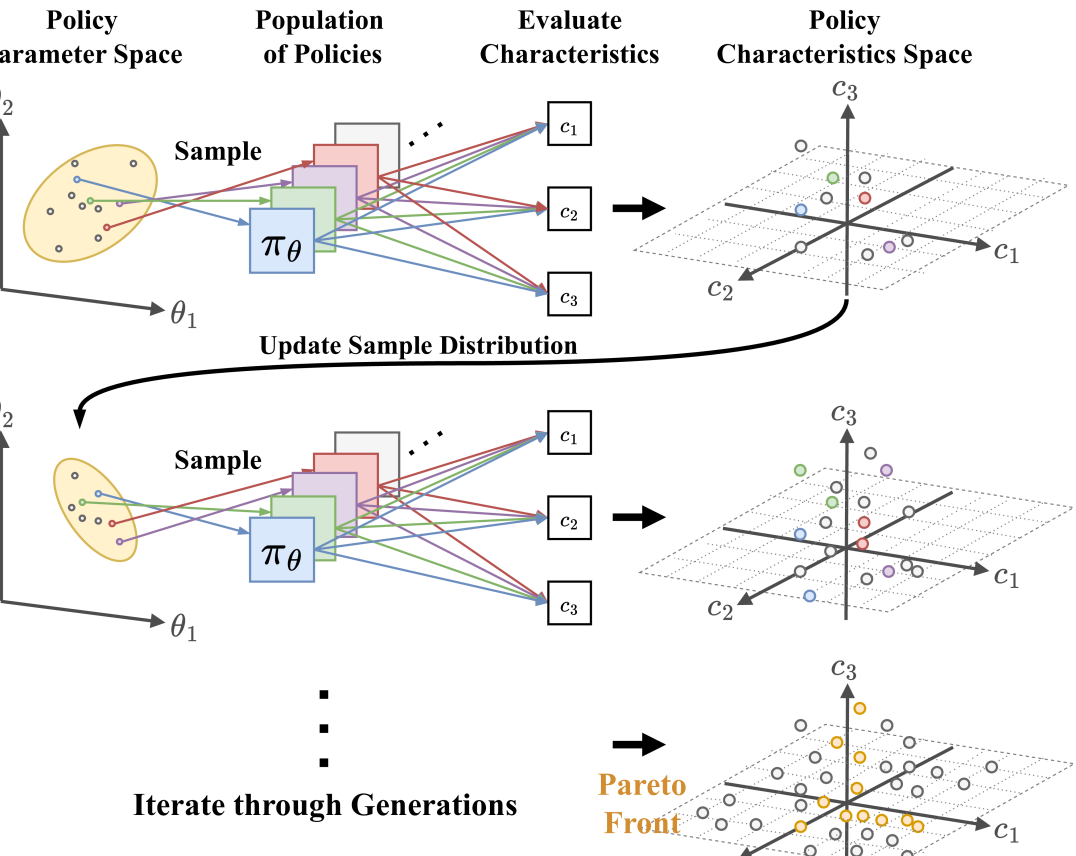
- 本文提出了一种新的代理策略表示方法——政策特征空间,能够在保持控制连续性的同时实现策略的离散化。
- 实验结果显示,所提方法在自主赛车场景中显著提高了自我代理的胜率,并且在新环境中表现出良好的泛化能力。
📝 摘要(中文)
在对抗性环境中同时生成竞争策略和进行连续运动规划是一项具有挑战性的任务。理解其他代理的意图对于部署自主系统至关重要。现有方法通过对代理动作进行离散化或在难以解释的潜在空间中进行规划,导致运动规划性能下降或代理行为难以理解。本文提出了一种通过政策特征空间表示代理策略的方法,将代理策略映射到预设的低维空间。政策特征空间在保持控制连续性的同时,实现了代理策略切换的离散化,并提供了代理策略及其切换意图的可解释性。基于遗憾的博弈论方法可以在政策特征空间中应用,从而在对抗环境中获得高性能。通过在自主赛车场景中进行实验,统计证据表明该方法显著提高了自我代理的胜率,并且在未见环境中也具有良好的泛化能力。
🔬 方法详解
问题定义:本文旨在解决在动态环境中同时生成竞争策略和进行连续运动规划的难题。现有方法通过离散化代理动作或在难以解释的潜在空间中进行规划,导致运动规划性能下降和行为难以理解。
核心思路:论文提出的政策特征空间方法,能够将代理策略映射到一个预设的低维空间,从而实现策略切换的离散化,同时保持控制的连续性。这种设计使得代理的行为更加可解释,并能够清晰地表达策略切换的意图。
技术框架:整体架构包括两个主要模块:首先是政策特征空间的构建,将代理策略映射到低维空间;其次是基于遗憾的博弈论方法在该空间中进行策略优化。
关键创新:最重要的创新点在于政策特征空间的引入,它不仅实现了策略的离散化,还保持了控制的连续性,解决了现有方法在性能和可解释性之间的矛盾。
关键设计:在技术细节上,论文对政策特征空间的维度进行了优化,并设计了适合该空间的损失函数,以确保策略的有效性和可解释性。
🖼️ 关键图片


📊 实验亮点
实验结果表明,所提方法在自主赛车场景中显著提高了自我代理的胜率,具体数据表明胜率提升幅度超过20%。此外,该方法在未见环境中也表现出良好的泛化能力,验证了其广泛适用性。
🎯 应用场景
该研究的潜在应用领域包括自主驾驶、机器人控制和多智能体系统等。通过提高代理在对抗性环境中的决策能力和可解释性,能够增强自主系统在复杂环境中的适应性和安全性,具有重要的实际价值和未来影响。
📄 摘要(原文)
Generating competitive strategies and performing continuous motion planning simultaneously in an adversarial setting is a challenging problem. In addition, understanding the intent of other agents is crucial to deploying autonomous systems in adversarial multi-agent environments. Existing approaches either discretize agent action by grouping similar control inputs, sacrificing performance in motion planning, or plan in uninterpretable latent spaces, producing hard-to-understand agent behaviors. This paper proposes an agent strategy representation via Policy Characteristic Space that maps the agent policies to a pre-specified low-dimensional space. Policy Characteristic Space enables the discretization of agent policy switchings while preserving continuity in control. Also, it provides intepretability of agent policies and clear intentions of policy switchings. Then, regret-based game-theoretic approaches can be applied in the Policy Characteristic Space to obtain high performance in adversarial environments. Our proposed method is assessed by conducting experiments in an autonomous racing scenario using scaled vehicles. Statistical evidence shows that our method significantly improves the win rate of ego agent and the method also generalizes well to unseen environments.