Mind the Error! Detection and Localization of Instruction Errors in Vision-and-Language Navigation
作者: Francesco Taioli, Stefano Rosa, Alberto Castellini, Lorenzo Natale, Alessio Del Bue, Alessandro Farinelli, Marco Cristani, Yiming Wang
分类: cs.RO, cs.AI, cs.CL
发布日期: 2024-03-15 (更新: 2025-01-15)
备注: 3 figures, 8 pages. Accepted at IROS'24
🔗 代码/项目: PROJECT_PAGE
💡 一句话要点
提出新基准以检测和定位视觉语言导航中的指令错误
🎯 匹配领域: 支柱九:具身大模型 (Embodied Foundation Models)
关键词: 视觉语言导航 指令错误检测 跨模态变换器 鲁棒性评估 数据集构建
📋 核心要点
- 现有的视觉语言导航方法假设指令是准确的,但实际应用中常常存在错误,导致系统脆弱。
- 本文提出了一种新基准数据集,涵盖多种指令错误类型,并定义了指令错误检测与定位任务。
- 实验结果显示,当前最先进的VLN-CE方法在新基准上成功率下降高达25%,而提出的方法在错误检测与定位上表现最佳。
📝 摘要(中文)
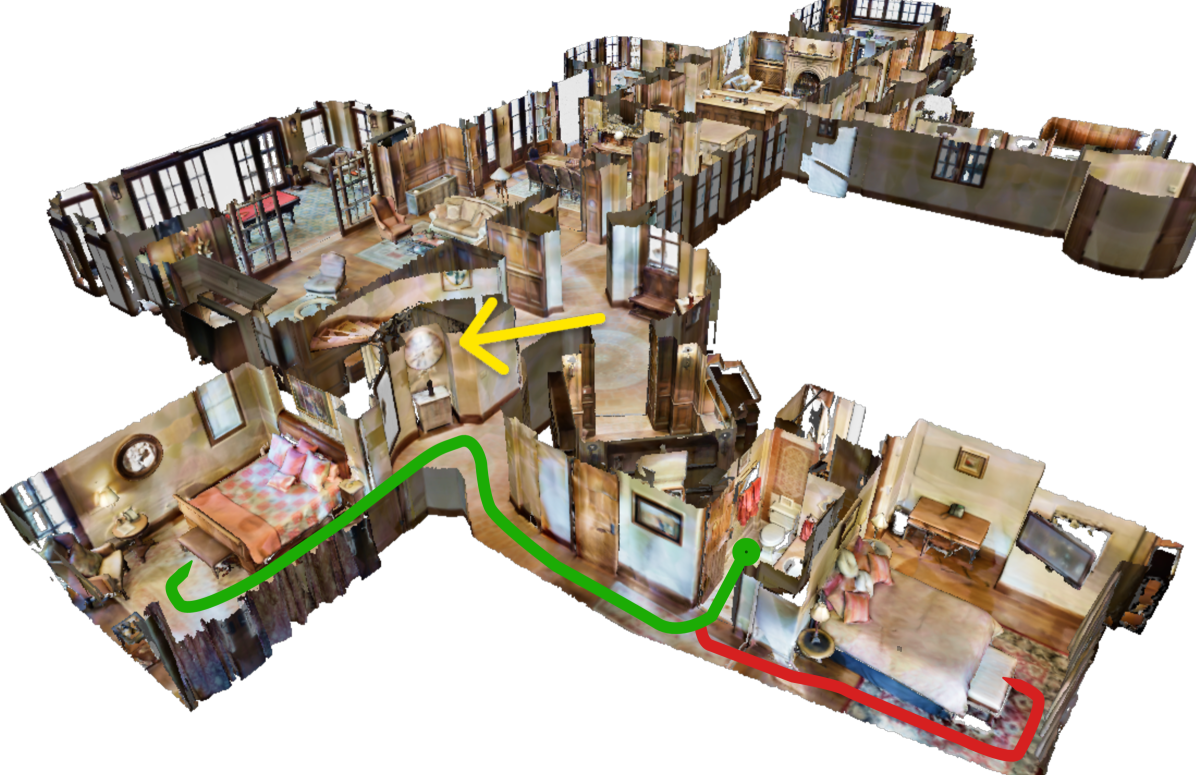
视觉语言导航在连续环境中(VLN-CE)是一项直观但具有挑战性的任务。现有的VLN-CE方法假设语言指令是准确的,但实际中人类提供的指令可能因记忆不准确或混淆而出现错误。本文首次提出了一种新基准数据集,涵盖多种指令错误类型,并定义了指令错误检测与定位任务,建立了评估协议。实验表明,当前最先进的VLN-CE方法在该基准上成功率下降高达25%。此外,基于跨模态变换器架构的方法在错误检测与定位上表现最佳,显示出其在其他任务中的实用性。
🔬 方法详解
问题定义:本文旨在解决视觉语言导航中指令错误的检测与定位问题。现有方法未考虑指令可能存在的错误,导致在实际应用中表现不佳。
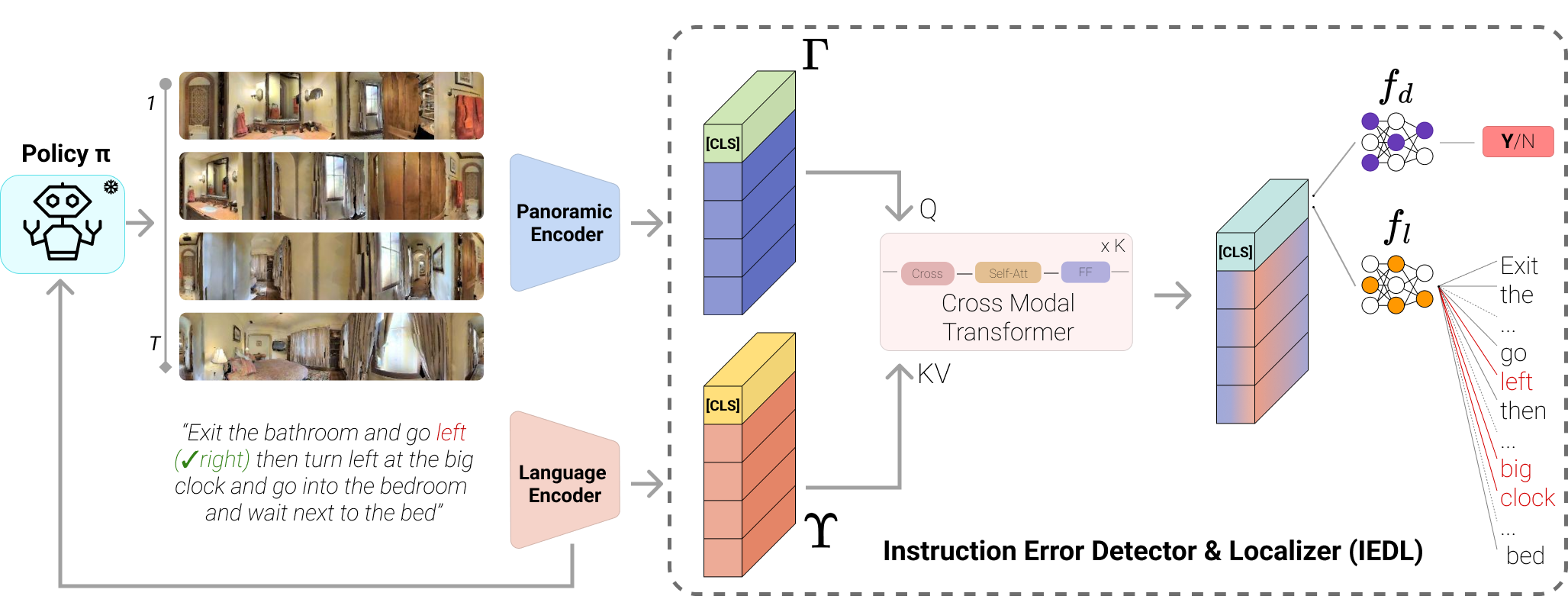
核心思路:通过构建一个包含多种指令错误的新基准数据集,论文定义了指令错误检测与定位任务,并提出了一种基于跨模态变换器架构的方法来解决这一问题。
技术框架:整体架构包括数据集构建、错误检测与定位模型的训练与评估。主要模块包括数据预处理、特征提取、模型训练和结果评估。
关键创新:最重要的创新在于首次系统性地定义了指令错误检测与定位任务,并提出了相应的评估协议,显著提高了系统在面对错误指令时的鲁棒性。
关键设计:在模型设计中,采用了跨模态变换器架构,结合了语言和视觉信息,优化了损失函数以提高错误检测的准确性。
🖼️ 关键图片

📊 实验亮点
实验结果显示,当前最先进的VLN-CE方法在新基准上成功率下降高达25%。而本文提出的基于跨模态变换器的方法在错误检测与定位上表现最佳,展示了其在其他任务中的实用性。
🎯 应用场景
该研究的潜在应用领域包括智能导航系统、机器人交互和人机协作等。通过提高系统对指令错误的鲁棒性,可以显著提升用户体验和系统的实际应用价值,尤其是在复杂环境中的导航任务。
📄 摘要(原文)
Vision-and-Language Navigation in Continuous Environments (VLN-CE) is one of the most intuitive yet challenging embodied AI tasks. Agents are tasked to navigate towards a target goal by executing a set of low-level actions, following a series of natural language instructions. All VLN-CE methods in the literature assume that language instructions are exact. However, in practice, instructions given by humans can contain errors when describing a spatial environment due to inaccurate memory or confusion. Current VLN-CE benchmarks do not address this scenario, making the state-of-the-art methods in VLN-CE fragile in the presence of erroneous instructions from human users. For the first time, we propose a novel benchmark dataset that introduces various types of instruction errors considering potential human causes. This benchmark provides valuable insight into the robustness of VLN systems in continuous environments. We observe a noticeable performance drop (up to -25%) in Success Rate when evaluating the state-of-the-art VLN-CE methods on our benchmark. Moreover, we formally define the task of Instruction Error Detection and Localization, and establish an evaluation protocol on top of our benchmark dataset. We also propose an effective method, based on a cross-modal transformer architecture, that achieves the best performance in error detection and localization, compared to baselines. Surprisingly, our proposed method has revealed errors in the validation set of the two commonly used datasets for VLN-CE, i.e., R2R-CE and RxR-CE, demonstrating the utility of our technique in other tasks. Code and dataset available at https://intelligolabs.github.io/R2RIE-CE