Do Visual-Language Grid Maps Capture Latent Semantics?
作者: Matti Pekkanen, Tsvetomila Mihaylova, Francesco Verdoja, Ville Kyrki
分类: cs.RO
发布日期: 2024-03-15 (更新: 2025-09-22)
备注: IROS 2025
💡 一句话要点
提出一种分析视觉语言网格地图质量的方法以解决语义表示问题
🎯 匹配领域: 支柱三:空间感知与语义 (Perception & Semantics)
关键词: 视觉语言模型 机器人映射 语义表示 可查询性 独特性 开放词汇 Matterport3D 图像嵌入
📋 核心要点
- 现有方法在地图质量分析上缺乏系统性,尤其是对语义表示的可查询性和独特性研究不足。
- 本文提出了一种新的评估框架,重点分析地图的可查询性和独特性,以提高语义表示的有效性。
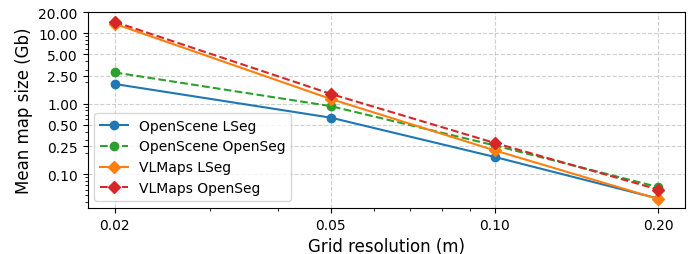
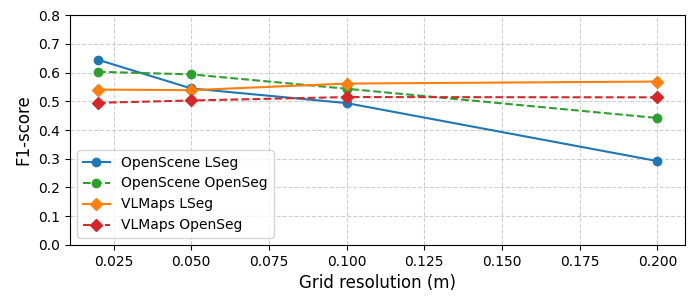
- 实验结果显示,基于图像的嵌入在多个分辨率下具有良好的泛化能力,并且能够保持较小的地图尺寸。
📝 摘要(中文)
视觉语言模型(VLMs)最近在机器人映射中被引入,利用其潜在表示(即嵌入)来表示地图中的语义。这种方法使得机器人能够从有限的人类创建标签转向开放词汇的场景理解,尤其在复杂的现实环境中与人类交互时非常有用。尽管已有一些证据表明这种方式构建的地图支持下游任务(如导航),但缺乏对使用这些嵌入的地图质量的严格分析。本文提出了一种分析VLMs创建的地图质量的方法,研究了地图质量的两个关键属性:可查询性和独特性。我们提出了评估这些属性的指标,并使用真实世界的Matterport3D数据集评估了两种最先进的映射方法VLMaps和OpenScene。研究结果表明,3D特征提高了可查询性,但不具备尺度不变性,而基于图像的嵌入则能在多个地图分辨率上进行泛化。
🔬 方法详解
问题定义:本文旨在解决使用视觉语言模型(VLMs)构建的地图在语义表示质量上的不足,特别是缺乏对可查询性和独特性的系统分析。现有方法未能充分评估这些地图在实际应用中的有效性。
核心思路:论文提出了一种新的分析框架,专注于评估地图的可查询性(信息检索能力)和独特性(语义类的表示能力),通过设计相应的评估指标来实现。
技术框架:整体架构包括数据收集、嵌入生成、质量评估和结果分析四个主要模块。首先,从Matterport3D数据集中收集真实世界数据,然后使用VLMaps和OpenScene两种映射方法生成地图,最后通过设计的指标评估地图质量。
关键创新:最重要的创新在于提出了针对地图质量的可查询性和独特性评估指标,这在现有文献中尚属首次,能够有效区分不同映射方法的性能。
关键设计:在实验中,使用了LSeg和OpenSeg两种编码器,评估了不同编码器对结果的影响。此外,研究还探讨了如何合理阈值开放词汇查询,以解决当前面临的挑战。
🖼️ 关键图片

📊 实验亮点
实验结果表明,基于图像的嵌入在多个地图分辨率上具有良好的泛化能力,能够保持较小的地图尺寸。相比之下,3D特征虽然提高了可查询性,但不具备尺度不变性。研究还发现编码器的选择对结果有显著影响,提出的评估指标为后续研究提供了新的方向。
🎯 应用场景
该研究的潜在应用领域包括机器人导航、智能家居和自动驾驶等场景。通过提高地图的语义表示质量,机器人能够更好地理解和适应复杂的环境,从而提升人机交互的效率和安全性。未来,随着技术的进一步发展,该方法可能会在更广泛的领域中得到应用。
📄 摘要(原文)
Visual-language models (VLMs) have recently been introduced in robotic mapping using the latent representations, i.e., embeddings, of the VLMs to represent semantics in the map. They allow moving from a limited set of human-created labels toward open-vocabulary scene understanding, which is very useful for robots when operating in complex real-world environments and interacting with humans. While there is anecdotal evidence that maps built this way support downstream tasks, such as navigation, rigorous analysis of the quality of the maps using these embeddings is missing. In this paper, we propose a way to analyze the quality of maps created using VLMs. We investigate two critical properties of map quality: queryability and distinctness. The evaluation of queryability addresses the ability to retrieve information from the embeddings. We investigate intra-map distinctness to study the ability of the embeddings to represent abstract semantic classes and inter-map distinctness to evaluate the generalization properties of the representation. We propose metrics to evaluate these properties and evaluate two state-of-the-art mapping methods, VLMaps and OpenScene, using two encoders, LSeg and OpenSeg, using real-world data from the Matterport3D data set. Our findings show that while 3D features improve queryability, they are not scale invariant, whereas image-based embeddings generalize to multiple map resolutions. This allows the image-based methods to maintain smaller map sizes, which can be crucial for using these methods in real-world deployments. Furthermore, we show that the choice of the encoder has an effect on the results. The results imply that properly thresholding open-vocabulary queries is an open problem.