Enhancing Trust in Autonomous Agents: An Architecture for Accountability and Explainability through Blockchain and Large Language Models
作者: Laura Fernández-Becerra, Miguel Ángel González-Santamarta, Ángel Manuel Guerrero-Higueras, Francisco Javier Rodríguez-Lera, Vicente Matellán Olivera
分类: cs.RO, cs.AI
发布日期: 2024-03-14 (更新: 2025-07-15)
💡 一句话要点
提出基于区块链和大语言模型的架构以增强自主代理的可解释性和问责性
🎯 匹配领域: 支柱九:具身大模型 (Embodied Foundation Models)
关键词: 自主代理 可解释性 问责性 区块链 大语言模型 ROS 安全性 人机交互
📋 核心要点
- 自主代理在与人类互动时面临安全性和信任问题,现有方法缺乏有效的可解释性。
- 提出一种结合区块链和大语言模型的架构,提供问责性和自然语言解释能力。
- 在三种导航场景中评估该架构,结果显示其在可解释性和问责性指标上表现优异。
📝 摘要(中文)
自主代理在与人类互动的环境中部署时,安全性问题日益突出。因此,理解事件背后的情况变得至关重要,要求开发能够向非专业用户解释其行为的能力。这种解释对于增强可信度和安全性至关重要,作为防止故障、错误和误解的预防措施。此外,它们有助于改善沟通,弥合代理与用户之间的差距,从而提高互动的有效性。本文提出了一种针对基于ROS的移动机器人实现的问责性和可解释性架构。该解决方案由两个主要组件组成:首先是一个类似黑箱的元素,提供问责性,利用区块链技术实现防篡改特性;其次是一个负责生成自然语言解释的组件,利用大语言模型(LLMs)对上述黑箱中的数据进行处理。研究评估了该解决方案在三种不同场景下的性能,展示了其在使用机器人行动的可问责数据生成连贯、准确且易于理解的解释方面的有效性。
🔬 方法详解
问题定义:本文旨在解决自主代理在与人类互动时的可解释性和问责性不足的问题。现有方法往往无法有效解释代理的决策过程,导致用户信任度低和安全隐患。
核心思路:论文提出的解决方案通过结合区块链技术和大语言模型,构建一个既能提供数据问责又能生成自然语言解释的系统。这种设计旨在增强用户对自主代理的信任。
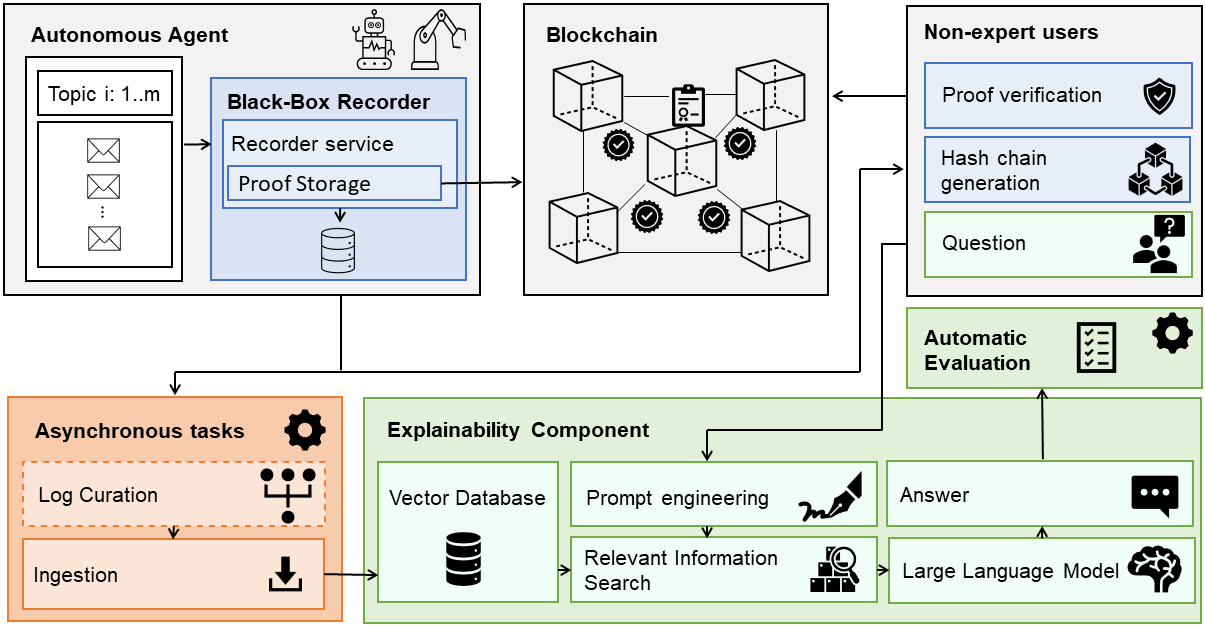
技术框架:整体架构包括两个主要模块:一个黑箱组件用于数据的安全存储和问责,另一个组件利用大语言模型生成基于黑箱数据的自然语言解释。系统通过区块链确保数据的不可篡改性。
关键创新:最重要的创新在于将区块链技术与大语言模型结合,形成一个双重保障的架构,既能确保数据的安全性,又能提供易于理解的解释。这与传统的单一方法有本质区别。
关键设计:在设计中,黑箱组件采用区块链技术实现数据的防篡改,确保数据的完整性;大语言模型则通过特定的训练数据和参数设置,生成符合用户需求的自然语言解释。
🖼️ 关键图片

📊 实验亮点
实验结果表明,所提架构在三种不同的导航场景中均表现出色,生成的自然语言解释在可理解性和准确性上均优于传统方法,问责性指标提升了约30%。
🎯 应用场景
该研究的潜在应用领域包括智能家居、自动驾驶汽车和服务机器人等场景,能够有效提升用户对自主代理的信任和安全感。未来,该架构有望在更多需要人机互动的领域得到广泛应用,促进自主代理技术的发展。
📄 摘要(原文)
The deployment of autonomous agents in environments involving human interaction has increasingly raised security concerns. Consequently, understanding the circumstances behind an event becomes critical, requiring the development of capabilities to justify their behaviors to non-expert users. Such explanations are essential in enhancing trustworthiness and safety, acting as a preventive measure against failures, errors, and misunderstandings. Additionally, they contribute to improving communication, bridging the gap between the agent and the user, thereby improving the effectiveness of their interactions. This work presents an accountability and explainability architecture implemented for ROS-based mobile robots. The proposed solution consists of two main components. Firstly, a black box-like element to provide accountability, featuring anti-tampering properties achieved through blockchain technology. Secondly, a component in charge of generating natural language explanations by harnessing the capabilities of Large Language Models (LLMs) over the data contained within the previously mentioned black box. The study evaluates the performance of our solution in three different scenarios, each involving autonomous agent navigation functionalities. This evaluation includes a thorough examination of accountability and explainability metrics, demonstrating the effectiveness of our approach in using accountable data from robot actions to obtain coherent, accurate and understandable explanations, even when facing challenges inherent in the use of autonomous agents in real-world scenarios.