ManiGaussian: Dynamic Gaussian Splatting for Multi-task Robotic Manipulation
作者: Guanxing Lu, Shiyi Zhang, Ziwei Wang, Changliu Liu, Jiwen Lu, Yansong Tang
分类: cs.RO, cs.CV
发布日期: 2024-03-13 (更新: 2024-07-18)
备注: https://guanxinglu.github.io/ManiGaussian/
🔗 代码/项目: PROJECT_PAGE
💡 一句话要点
提出ManiGaussian以解决多任务机器人操控中的场景动态问题
🎯 匹配领域: 支柱一:机器人控制 (Robot Control) 支柱二:RL算法与架构 (RL & Architecture) 支柱三:空间感知与语义 (Perception & Semantics) 支柱八:物理动画 (Physics-based Animation) 支柱九:具身大模型 (Embodied Foundation Models)
关键词: 动态高斯点云 机器人操控 场景重建 多任务学习 语义表示
📋 核心要点
- 现有的机器人操控方法往往忽视了场景的时空动态,导致在复杂环境中执行任务的效果不佳。
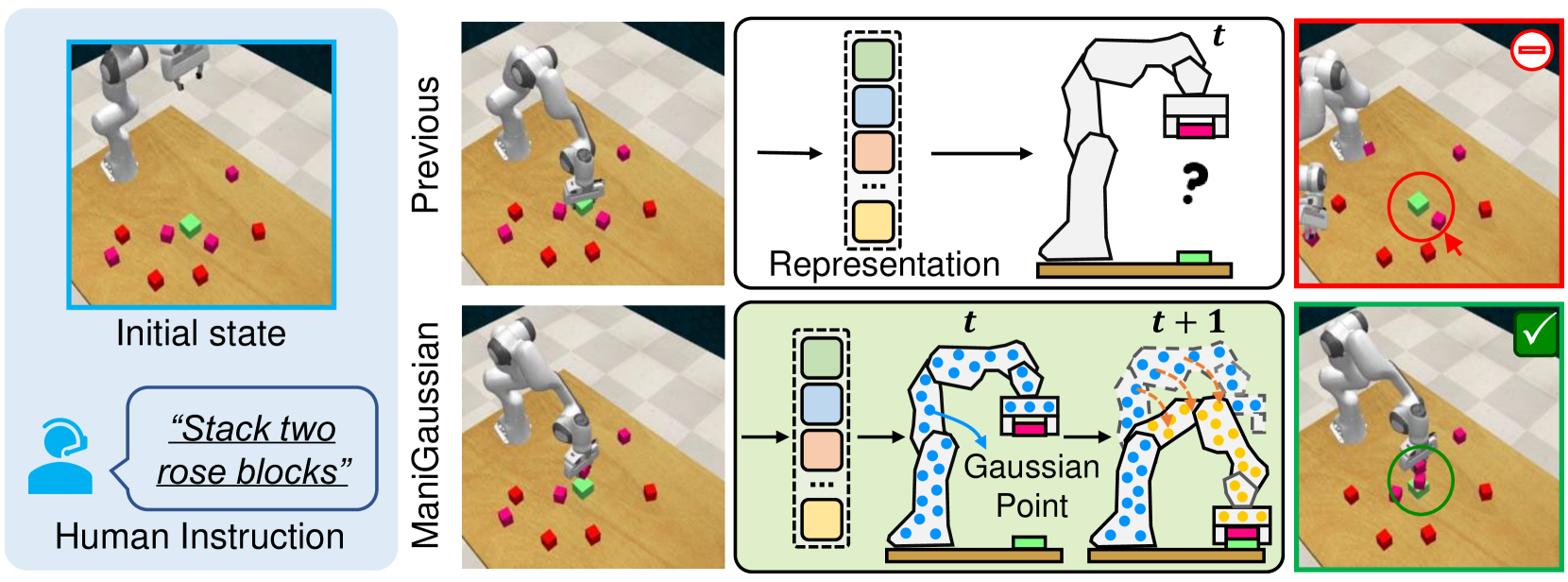
- 本文提出的ManiGaussian方法通过动态高斯点云框架,结合未来场景重建,增强了对场景动态的理解和利用。
- 在10个RLBench任务的评估中,ManiGaussian的平均成功率比现有方法提高了13.1%,显示出显著的性能提升。
📝 摘要(中文)
在非结构化环境中执行语言条件的机器人操控任务对通用智能机器人有着极高的需求。传统的机器人操控方法通常学习观察的语义表示以进行动作预测,但忽略了场景级时空动态对人类目标完成的影响。本文提出了一种名为ManiGaussian的动态高斯点云方法,用于多任务机器人操控,通过未来场景重建挖掘场景动态。我们首先构建动态高斯点云框架,推断高斯嵌入空间中的语义传播,并利用语义表示预测最优机器人动作。然后,我们建立高斯世界模型,以参数化动态高斯点云框架中的分布,通过未来场景重建在交互环境中提供信息监督。我们在10个RLBench任务上评估了ManiGaussian,结果表明该框架在平均成功率上超越了最先进的方法13.1%。
🔬 方法详解
问题定义:本文旨在解决传统机器人操控方法在非结构化环境中对场景时空动态的忽视,导致任务执行效果不佳的问题。
核心思路:ManiGaussian通过动态高斯点云框架,结合未来场景重建,挖掘场景动态信息,从而优化机器人动作预测。
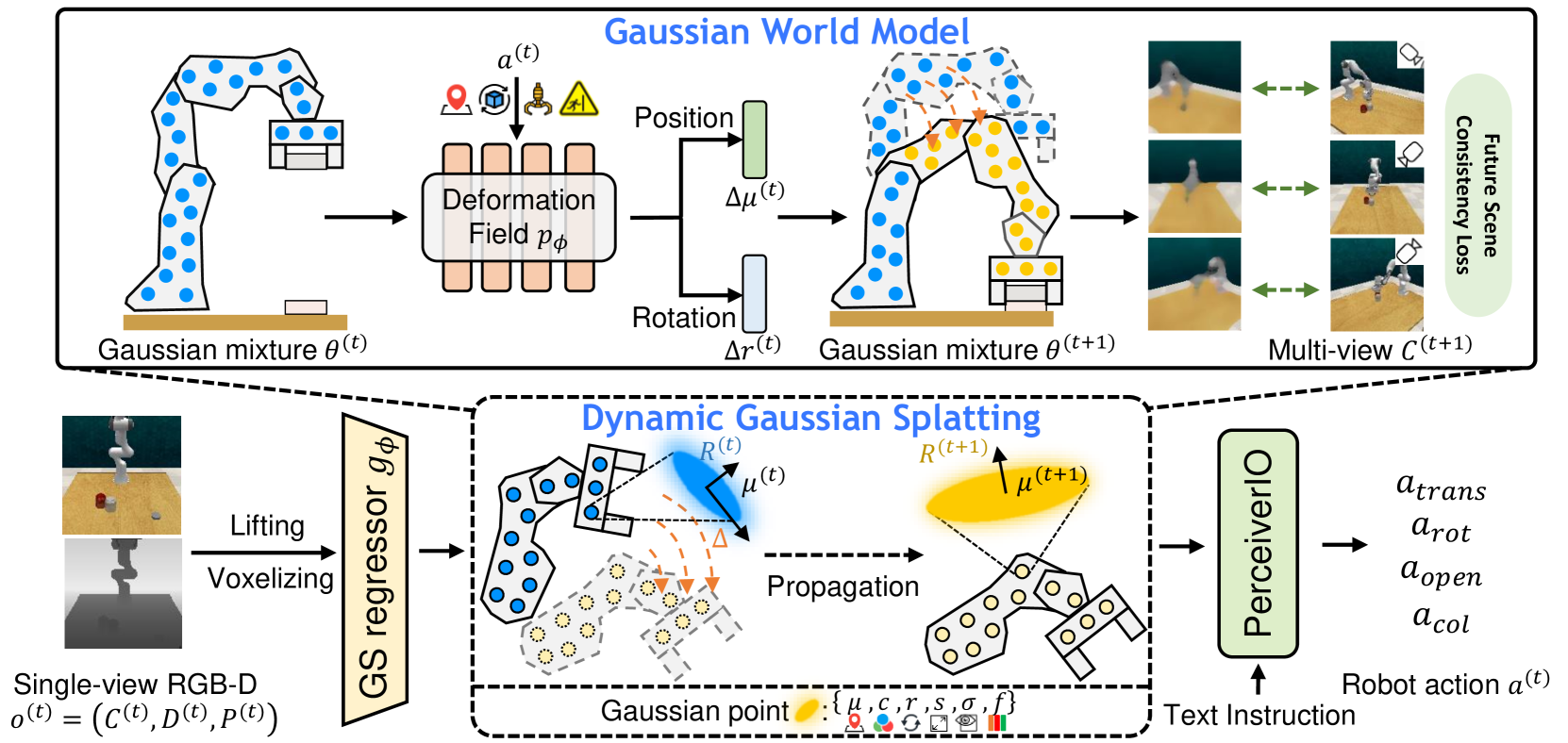
技术框架:整体架构包括动态高斯点云框架和高斯世界模型,前者用于推断语义传播,后者则通过参数化分布提供信息监督。
关键创新:最重要的创新在于动态高斯点云框架的设计,使得语义表示能够在高斯嵌入空间中有效传播,显著提升了任务执行的成功率。
关键设计:在技术细节上,采用了特定的损失函数和网络结构,以确保高斯嵌入的有效性和准确性,同时优化了模型的参数设置以适应多任务环境。
🖼️ 关键图片

📊 实验亮点
在实验中,ManiGaussian在10个RLBench任务上表现优异,平均成功率比最先进的方法提高了13.1%,显示出其在多任务机器人操控中的有效性和优势。
🎯 应用场景
该研究的潜在应用领域包括智能家居、工业自动化和服务机器人等,能够提升机器人在复杂环境中的操作能力和灵活性。未来,ManiGaussian方法可能推动更智能的机器人系统的发展,使其能够更好地理解和适应动态环境。
📄 摘要(原文)
Performing language-conditioned robotic manipulation tasks in unstructured environments is highly demanded for general intelligent robots. Conventional robotic manipulation methods usually learn semantic representation of the observation for action prediction, which ignores the scene-level spatiotemporal dynamics for human goal completion. In this paper, we propose a dynamic Gaussian Splatting method named ManiGaussian for multi-task robotic manipulation, which mines scene dynamics via future scene reconstruction. Specifically, we first formulate the dynamic Gaussian Splatting framework that infers the semantics propagation in the Gaussian embedding space, where the semantic representation is leveraged to predict the optimal robot action. Then, we build a Gaussian world model to parameterize the distribution in our dynamic Gaussian Splatting framework, which provides informative supervision in the interactive environment via future scene reconstruction. We evaluate our ManiGaussian on 10 RLBench tasks with 166 variations, and the results demonstrate our framework can outperform the state-of-the-art methods by 13.1\% in average success rate. Project page: https://guanxinglu.github.io/ManiGaussian/.