CoPa: General Robotic Manipulation through Spatial Constraints of Parts with Foundation Models
作者: Haoxu Huang, Fanqi Lin, Yingdong Hu, Shengjie Wang, Yang Gao
分类: cs.RO
发布日期: 2024-03-13
💡 一句话要点
提出CoPa框架以解决机器人操作中的空间约束问题
🎯 匹配领域: 支柱一:机器人控制 (Robot Control) 支柱九:具身大模型 (Embodied Foundation Models)
关键词: 机器人操作 空间约束 基础模型 视觉-语言模型 任务规划 开放世界 运动规划
📋 核心要点
- 现有方法在机器人操作中依赖特定任务的学习,导致数据收集需求高且难以推广到新任务。
- 提出CoPa框架,通过基础模型的常识知识生成6自由度末端执行器姿态,分为抓取和运动规划两个阶段。
- 实验证明,CoPa在处理开放集指令和对象时,具备细致的物理理解,且无需额外训练,效果显著提升。
📝 摘要(中文)
基础模型在网络规模数据上预训练,展现出丰富的世界知识,有助于机器人操作中的任务规划。然而,实际的物理实现往往依赖于特定任务的学习方法,这需要大量数据收集且难以推广。本文提出了一种新的框架——通过部件的空间约束进行机器人操作(CoPa),利用基础模型中嵌入的常识知识生成开放世界机器人操作的6自由度末端执行器姿态序列。我们将操作过程分为两个阶段:面向任务的抓取和任务感知的运动规划。通过基础视觉-语言模型(VLMs),我们在抓取阶段选择对象的抓取部位,并在运动规划阶段识别任务相关对象部件的空间几何约束,从而推导出抓取后的姿态。我们的实验证明,CoPa能够与现有的机器人规划算法无缝集成,完成复杂的长时间任务。
🔬 方法详解
问题定义:本文旨在解决机器人操作中对特定任务学习方法的依赖问题,这些方法往往需要大量数据并且难以推广到新场景。
核心思路:CoPa框架利用基础模型中嵌入的常识知识,通过分阶段的方式生成操作指令,旨在提高机器人操作的灵活性和适应性。
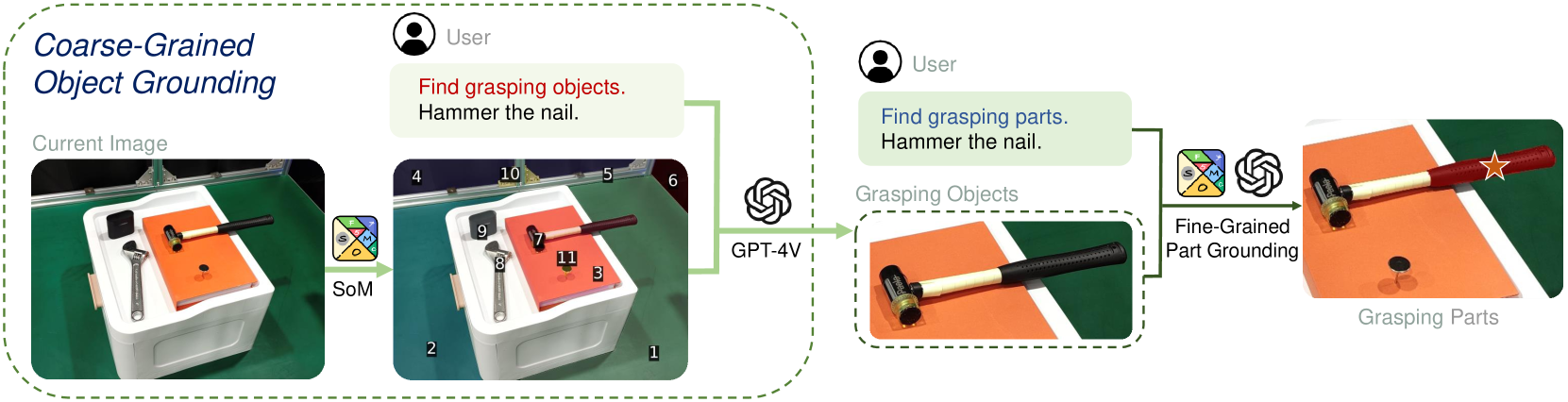
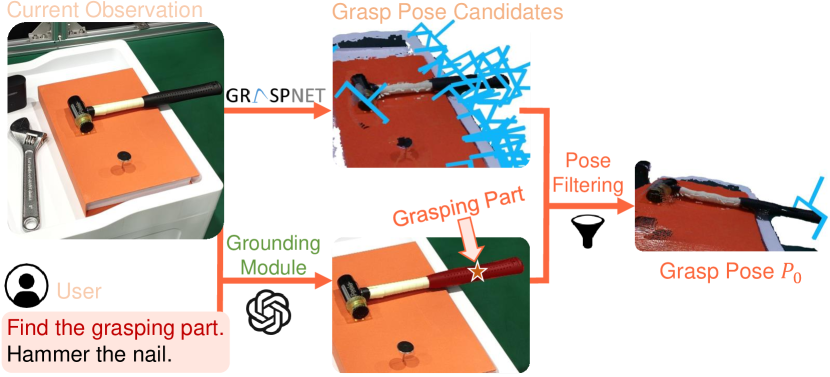
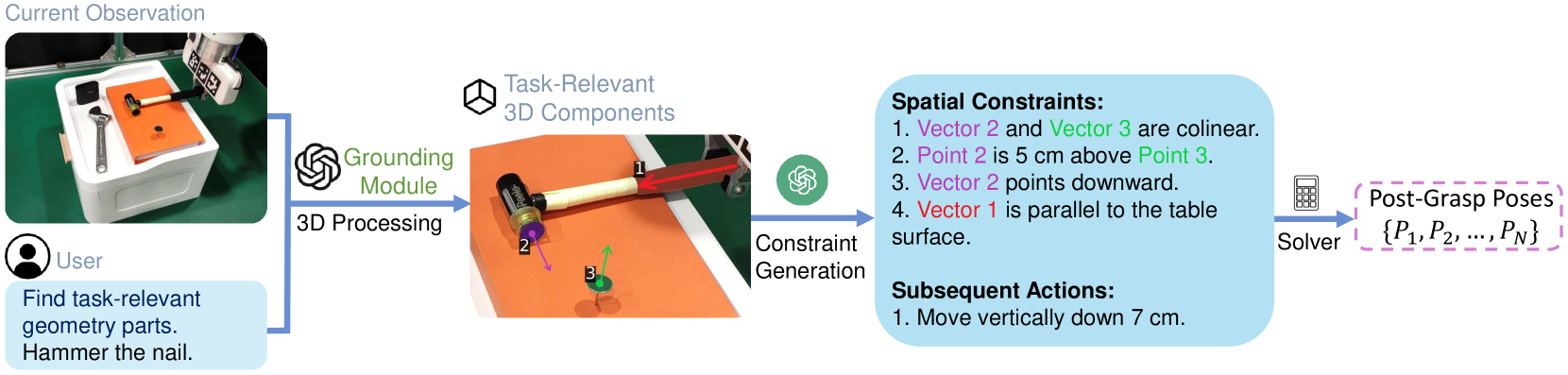
技术框架:CoPa框架分为两个主要阶段:面向任务的抓取阶段和任务感知的运动规划阶段。在抓取阶段,使用基础视觉-语言模型(VLMs)进行粗到细的定位;在运动规划阶段,VLMs识别对象部件的空间几何约束,以推导出抓取后的姿态。
关键创新:CoPa的创新在于将基础模型的常识知识与机器人操作结合,提供了一种新的思路来处理开放世界的操作任务,显著提升了操作的通用性和灵活性。
关键设计:在抓取阶段,采用了新颖的粗到细定位机制;在运动规划阶段,利用VLMs识别空间几何约束,确保生成的姿态符合物理现实,减少了对额外训练的需求。
🖼️ 关键图片
📊 实验亮点
实验结果表明,CoPa在处理开放集指令时表现出色,能够在不进行额外训练的情况下,成功完成复杂的长时间任务。与传统方法相比,CoPa在任务执行的准确性和灵活性上有显著提升,具体性能数据尚未披露。
🎯 应用场景
该研究的潜在应用领域包括服务机器人、工业自动化和家庭助理等场景。通过提升机器人对开放世界任务的理解和执行能力,CoPa框架能够在多种实际应用中提供更高的灵活性和效率,推动智能机器人技术的发展。
📄 摘要(原文)
Foundation models pre-trained on web-scale data are shown to encapsulate extensive world knowledge beneficial for robotic manipulation in the form of task planning. However, the actual physical implementation of these plans often relies on task-specific learning methods, which require significant data collection and struggle with generalizability. In this work, we introduce Robotic Manipulation through Spatial Constraints of Parts (CoPa), a novel framework that leverages the common sense knowledge embedded within foundation models to generate a sequence of 6-DoF end-effector poses for open-world robotic manipulation. Specifically, we decompose the manipulation process into two phases: task-oriented grasping and task-aware motion planning. In the task-oriented grasping phase, we employ foundation vision-language models (VLMs) to select the object's grasping part through a novel coarse-to-fine grounding mechanism. During the task-aware motion planning phase, VLMs are utilized again to identify the spatial geometry constraints of task-relevant object parts, which are then used to derive post-grasp poses. We also demonstrate how CoPa can be seamlessly integrated with existing robotic planning algorithms to accomplish complex, long-horizon tasks. Our comprehensive real-world experiments show that CoPa possesses a fine-grained physical understanding of scenes, capable of handling open-set instructions and objects with minimal prompt engineering and without additional training. Project page: https://copa-2024.github.io/