3D Diffusion Policy: Generalizable Visuomotor Policy Learning via Simple 3D Representations
作者: Yanjie Ze, Gu Zhang, Kangning Zhang, Chenyuan Hu, Muhan Wang, Huazhe Xu
分类: cs.RO, cs.CV, cs.LG
发布日期: 2024-03-06 (更新: 2024-09-27)
备注: Published at Robotics: Science and Systems (RSS) 2024. Videos, code, and data: https://3d-diffusion-policy.github.io
💡 一句话要点
提出3D扩散策略以解决机器人模仿学习中的示范需求问题
🎯 匹配领域: 支柱二:RL算法与架构 (RL & Architecture)
关键词: 模仿学习 3D视觉表示 扩散策略 机器人控制 泛化能力
📋 核心要点
- 现有的模仿学习方法在学习复杂技能时通常需要大量的人类示范,导致效率低下。
- 本文提出的3D扩散策略通过紧凑的3D视觉表示,结合扩散策略,显著提高了学习效率和泛化能力。
- 实验结果显示,DP3在72个仿真任务中相较于基线方法提升了24.2%,在真实任务中成功率达到85%。
📝 摘要(中文)
模仿学习为机器人教授灵巧技能提供了一种高效的方法,但学习复杂技能的鲁棒性和可泛化性通常需要大量的人类示范。为了解决这一挑战,本文提出了3D扩散策略(DP3),这是一种新颖的视觉模仿学习方法,结合了3D视觉表示与扩散策略。DP3的核心设计是利用从稀疏点云中提取的紧凑3D视觉表示。在72个仿真任务的实验中,DP3仅需10个示范便成功处理大多数任务,相较于基线方法提高了24.2%。在4个真实机器人任务中,DP3在仅有40个示范的情况下,成功率达到85%,并在空间、视角、外观和实例等多方面展现出优异的泛化能力。实验结果强调了3D表示在现实世界机器人学习中的重要性。
🔬 方法详解
问题定义:本文旨在解决机器人模仿学习中对大量人类示范的依赖问题,现有方法在复杂技能学习时效率低下且泛化能力不足。
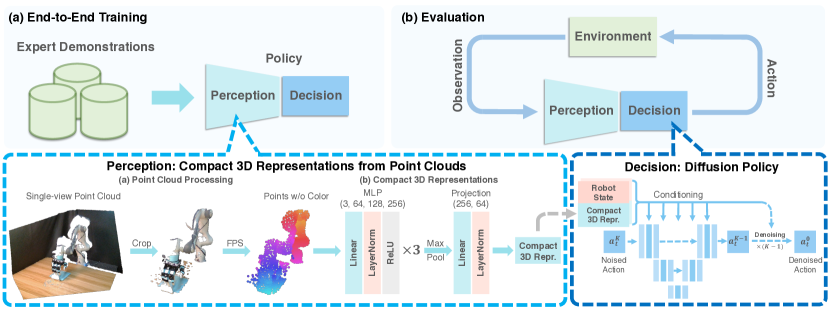
核心思路:DP3通过引入紧凑的3D视觉表示,利用扩散策略生成条件动作,从而减少对示范数量的需求并提升学习效果。
技术框架:DP3的整体架构包括一个高效的点编码器用于提取3D视觉表示,随后通过扩散模型生成动作策略,整个流程从输入的稀疏点云到输出的控制动作。
关键创新:DP3的核心创新在于将3D视觉表示与扩散策略结合,显著提高了模仿学习的效率和泛化能力,这与传统方法依赖于大量示范的方式形成鲜明对比。
关键设计:在设计中,采用了高效的点编码器,损失函数设计考虑了动作生成的条件性,网络结构则优化了3D表示的处理能力,以确保在有限示范下仍能实现高效学习。
🖼️ 关键图片
📊 实验亮点
DP3在72个仿真任务中仅需10个示范便成功处理大多数任务,相较于基线方法提升了24.2%。在4个真实机器人任务中,DP3的成功率达到85%,且在安全性方面表现优异,极少违反安全要求。
🎯 应用场景
该研究的潜在应用领域包括机器人操作、自动化制造和人机交互等。通过提高机器人在复杂任务中的学习效率,DP3有望在实际应用中降低人力成本,提升工作效率,未来可能推动更广泛的智能机器人技术的发展。
📄 摘要(原文)
Imitation learning provides an efficient way to teach robots dexterous skills; however, learning complex skills robustly and generalizablely usually consumes large amounts of human demonstrations. To tackle this challenging problem, we present 3D Diffusion Policy (DP3), a novel visual imitation learning approach that incorporates the power of 3D visual representations into diffusion policies, a class of conditional action generative models. The core design of DP3 is the utilization of a compact 3D visual representation, extracted from sparse point clouds with an efficient point encoder. In our experiments involving 72 simulation tasks, DP3 successfully handles most tasks with just 10 demonstrations and surpasses baselines with a 24.2% relative improvement. In 4 real robot tasks, DP3 demonstrates precise control with a high success rate of 85%, given only 40 demonstrations of each task, and shows excellent generalization abilities in diverse aspects, including space, viewpoint, appearance, and instance. Interestingly, in real robot experiments, DP3 rarely violates safety requirements, in contrast to baseline methods which frequently do, necessitating human intervention. Our extensive evaluation highlights the critical importance of 3D representations in real-world robot learning. Videos, code, and data are available on https://3d-diffusion-policy.github.io .