Whole-body Humanoid Robot Locomotion with Human Reference
作者: Qiang Zhang, Peter Cui, David Yan, Jingkai Sun, Yiqun Duan, Gang Han, Wen Zhao, Weining Zhang, Yijie Guo, Arthur Zhang, Renjing Xu
分类: cs.RO
发布日期: 2024-02-28 (更新: 2024-08-26)
备注: 7pages, 7 figures
💡 一句话要点
提出基于对抗运动先验的模仿学习框架以提升类人机器人运动能力
🎯 匹配领域: 支柱一:机器人控制 (Robot Control) 支柱二:RL算法与架构 (RL & Architecture) 支柱八:物理动画 (Physics-based Animation)
关键词: 类人机器人 模仿学习 对抗训练 运动控制 强化学习
📋 核心要点
- 现有类人机器人在复杂运动任务中的表现受限于设计复杂的奖励函数和训练整个系统的挑战。
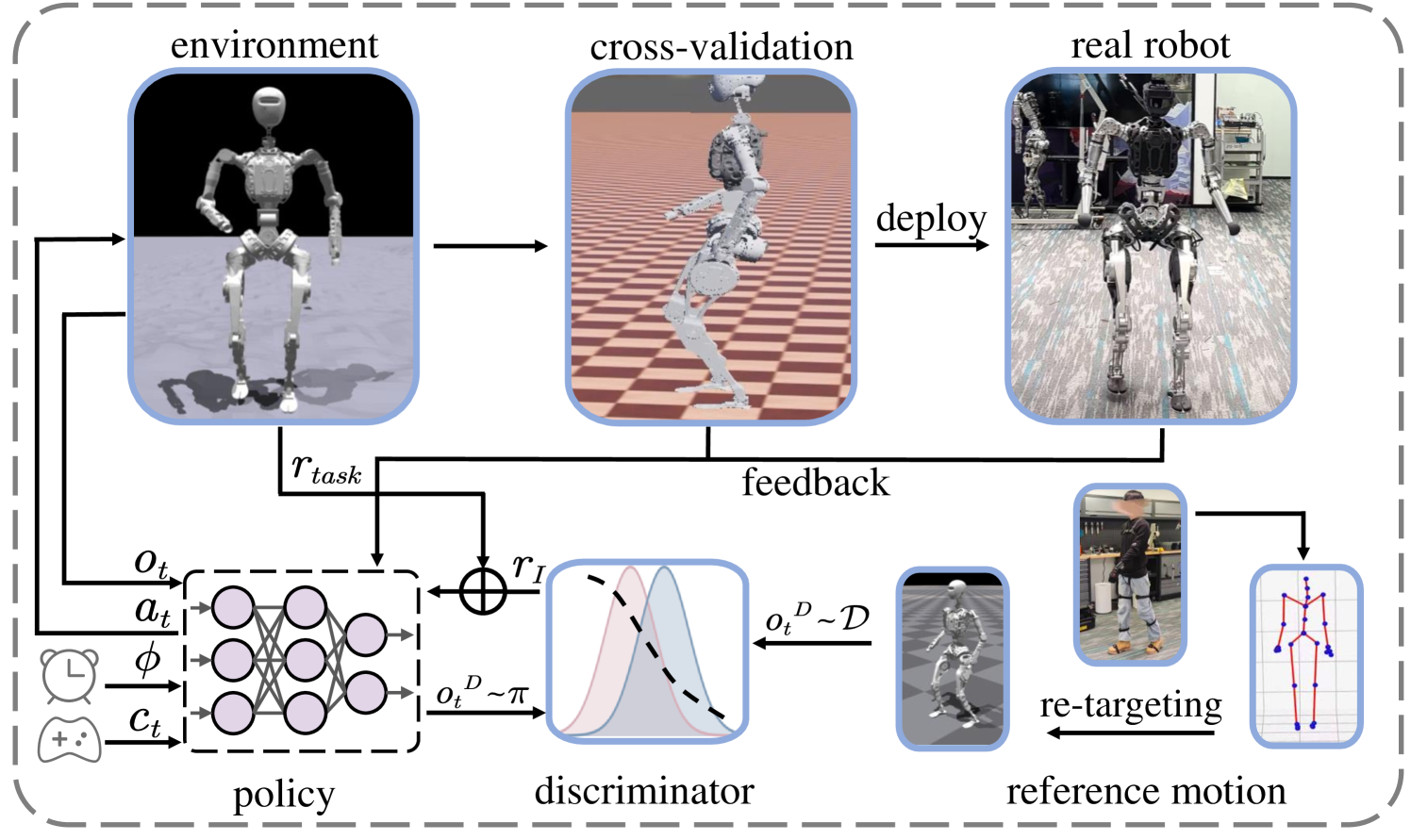
- 本文提出了一种基于对抗运动先验的模仿学习框架,旨在提高类人机器人在运动任务中的表现。
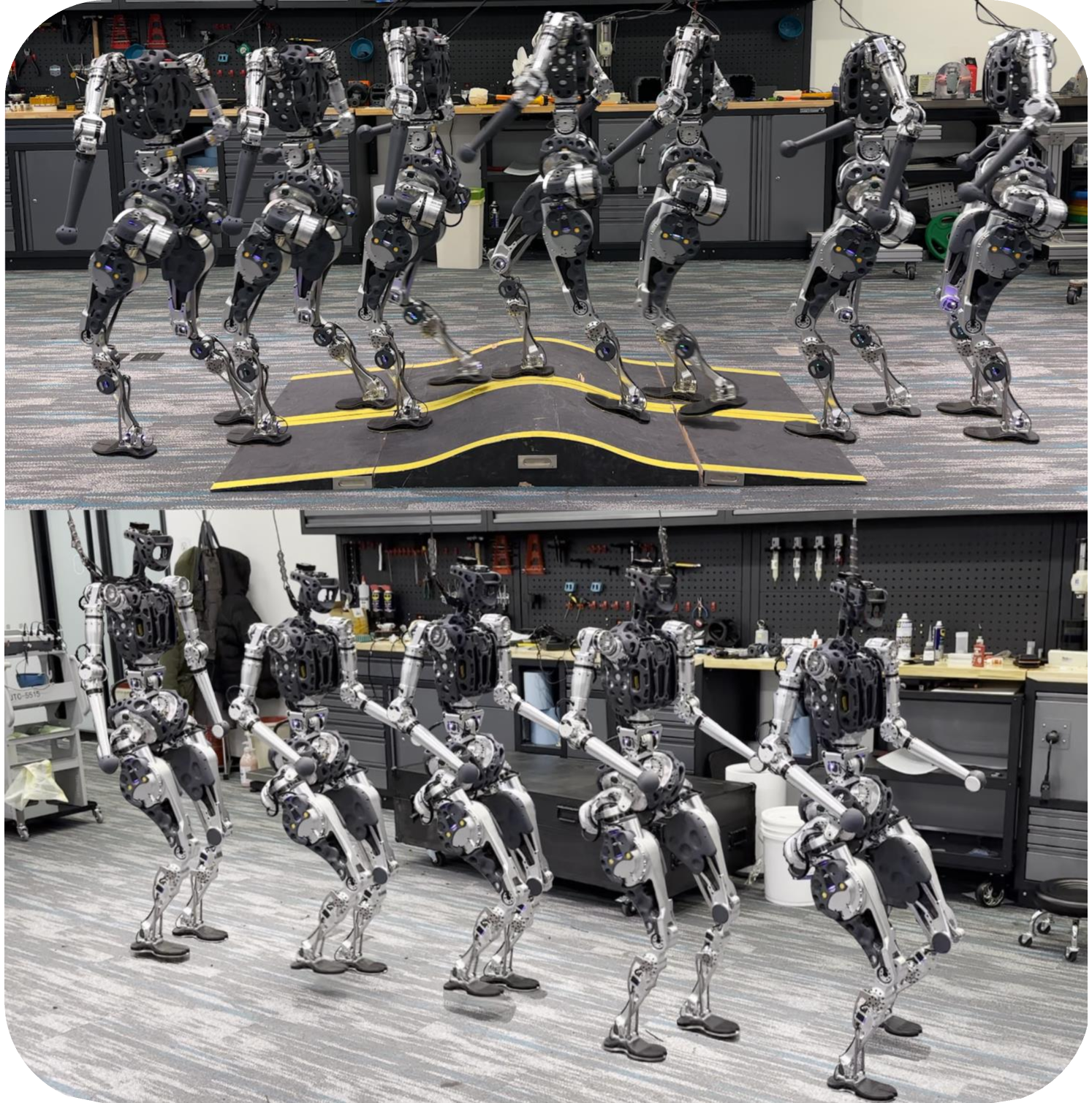
- 实验结果显示,Adam在复杂运动任务中达到了与人类相当的表现,标志着模仿学习的新进展。
📝 摘要(中文)
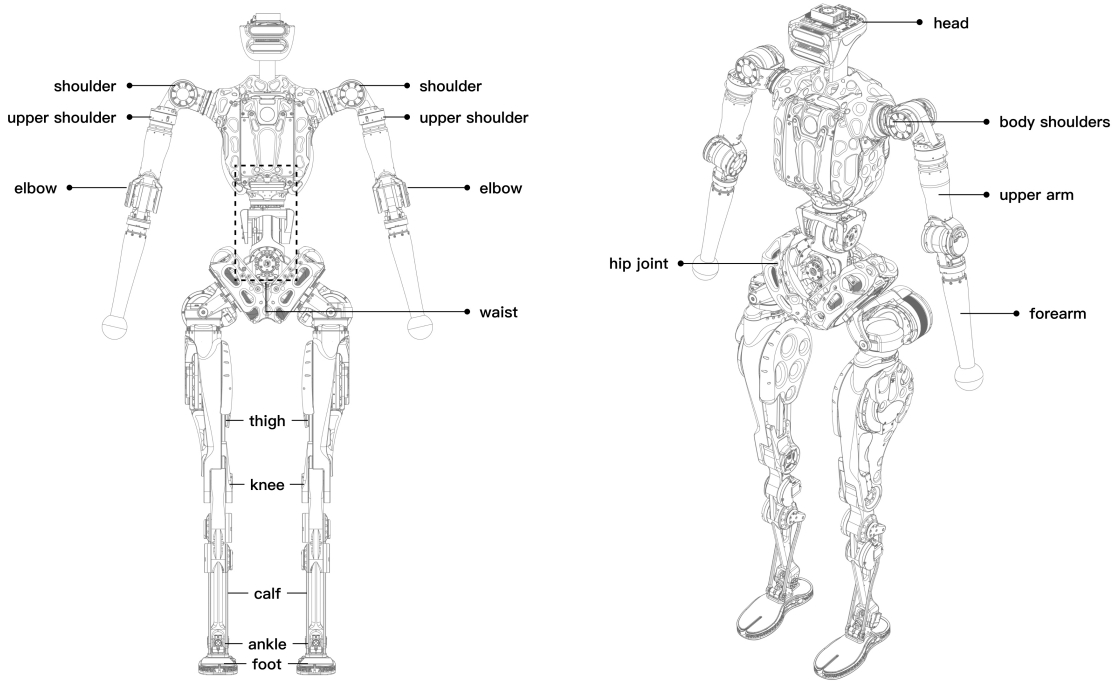
近年来,类人机器人在执行复杂任务方面取得了显著进展,尤其是通过强化学习(RL)的应用。然而,类人机器人的复杂性,如设计复杂奖励函数和训练整个系统的困难,仍然是一个显著挑战。为了解决这些问题,本文开发了全尺寸类人机器人“Adam”,其创新的结构设计显著提高了模仿学习过程的效率和效果。此外,提出了一种基于对抗运动先验的新型模仿学习框架,适用于Adam及其他类人机器人。实验结果表明,该框架使Adam在复杂运动任务中展现出前所未有的人类特征,首次将人类运动数据应用于全尺寸类人机器人的模仿学习中。
🔬 方法详解
问题定义:本文旨在解决类人机器人在复杂运动任务中表现不佳的问题,现有方法在设计奖励函数和训练系统时面临诸多挑战。
核心思路:通过开发一款全尺寸类人机器人“Adam”,并基于对抗运动先验设计模仿学习框架,旨在提升类人机器人的运动能力和效率。
技术框架:该框架包括数据收集、对抗训练和模仿学习三个主要模块。首先收集人类运动数据,然后通过对抗训练优化模仿策略,最后实现高效的运动控制。
关键创新:最重要的创新在于将对抗运动先验引入模仿学习框架,使得机器人能够更好地模拟人类运动,显著提升了运动表现。
关键设计:在设计中,采用了特定的损失函数以平衡模仿学习与对抗训练的目标,同时优化了网络结构以提高学习效率。具体参数设置和网络架构细节在实验部分进行了详细描述。
🖼️ 关键图片
📊 实验亮点
实验结果表明,Adam在复杂运动任务中达到了与人类相当的表现,具体性能数据展示了在多个任务中相较于传统方法的显著提升,标志着模仿学习在类人机器人领域的突破。
🎯 应用场景
该研究的潜在应用领域包括服务机器人、医疗辅助机器人和娱乐机器人等。通过提升类人机器人的运动能力,可以在更复杂的环境中执行任务,具有广泛的实际价值和未来影响。
📄 摘要(原文)
Recently, humanoid robots have made significant advances in their ability to perform challenging tasks due to the deployment of Reinforcement Learning (RL), however, the inherent complexity of humanoid robots, including the difficulty of designing complicated reward functions and training entire sophisticated systems, still poses a notable challenge. To conquer these challenges, after many iterations and in-depth investigations, we have meticulously developed a full-size humanoid robot, "Adam", whose innovative structural design greatly improves the efficiency and effectiveness of the imitation learning process. In addition, we have developed a novel imitation learning framework based on an adversarial motion prior, which applies not only to Adam but also to humanoid robots in general. Using the framework, Adam can exhibit unprecedented human-like characteristics in locomotion tasks. Our experimental results demonstrate that the proposed framework enables Adam to achieve human-comparable performance in complex locomotion tasks, marking the first time that human locomotion data has been used for imitation learning in a full-size humanoid robot.