PhyGrasp: Generalizing Robotic Grasping with Physics-informed Large Multimodal Models
作者: Dingkun Guo, Yuqi Xiang, Shuqi Zhao, Xinghao Zhu, Masayoshi Tomizuka, Mingyu Ding, Wei Zhan
分类: cs.RO, cs.AI, cs.CL, cs.CV
发布日期: 2024-02-26
💡 一句话要点
提出PhyGrasp以解决机器人抓取的通用性问题
🎯 匹配领域: 支柱一:机器人控制 (Robot Control) 支柱九:具身大模型 (Embodied Foundation Models)
关键词: 机器人抓取 多模态学习 物理推理 长尾场景 自然语言处理 3D点云 深度学习 智能机器人
📋 核心要点
- 现有的机器人抓取方法在处理不常见物体时表现不佳,缺乏对物理属性的有效理解。
- PhyGrasp通过结合自然语言和3D点云信息,利用物理常识推理来优化抓取策略。
- 实验结果显示,PhyGrasp在长尾场景中的成功率提高了约10%,超越了现有的GraspNet模型。
📝 摘要(中文)
机器人抓取是机器人功能的基本方面,定义了机器人如何与物体交互。尽管已有显著进展,但在处理反直觉或长尾场景(如不常见材料或形状的物体)时,抓取的通用性仍然是一个挑战。本文探讨了将物理常识推理融入机器人操作中,提出了PhyGrasp,一个利用自然语言和3D点云两种模态输入的多模态大模型。该模型能够准确评估物体部分的物理属性并确定最佳抓取姿势,同时理解人类指令,生成符合人类偏好的抓取姿势。通过构建包含195K个物体实例的PhyPartNet数据集,PhyGrasp在模拟和真实机器人上的实验表明,其在长尾案例中的成功率比GraspNet提高了约10%。
🔬 方法详解
问题定义:本文旨在解决机器人抓取在面对不常见物体时的通用性问题。现有方法在处理具有不同物理属性和形状的物体时,往往无法有效适应,导致抓取成功率低下。
核心思路:PhyGrasp的核心思路是将物理常识推理融入到机器人抓取中,通过多模态输入(自然语言和3D点云)来增强模型对物体物理属性的理解,从而优化抓取策略。
技术框架:PhyGrasp的整体架构包括两个主要模块:语言模态模块和3D模态模块。语言模态负责理解物体的物理属性及其对抓取的影响,而3D模态则专注于物体形状和部件的识别。两者通过桥接模块无缝集成,形成一个统一的抓取决策系统。
关键创新:PhyGrasp的主要创新在于其多模态融合能力,能够同时处理语言和视觉信息,从而在长尾场景中表现出色。这一设计使得模型能够在未见过的物体上进行有效抓取,显著提高了通用性。
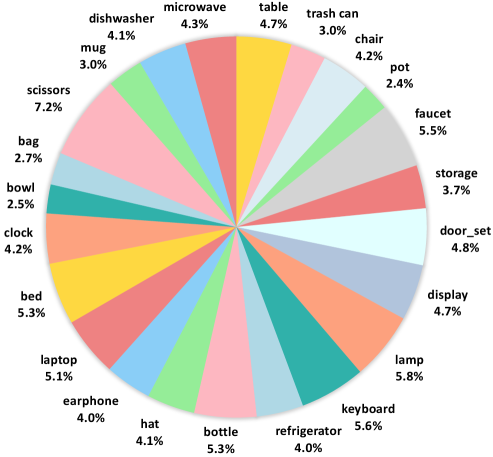
关键设计:在训练过程中,PhyGrasp使用了包含195K个物体实例的PhyPartNet数据集,设计了特定的损失函数以平衡语言理解和物理属性评估的权重。此外,网络结构采用了先进的深度学习技术,以确保模型的高效性和准确性。
🖼️ 关键图片


📊 实验亮点
PhyGrasp在长尾场景中的实验结果显示,其成功率比基线模型GraspNet提高了约10%。这一显著提升证明了其在处理不常见物体时的有效性,标志着机器人抓取技术的一次重要进步。
🎯 应用场景
PhyGrasp的研究成果在多个领域具有广泛的应用潜力,包括服务机器人、工业自动化和智能家居等。通过提升机器人对复杂物体的抓取能力,该技术可以显著提高机器人在实际环境中的适应性和灵活性,推动智能机器人技术的进一步发展。
📄 摘要(原文)
Robotic grasping is a fundamental aspect of robot functionality, defining how robots interact with objects. Despite substantial progress, its generalizability to counter-intuitive or long-tailed scenarios, such as objects with uncommon materials or shapes, remains a challenge. In contrast, humans can easily apply their intuitive physics to grasp skillfully and change grasps efficiently, even for objects they have never seen before. This work delves into infusing such physical commonsense reasoning into robotic manipulation. We introduce PhyGrasp, a multimodal large model that leverages inputs from two modalities: natural language and 3D point clouds, seamlessly integrated through a bridge module. The language modality exhibits robust reasoning capabilities concerning the impacts of diverse physical properties on grasping, while the 3D modality comprehends object shapes and parts. With these two capabilities, PhyGrasp is able to accurately assess the physical properties of object parts and determine optimal grasping poses. Additionally, the model's language comprehension enables human instruction interpretation, generating grasping poses that align with human preferences. To train PhyGrasp, we construct a dataset PhyPartNet with 195K object instances with varying physical properties and human preferences, alongside their corresponding language descriptions. Extensive experiments conducted in the simulation and on the real robots demonstrate that PhyGrasp achieves state-of-the-art performance, particularly in long-tailed cases, e.g., about 10% improvement in success rate over GraspNet. Project page: https://sites.google.com/view/phygrasp