LaserSAM: Zero-Shot Change Detection Using Visual Segmentation of Spinning LiDAR
作者: Alexander Krawciw, Sven Lilge, Timothy D. Barfoot
分类: cs.RO
发布日期: 2024-02-15 (更新: 2024-04-29)
备注: 9 pages (8 content, 1 references). 9 figures, Presented at 2024 Conference on Robots and Vision (CRV)
💡 一句话要点
提出LaserSAM以解决旋转LiDAR数据的零-shot变化检测问题
🎯 匹配领域: 支柱九:具身大模型 (Embodied Foundation Models)
关键词: 变化检测 旋转LiDAR 深度学习 语义分割 无人驾驶 环境监测 机器人导航
📋 核心要点
- 现有的变化检测方法在处理旋转LiDAR数据时,往往受到环境亮度变化的影响,导致鲁棒性不足。
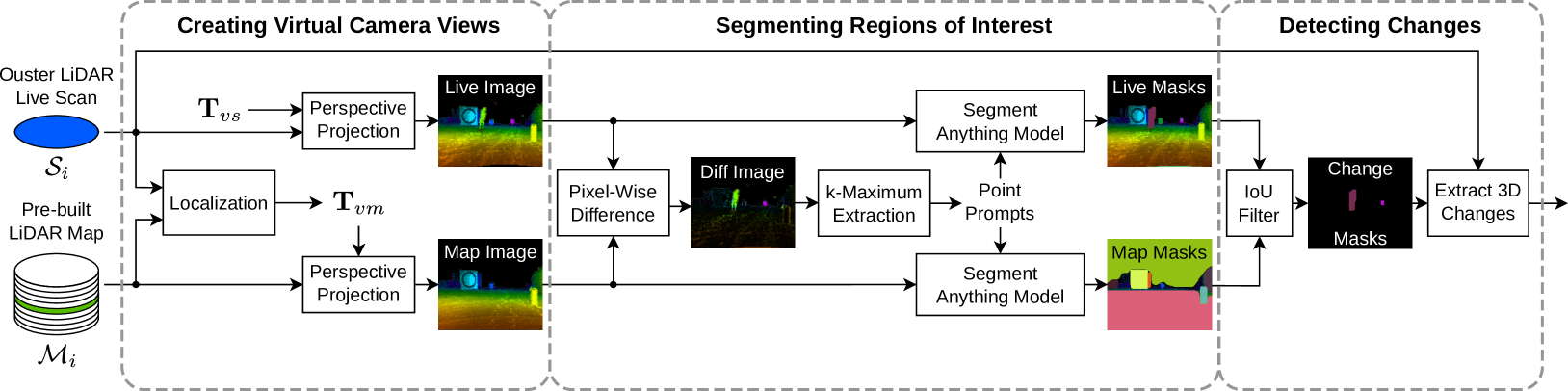
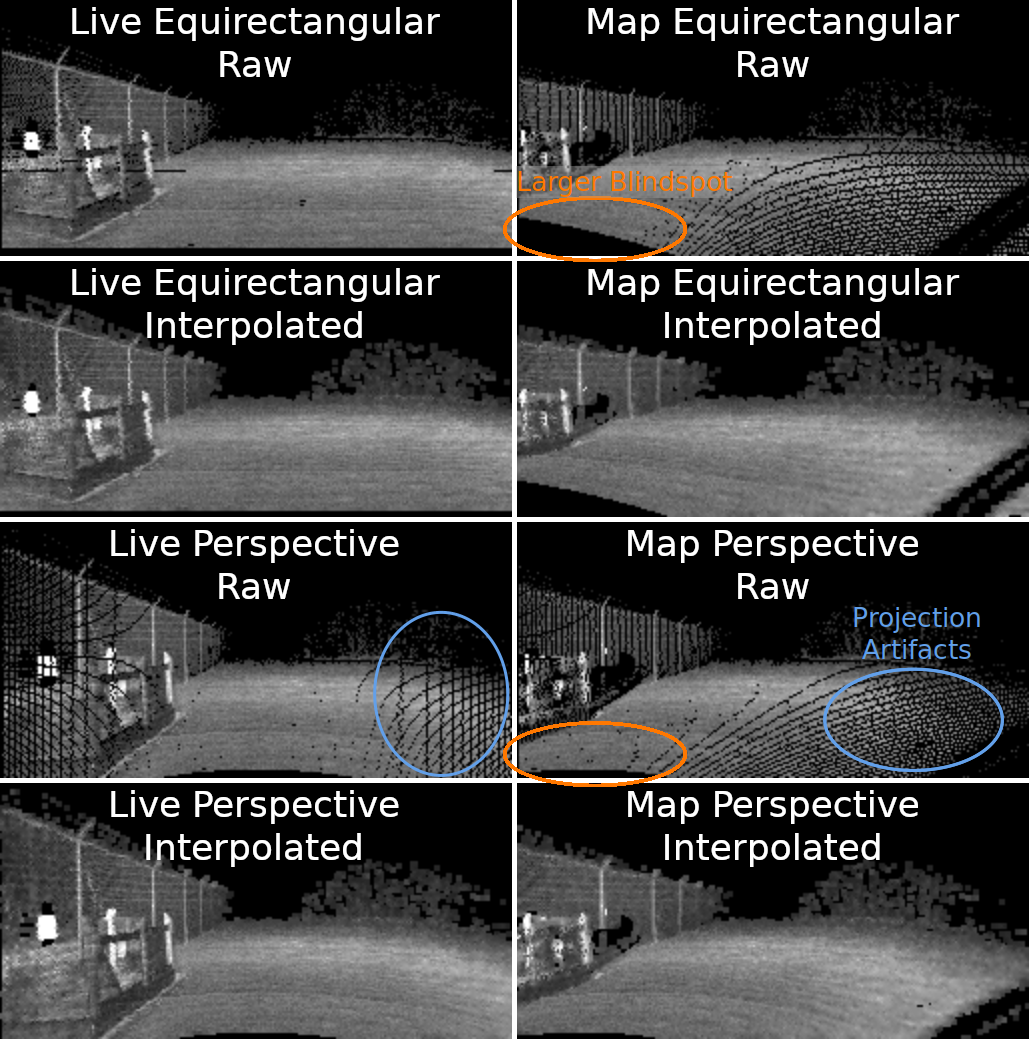
- 论文提出了一种新的方法,通过将LiDAR数据渲染为虚拟视角图像,结合相机感知技术进行变化检测。
- 实验结果显示,该方法在不同环境下的变化检测准确率显著提高,尤其在昼夜照明变化情况下表现优异。
📝 摘要(中文)
本文提出了一种将相机感知技术应用于旋转LiDAR数据的方法。为了提高从3D LiDAR进行长期变化检测的鲁棒性,利用针孔相机模型将范围和强度信息渲染为虚拟视角。通过色调-饱和度-明度图像编码,根据范围和近红外强度对图像进行着色。LiDAR的主动场景照明使其对环境亮度不变,从而实现昼夜变化检测而无需额外处理。使用范围着色的透视图像,现有的基础模型能够检测语义区域。具体而言,Segment Anything Model能够在先前获取的地图和路径重复机器人实时视图中检测语义相似区域。通过比较两个视图中的掩膜,检测实时扫描中的变化。结果表明,Segment Anything Model能够准确捕捉场景中引入的任意变化的形状。该方法在非结构化环境中的分割交并比达到73.3%,在规划走廊内达到80.4%。
🔬 方法详解
问题定义:本文旨在解决旋转LiDAR数据在变化检测中的鲁棒性问题,尤其是在环境亮度变化时的准确性不足。
核心思路:通过将LiDAR的范围和强度信息渲染为虚拟视角图像,利用色调-饱和度-明度编码实现对图像的着色,从而提高变化检测的准确性。
技术框架:整体方法包括数据采集、图像渲染、语义区域检测和变化比较四个主要模块。首先,采集LiDAR数据并进行渲染,然后使用Segment Anything Model进行语义区域检测,最后比较不同视图中的掩膜以识别变化。
关键创新:该方法的创新点在于将LiDAR数据与相机感知技术结合,利用主动照明特性实现昼夜变化检测的鲁棒性,显著提升了变化检测的准确性。
关键设计:在技术细节上,采用了色调-饱和度-明度图像编码来处理LiDAR数据,并通过精确的掩膜生成与3D点的一一对应关系,确保了2D掩膜可以直接用于恢复变化的3D位置。实验中,采用了特定的损失函数和网络结构以优化检测性能。
🖼️ 关键图片

📊 实验亮点
实验结果显示,所提出的方法在非结构化环境中的分割交并比达到73.3%,在规划走廊内达到80.4%。此外,该方法能够可靠地检测昼夜照明变化下的场景变化,展现出优越的鲁棒性和准确性。
🎯 应用场景
该研究的潜在应用领域包括自动驾驶、环境监测和机器人导航等。通过提高变化检测的准确性,能够有效支持无人驾驶车辆在复杂环境中的安全行驶,增强机器人在动态场景中的适应能力,具有重要的实际价值和未来影响。
📄 摘要(原文)
This paper presents an approach for applying camera perception techniques to spinning LiDAR data. To improve the robustness of long-term change detection from a 3D LiDAR, range and intensity information are rendered into virtual perspectives using a pinhole camera model. Hue-saturation-value image encoding is used to colourize the images by range and near-IR intensity. The LiDAR's active scene illumination makes it invariant to ambient brightness, which enables night-to-day change detection without additional processing. Using the range-colourized, perspective image allows existing foundation models to detect semantic regions. Specifically, the Segment Anything Model detects semantically similar regions in both a previously acquired map and live view from a path-repeating robot. By comparing the masks in both views, changes in the live scan are detected. Results indicate that the Segment Anything Model accurately captures the shape of arbitrary changes introduced into scenes. The proposed method achieves a segmentation intersection over union of 73.3% when evaluated in unstructured environments and 80.4% when evaluated within the planning corridor. Changes can be detected reliably through day-to-night illumination variations. After pixel-level masks are generated, the one-to-one correspondence with 3D points means that the 2D masks can be used directly to recover the 3D location of the changes. The detected 3D changes are avoided in a closed loop by treating them as obstacles in a local motion planner. Experiments on an unmanned ground vehicle demonstrate the performance of the method.