Grounding LLMs For Robot Task Planning Using Closed-loop State Feedback
作者: Vineet Bhat, Ali Umut Kaypak, Prashanth Krishnamurthy, Ramesh Karri, Farshad Khorrami
分类: cs.RO
发布日期: 2024-02-13 (更新: 2025-11-20)
备注: Preprint version. Accepted full paper available here: https://advanced.onlinelibrary.wiley.com/doi/10.1002/adrr.202500072
💡 一句话要点
提出BrainBody-LLM以解决机器人任务规划中的环境反馈不足问题
🎯 匹配领域: 支柱九:具身大模型 (Embodied Foundation Models)
关键词: 机器人任务规划 大型语言模型 闭环反馈 高低层次规划 模拟环境 执行错误纠正 智能决策 人类神经系统
📋 核心要点
- 现有方法在机器人任务规划中面临LLMs的幻觉问题,导致环境适应性不足。
- 本文提出的BrainBody-LLM通过高低层次分离的LLMs结构化规划,增强了任务成功率。
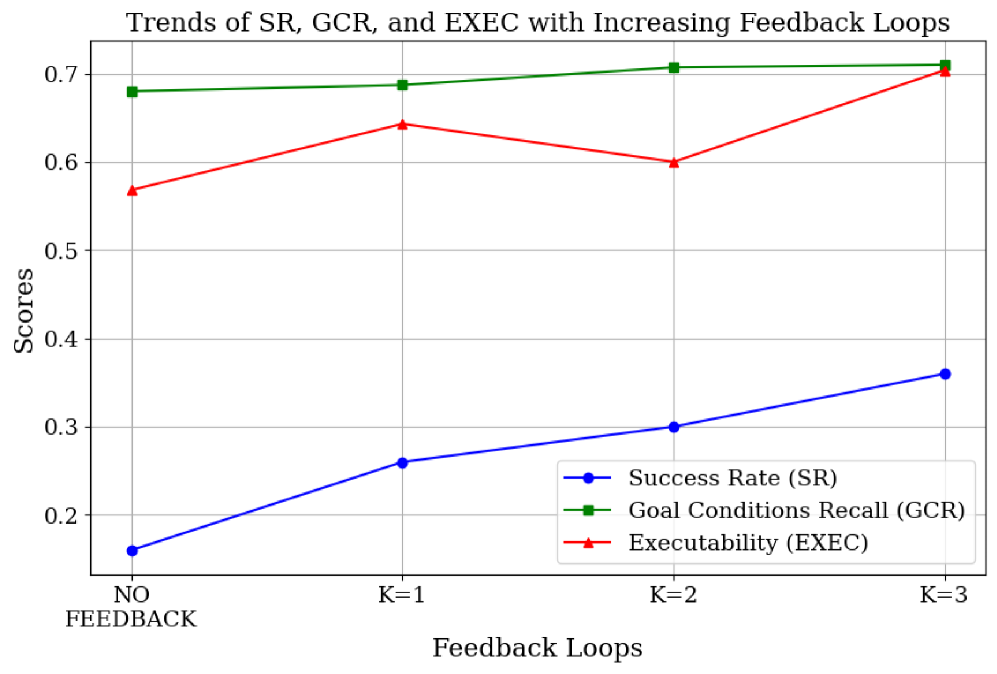
- 在复杂任务的实验中,BrainBody-LLM在物理模拟器上表现出显著的性能提升,成功率提高29%。
📝 摘要(中文)
规划算法将复杂问题分解为可由机器人顺序执行的中间步骤。近期研究利用大型语言模型(LLMs)进行任务规划,使用自然语言生成机器人策略。然而,由于缺乏对机器人环境的充分基础,LLMs在任务规划中的适用性受到限制。本文提出了一种新方法,利用两个独立的LLMs进行高层规划和低层控制,提升任务成功率和目标条件回忆。我们的算法BrainBody-LLM借鉴人类神经系统,采用闭环反馈机制,从模拟器错误中学习,以解决复杂环境中的执行错误。实验结果表明,BrainBody-LLM在VirtualHome模拟环境中成功应用,任务成功率比竞争基线提高了29%。
🔬 方法详解
问题定义:本文旨在解决现有大型语言模型(LLMs)在机器人任务规划中因环境反馈不足而导致的幻觉问题,影响其在复杂任务中的执行能力。
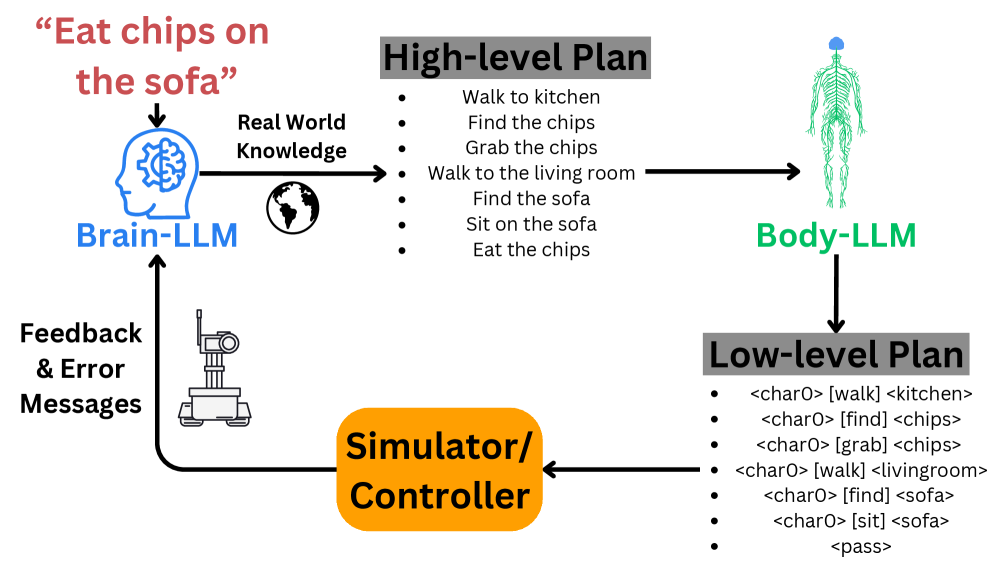
核心思路:论文提出的BrainBody-LLM通过将任务规划分为高层次和低层次两个独立的LLMs,模仿人类神经系统的结构,利用闭环反馈机制来增强模型的学习能力和执行精度。
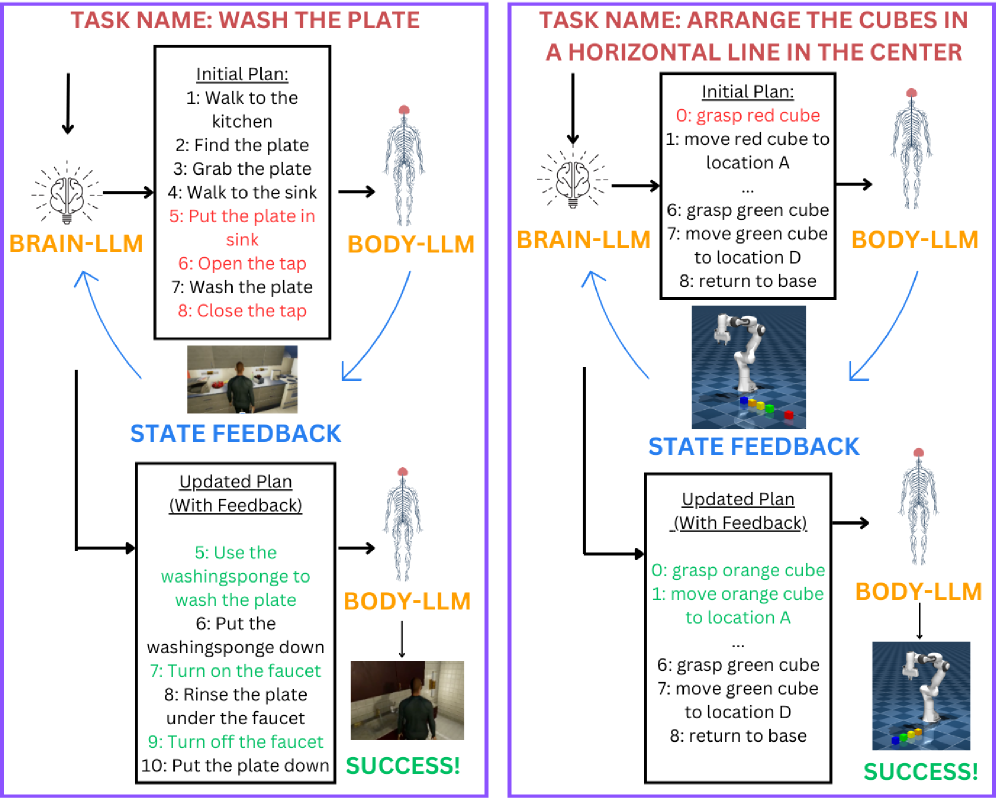
技术框架:整体架构包括高层规划LLM负责生成任务策略,低层控制LLM负责执行和调整策略。闭环反馈机制使得系统能够从执行中的错误中学习并进行调整。
关键创新:最重要的创新在于将任务规划分为两个层次的LLMs,并通过闭环反馈机制提升了模型的适应性和执行效率,这与传统的单一LLM方法有本质区别。
关键设计:在设计中,采用了特定的损失函数来优化高低层次LLMs的协同工作,并通过环境状态信息的反馈来调整策略,确保模型在复杂环境中的有效性。
🖼️ 关键图片
📊 实验亮点
实验结果显示,BrainBody-LLM在VirtualHome模拟环境中实现了29%的任务成功率提升,相较于使用GPT-4后端的竞争基线,展现出显著的性能优势。此外,在七个复杂任务的评估中,BrainBody-LLM的推理能力得到了有效增强,能够从原始模拟器错误中学习并纠正计划。
🎯 应用场景
该研究的潜在应用领域包括智能机器人、自动化制造和家庭服务机器人等。通过提高机器人在复杂环境中的任务执行能力,BrainBody-LLM能够在实际应用中显著提升机器人自主决策和执行的效率,具有广泛的市场价值和社会影响。
📄 摘要(原文)
Planning algorithms decompose complex problems into intermediate steps that can be sequentially executed by robots to complete tasks. Recent works have employed Large Language Models (LLMs) for task planning, using natural language to generate robot policies in both simulation and real-world environments. LLMs like GPT-4 have shown promising results in generalizing to unseen tasks, but their applicability is limited due to hallucinations caused by insufficient grounding in the robot environment. The robustness of LLMs in task planning can be enhanced with environmental state information and feedback. In this paper, we introduce a novel approach to task planning that utilizes two separate LLMs for high-level planning and low-level control, improving task-related success rates and goal condition recall. Our algorithm, \textit{BrainBody-LLM}, draws inspiration from the human neural system, emulating its brain-body architecture by dividing planning across two LLMs in a structured, hierarchical manner. BrainBody-LLM implements a closed-loop feedback mechanism, enabling learning from simulator errors to resolve execution errors in complex settings. We demonstrate the successful application of BrainBody-LLM in the VirtualHome simulation environment, achieving a 29\% improvement in task-oriented success rates over competitive baselines with the GPT-4 backend. Additionally, we evaluate our algorithm on seven complex tasks using a realistic physics simulator and the Franka Research 3 robotic arm, comparing it with various state-of-the-art LLMs. Our results show advancements in the reasoning capabilities of recent LLMs, which enable them to learn from raw simulator/controller errors to correct plans, making them highly effective in robotic task planning.