Conditional Neural Expert Processes for Learning Movement Primitives from Demonstration
作者: Yigit Yildirim, Emre Ugur
分类: cs.RO, cs.LG
发布日期: 2024-02-13 (更新: 2024-07-06)
备注: This work has been submitted to the IEEE RA-L for possible publication. Submitted to Robotics and Automation Letters on July 5, 2024
💡 一句话要点
提出条件神经专家过程以解决运动原型学习中的多模态挑战
🎯 匹配领域: 支柱九:具身大模型 (Embodied Foundation Models)
关键词: 学习示范 运动原型 多模态学习 机器人技术 专家网络 无监督学习 轨迹生成
📋 核心要点
- 现有的学习示范方法在处理同一技能的多样化示范时面临显著的挑战,难以有效编码运动原型。
- 本文提出的条件神经专家过程(CNEP)框架能够自动将不同模式的示范分配给不同的专家网络,无需监督信息。
- 实验结果表明,CNEP在多模态轨迹数据集上表现优于传统方法,尤其在复杂任务中展现了更好的适应性和性能。
📝 摘要(中文)
学习示范(LfD)是一种广泛应用于机器人技能获取的技术。然而,同一技能的示范可能存在显著差异,或学习系统可能同时尝试获取同一技能的不同方式,这使得将这些运动编码为运动原型变得具有挑战性。为了解决这些问题,本文提出了一种LfD框架,即条件神经专家过程(CNEP),该框架学习将不同模式的示范分配给不同的专家网络,利用潜在空间中的固有信息将专家与编码表示匹配。CNEP不需要对轨迹所属模式进行监督。我们将CNEP的性能与广泛使用的LfD方法(如高斯混合模型、概率运动原型和稳定运动原型)进行了比较,结果表明我们的方法在多模态轨迹数据集上优于这些基线。实验结果显示,CNEP在运动原型建模性能上有所提升,能够更准确地合成反映专家示范的轨迹,尤其是在技能示范包含不同轨迹交叉点时。我们在两个真实机器人任务(障碍物避让和抓取放置)上评估了CNEP模型,展示了其在环境条件下学习多模态运动轨迹并执行正确原型的能力。最后,我们认为CNEP通过自主发现离散行为原型并提供专家选择决策的概率值,提升了可解释性和可理解性。
🔬 方法详解
问题定义:本文旨在解决学习示范(LfD)中运动原型学习的多模态挑战。现有方法在处理同一技能的不同示范时,往往无法有效编码这些运动,导致性能下降。
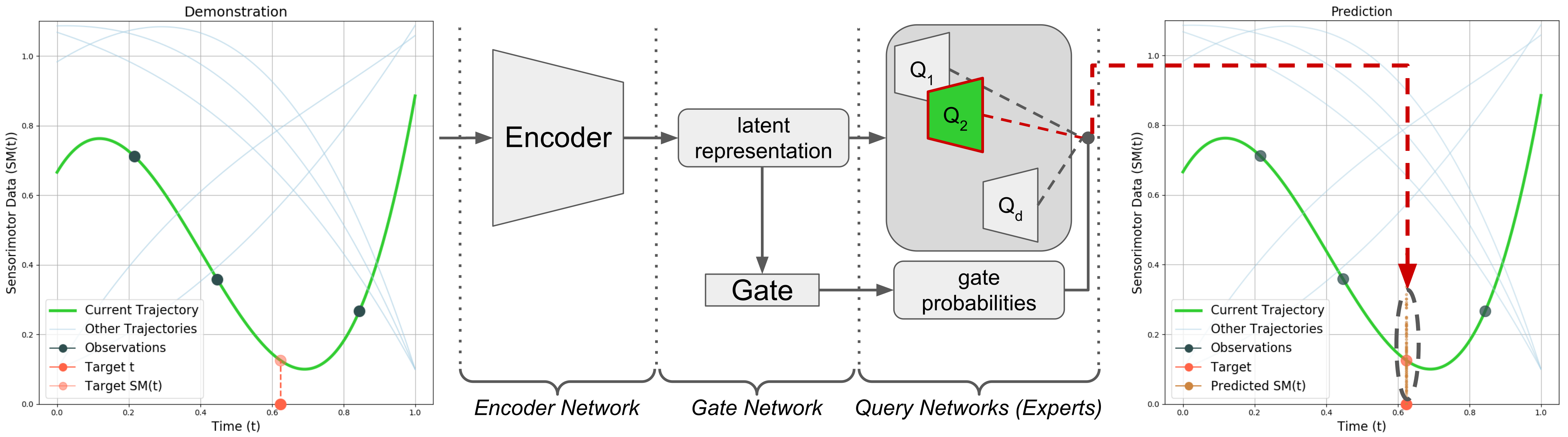
核心思路:CNEP框架通过利用潜在空间中的信息,将不同模式的示范分配给不同的专家网络,避免了对轨迹模式的监督需求,从而提高了学习的灵活性和准确性。
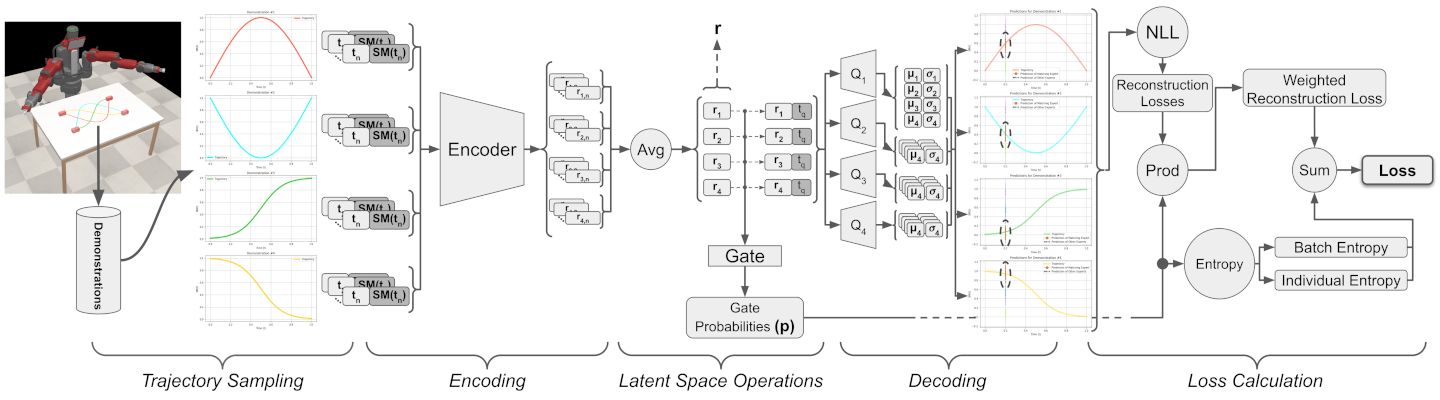
技术框架:CNEP的整体架构包括多个专家网络,每个网络负责处理特定模式的示范。系统通过潜在空间的编码表示来匹配示范与专家,形成一个动态适应的学习过程。
关键创新:CNEP的核心创新在于其无监督的专家选择机制,能够根据示范的特征自动选择合适的专家网络,与传统方法相比,显著提升了多模态轨迹的建模能力。
关键设计:在设计上,CNEP采用了特定的损失函数来优化专家选择的准确性,并通过网络结构的灵活性来适应不同的环境条件,确保在实时任务中能够快速适应变化。
🖼️ 关键图片

📊 实验亮点
实验结果显示,CNEP在多模态轨迹数据集上相较于高斯混合模型、概率运动原型和稳定运动原型等基线方法,表现出更优的建模性能,特别是在复杂任务中,合成的轨迹更准确地反映了专家示范,提升幅度显著。
🎯 应用场景
该研究的潜在应用领域包括机器人操作、自动化生产线和人机协作等场景。CNEP能够有效学习和执行复杂的多模态运动轨迹,提升机器人在动态环境中的适应能力,具有重要的实际价值和未来影响。
📄 摘要(原文)
Learning from Demonstration (LfD) is a widely used technique for skill acquisition in robotics. However, demonstrations of the same skill may exhibit significant variances, or learning systems may attempt to acquire different means of the same skill simultaneously, making it challenging to encode these motions into movement primitives. To address these challenges, we propose an LfD framework, namely the Conditional Neural Expert Processes (CNEP), that learns to assign demonstrations from different modes to distinct expert networks utilizing the inherent information within the latent space to match experts with the encoded representations. CNEP does not require supervision on which mode the trajectories belong to. We compare the performance of CNEP against widely used and powerful LfD methods such as Gaussian Mixture Models, Probabilistic Movement Primitives, and Stable Movement Primitives and show that our method outperforms these baselines on multimodal trajectory datasets. The results reveal enhanced modeling performance for movement primitives, leading to the synthesis of trajectories that more accurately reflect those demonstrated by experts, particularly when the skill demonstrations include intersection points from various trajectories. We evaluated the CNEP model on two real-robot tasks, namely obstacle avoidance and pick-and-place tasks, that require the robot to learn multi-modal motion trajectories and execute the correct primitives given target environment conditions. We also showed that our system is capable of on-the-fly adaptation to environmental changes via an online conditioning mechanism. Lastly, we believe that CNEP offers improved explainability and interpretability by autonomously finding discrete behavior primitives and providing probability values about its expert selection decisions.