Language-Based Augmentation to Address Shortcut Learning in Object Goal Navigation
作者: Dennis Hoftijzer, Gertjan Burghouts, Luuk Spreeuwers
分类: cs.RO, cs.CV
发布日期: 2024-02-07
备注: 8 pages, 6 figures, to be published in IEEE IRC 2023
💡 一句话要点
提出语言增强方法以解决目标导航中的快捷学习问题
🎯 匹配领域: 支柱二:RL算法与架构 (RL & Architecture) 支柱九:具身大模型 (Embodied Foundation Models)
关键词: 目标导航 深度强化学习 快捷学习 多模态特征 语言增强 机器人导航 视觉-语言模型
📋 核心要点
- 现有的深度强化学习方法在目标导航任务中存在快捷学习问题,导致模型对训练环境的泛化能力不足。
- 论文提出了一种基于语言的增强方法,通过利用视觉-语言模型的多模态特征空间来增强视觉表示,避免了对模拟器的修改。
- 实验结果显示,提出的方法在环境变化下的成功率下降幅度显著低于现有最先进方法,提升了模型的泛化能力。
📝 摘要(中文)
深度强化学习(DRL)在机器人目标导航任务中展现出巨大潜力,但现有方法容易受到训练环境偏差的影响,导致快捷学习现象。本文通过实验验证了这一问题,发现代理通过寻找目标房间的特定墙面颜色来进行导航,导致泛化能力差。为了解决这一问题,提出了一种基于语言的增强方法,利用多模态特征空间直接增强视觉表示,显著提高了在不同环境中的导航成功率。实验结果表明,提出的方法在环境变化时的成功率下降仅为23%,而现有方法下降高达69%。
🔬 方法详解
问题定义:本文旨在解决目标导航任务中的快捷学习问题,现有方法在特定视觉细节上过度拟合,导致在新环境中的表现不佳。
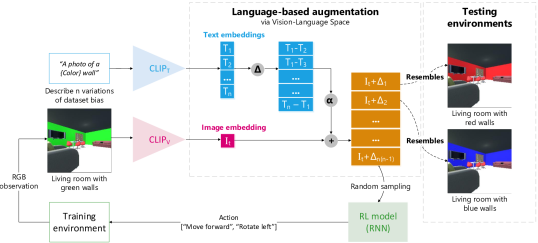
核心思路:通过引入基于语言的增强方法,利用视觉-语言模型的多模态特征空间,直接在特征层面增强视觉表示,避免对训练环境的依赖。
技术框架:整体架构包括一个视觉-语言模型,新增一层用于特征增强,模型在训练过程中结合语言信息来提升视觉特征的泛化能力。
关键创新:最重要的创新在于通过语言信息增强视觉特征,显著降低了因环境变化导致的性能下降,与现有方法相比,提供了更强的泛化能力。
关键设计:在模型设计中,关键参数包括特征增强层的设置,损失函数的选择,以及如何有效整合语言信息与视觉信息以提升模型性能。通过这些设计,模型能够在不同环境中保持较高的导航成功率。
🖼️ 关键图片
📊 实验亮点
实验结果显示,现有最先进的目标导航方法在环境变化时的成功率下降达69%,而本文提出的基于语言的增强方法仅下降23%。这一显著的性能提升表明,所提方法在解决快捷学习问题上具有重要的实际价值。
🎯 应用场景
该研究的潜在应用领域包括家庭服务机器人、教育机器人等场景,能够帮助机器人在复杂环境中更好地定位和导航。通过提升模型的泛化能力,未来可扩展到更多实际应用中,增强机器人在动态环境中的适应性和智能化水平。
📄 摘要(原文)
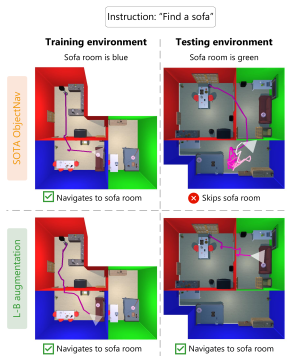
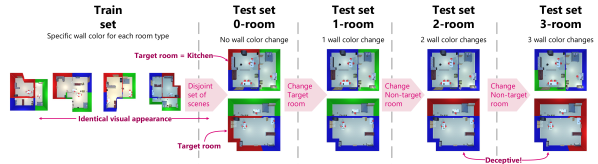
Deep Reinforcement Learning (DRL) has shown great potential in enabling robots to find certain objects (e.g., `find a fridge') in environments like homes or schools. This task is known as Object-Goal Navigation (ObjectNav). DRL methods are predominantly trained and evaluated using environment simulators. Although DRL has shown impressive results, the simulators may be biased or limited. This creates a risk of shortcut learning, i.e., learning a policy tailored to specific visual details of training environments. We aim to deepen our understanding of shortcut learning in ObjectNav, its implications and propose a solution. We design an experiment for inserting a shortcut bias in the appearance of training environments. As a proof-of-concept, we associate room types to specific wall colors (e.g., bedrooms with green walls), and observe poor generalization of a state-of-the-art (SOTA) ObjectNav method to environments where this is not the case (e.g., bedrooms with blue walls). We find that shortcut learning is the root cause: the agent learns to navigate to target objects, by simply searching for the associated wall color of the target object's room. To solve this, we propose Language-Based (L-B) augmentation. Our key insight is that we can leverage the multimodal feature space of a Vision-Language Model (VLM) to augment visual representations directly at the feature-level, requiring no changes to the simulator, and only an addition of one layer to the model. Where the SOTA ObjectNav method's success rate drops 69%, our proposal has only a drop of 23%.