FRENETIX: A High-Performance and Modular Motion Planning Framework for Autonomous Driving
作者: Rainer Trauth, Korbinian Moller, Gerald Wuersching, Johannes Betz
分类: cs.RO
发布日期: 2024-02-02 (更新: 2024-06-14)
备注: Submitted to IEEE ACCESS
DOI: 10.1109/ACCESS.2024.3436835
🔗 代码/项目: GITHUB
💡 一句话要点
提出FRENETIX框架以解决自主驾驶路径规划问题
🎯 匹配领域: 支柱一:机器人控制 (Robot Control)
关键词: 自主驾驶 路径规划 运动规划 多目标优化 模块化设计 复杂环境 轨迹采样 算法性能
📋 核心要点
- 现有的路径规划方法在复杂环境中面临解空间构建和优化的挑战,导致计算效率低下和成功率不高。
- FRENETIX框架通过模块化设计和基于采样的轨迹规划算法,采用多目标优化策略,提升了路径规划的效率和可靠性。
- 实验结果表明,该算法在复杂场景中具有88%的成功率,且计算时间仅为8毫秒,展示了其在真实应用中的潜力。
📝 摘要(中文)
本研究介绍了一种模块化的自主驾驶运动规划框架FRENETIX,采用基于采样的轨迹规划算法,有效应对路径规划中的解空间构建和优化挑战。该算法适用于真实车辆和模拟环境,提供了复杂自主导航的稳健解决方案。我们的方法采用多目标优化策略,旨在优化静态和高度动态环境中的轨迹舒适性、安全性和路径精度。通过在1750个复杂城市和高速公路场景中分析算法性能和成功率,结果显示在800条轨迹的情况下计算时间为8毫秒,复杂场景中的成功率高达88%,并且不同模块的适应性强。我们还在真实车辆上集成并执行了该框架,评估了与控制器的偏差,验证了算法的稳健性和可靠性,确保其满足现实世界自主驾驶场景的严格要求。
🔬 方法详解
问题定义:本研究旨在解决自主驾驶中的路径规划问题,尤其是在复杂环境下现有方法的效率低下和成功率不足的痛点。
核心思路:FRENETIX框架采用模块化设计,结合基于采样的轨迹规划算法,通过多目标优化策略来提升路径规划的舒适性、安全性和精度。
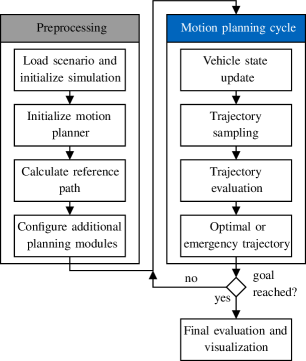
技术框架:该框架包括多个模块,主要流程为轨迹采样、可行性检查和成本评估,能够快速处理大量轨迹并优化路径。
关键创新:最重要的创新在于快速的轨迹采样和成本评估步骤,使得算法在处理复杂场景时表现出色,显著提高了计算效率和成功率。
关键设计:在参数设置上,算法优化了多目标损失函数,确保在不同环境下的适应性,同时通过模块化设计使得各个部分可以灵活替换和组合。
🖼️ 关键图片


📊 实验亮点
实验结果显示,FRENETIX在1750个复杂场景中的成功率达到88%,计算时间仅为8毫秒,表现出优于现有方法的显著提升。该框架的模块化设计使得不同模块的适应性强,能够快速应对多变的环境需求。
🎯 应用场景
FRENETIX框架具有广泛的应用潜力,特别是在城市交通、自动驾驶汽车和智能交通系统中。其高效的路径规划能力能够提升自动驾驶车辆在复杂环境中的导航性能,未来可能对智能交通管理和自动驾驶技术的发展产生深远影响。
📄 摘要(原文)
Our research introduces a modular motion planning framework for autonomous vehicles using a sampling-based trajectory planning algorithm. This approach effectively tackles the challenges of solution space construction and optimization in path planning. The algorithm is applicable to both real vehicles and simulations, offering a robust solution for complex autonomous navigation. Our method employs a multi-objective optimization strategy for efficient navigation in static and highly dynamic environments, focusing on optimizing trajectory comfort, safety, and path precision. The algorithm is used to analyze the algorithm performance and success rate in 1750 virtual complex urban and highway scenarios. Our results demonstrate fast calculation times (8ms for 800 trajectories), a high success rate in complex scenarios (88%), and easy adaptability with different modules presented. The most noticeable difference exhibited was the fast trajectory sampling, feasibility check, and cost evaluation step across various trajectory counts. We demonstrate the integration and execution of the framework on real vehicles by evaluating deviations from the controller using a test track. This evaluation highlights the algorithm's robustness and reliability, ensuring it meets the stringent requirements of real-world autonomous driving scenarios. The code and the additional modules used in this research are publicly available as open-source software and can be accessed at the following link: https://github.com/TUM-AVS/Frenetix-Motion-Planner.