Neural Trajectory Model: Implicit Neural Trajectory Representation for Trajectories Generation
作者: Zihan Yu, Yuqing Tang
分类: cs.RO
发布日期: 2024-02-02 (更新: 2024-02-11)
🔗 代码/项目: GITHUB
💡 一句话要点
提出神经轨迹模型以解决复杂环境中的轨迹规划问题
🎯 匹配领域: 支柱一:机器人控制 (Robot Control) 支柱三:空间感知与语义 (Perception & Semantics)
关键词: 轨迹规划 神经网络 多智能体系统 隐式表示 机器人导航 运动规划
📋 核心要点
- 现有轨迹规划方法在处理复杂环境时面临计算复杂性和实时性要求的挑战,尤其是在多智能体交互的情况下。
- 本文提出神经轨迹模型(NTM),将轨迹规划问题转化为对隐式神经表示的查询,从而高效生成近似最优轨迹。
- 实验表明,NTM在规划时间、环境碰撞和智能体间碰撞的避免率以及路径长度上均有显著提升,表现出色。
📝 摘要(中文)
轨迹规划是机器人领域的基本问题,涉及导航、运动规划、控制和多智能体协调等广泛应用。由于计算复杂性和现实环境的不确定性、非线性以及实时要求,轨迹规划面临诸多挑战。现有方法多为基于搜索或优化的方案,假设环境简化,规划速度和可扩展性有限。本文首次将单智能体和多智能体轨迹规划问题重新表述为对隐式神经轨迹表示的查询问题,提出了神经轨迹模型(NTM),能够在复杂环境中生成近似最优轨迹。实验结果表明,NTM在单智能体和多智能体轨迹规划中表现出色,具有亚毫秒的规划时间、几乎避免所有环境碰撞和智能体间碰撞,并生成几乎最短路径。
🔬 方法详解
问题定义:本文旨在解决复杂环境中的单智能体和多智能体轨迹规划问题。现有方法多依赖于搜索或优化,假设环境简化,导致规划速度慢且难以扩展到更多智能体。
核心思路:论文提出的神经轨迹模型(NTM)通过隐式神经表示来处理轨迹规划问题,允许对复杂环境进行高效查询,从而生成近似最优的轨迹。这样的设计使得模型能够在动态和不确定的环境中快速适应。
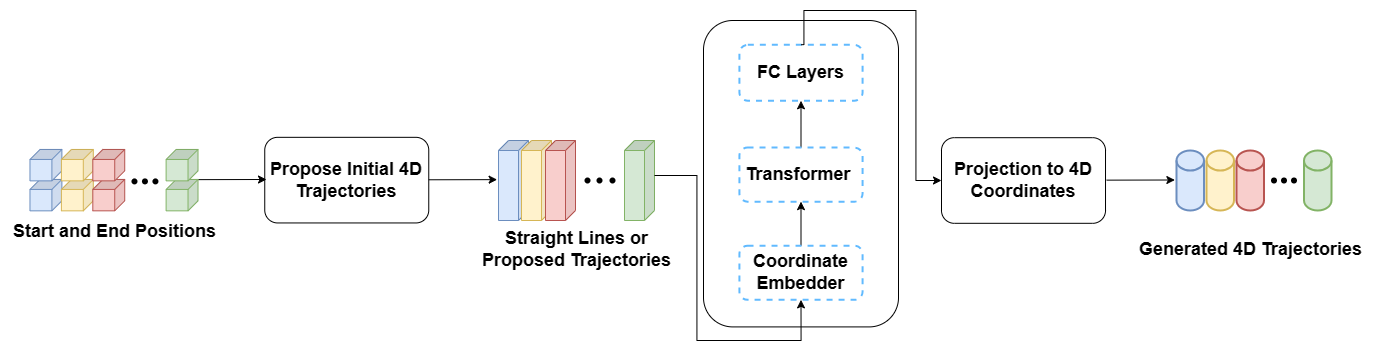
技术框架:NTM的整体架构包括数据输入、隐式神经表示的构建、轨迹查询和生成模块。首先,输入环境信息,然后通过神经网络生成隐式轨迹表示,最后进行轨迹查询以生成最终轨迹。
关键创新:NTM的主要创新在于将轨迹规划问题转化为查询问题,利用隐式神经表示来提高规划效率和准确性。这一方法与传统的基于搜索或优化的方案有本质区别,能够处理更复杂的环境和多智能体交互。
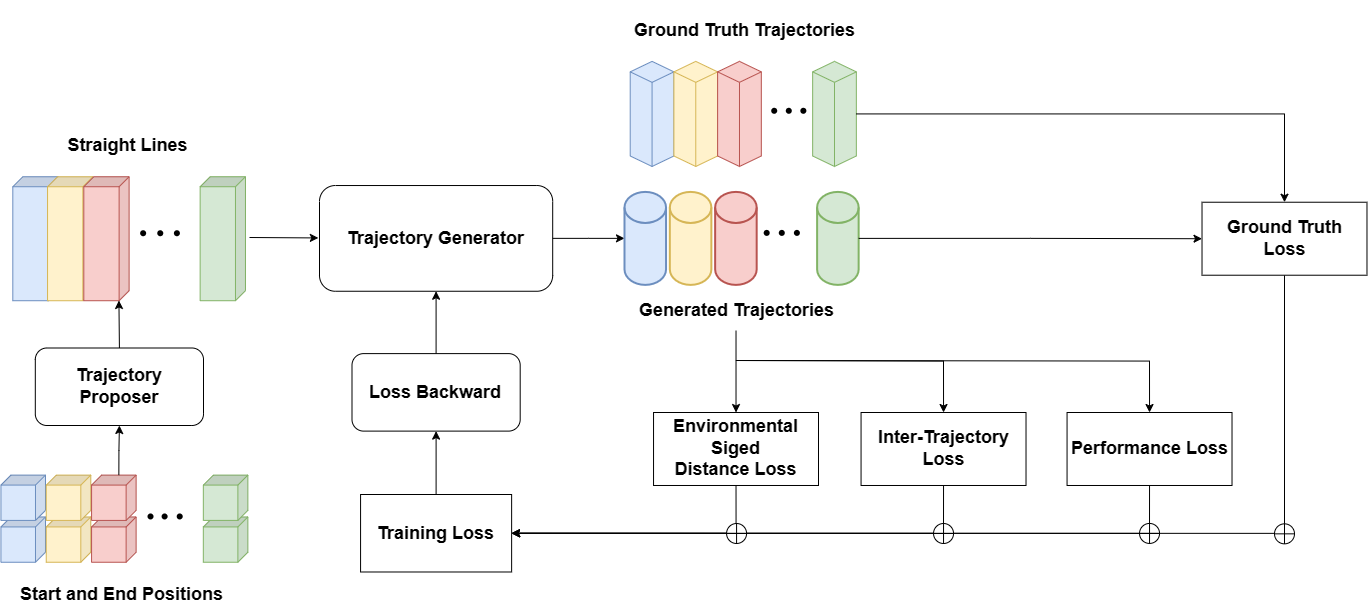
关键设计:在模型设计中,采用了特定的损失函数以优化轨迹生成的质量,并通过调整神经网络的结构和参数设置来提高模型的性能。
🖼️ 关键图片
📊 实验亮点
实验结果显示,NTM在GPU上实现了亚毫秒的规划时间,几乎避免了所有环境碰撞和智能体间碰撞,并生成了接近最短的路径。这些结果表明NTM在复杂环境中的有效性和高效性。
🎯 应用场景
该研究的潜在应用领域包括自动驾驶、无人机导航和机器人协作等。通过高效的轨迹规划,能够显著提升这些领域中智能体的导航能力和协作效率,具有重要的实际价值和未来影响。
📄 摘要(原文)
Trajectory planning is a fundamental problem in robotics. It facilitates a wide range of applications in navigation and motion planning, control, and multi-agent coordination. Trajectory planning is a difficult problem due to its computational complexity and real-world environment complexity with uncertainty, non-linearity, and real-time requirements. The multi-agent trajectory planning problem adds another dimension of difficulty due to inter-agent interaction. Existing solutions are either search-based or optimization-based approaches with simplified assumptions of environment, limited planning speed, and limited scalability in the number of agents. In this work, we make the first attempt to reformulate single agent and multi-agent trajectory planning problem as query problems over an implicit neural representation of trajectories. We formulate such implicit representation as Neural Trajectory Models (NTM) which can be queried to generate nearly optimal trajectory in complex environments. We conduct experiments in simulation environments and demonstrate that NTM can solve single-agent and multi-agent trajectory planning problems. In the experiments, NTMs achieve (1) sub-millisecond panning time using GPUs, (2) almost avoiding all environment collision, (3) almost avoiding all inter-agent collision, and (4) generating almost shortest paths. We also demonstrate that the same NTM framework can also be used for trajectories correction and multi-trajectory conflict resolution refining low quality and conflicting multi-agent trajectories into nearly optimal solutions efficiently. (Open source code will be available at https://github.com/laser2099/neural-trajectory-model)