Reinforcement Learning for Versatile, Dynamic, and Robust Bipedal Locomotion Control
作者: Zhongyu Li, Xue Bin Peng, Pieter Abbeel, Sergey Levine, Glen Berseth, Koushil Sreenath
分类: cs.RO, cs.AI, eess.SY
发布日期: 2024-01-30 (更新: 2024-08-26)
备注: Accepted in International Journal of Robotics Research (IJRR) 2024. This is the author's version and will no longer be updated as the copyright may get transferred at anytime
💡 一句话要点
提出深度强化学习以实现多样化、动态且鲁棒的双足机器人运动控制
🎯 匹配领域: 支柱一:机器人控制 (Robot Control) 支柱二:RL算法与架构 (RL & Architecture)
关键词: 深度强化学习 双足机器人 动态控制 运动技能 鲁棒性 适应性 人形机器人
📋 核心要点
- 现有的双足机器人控制方法往往专注于单一运动技能,缺乏通用性和适应性。
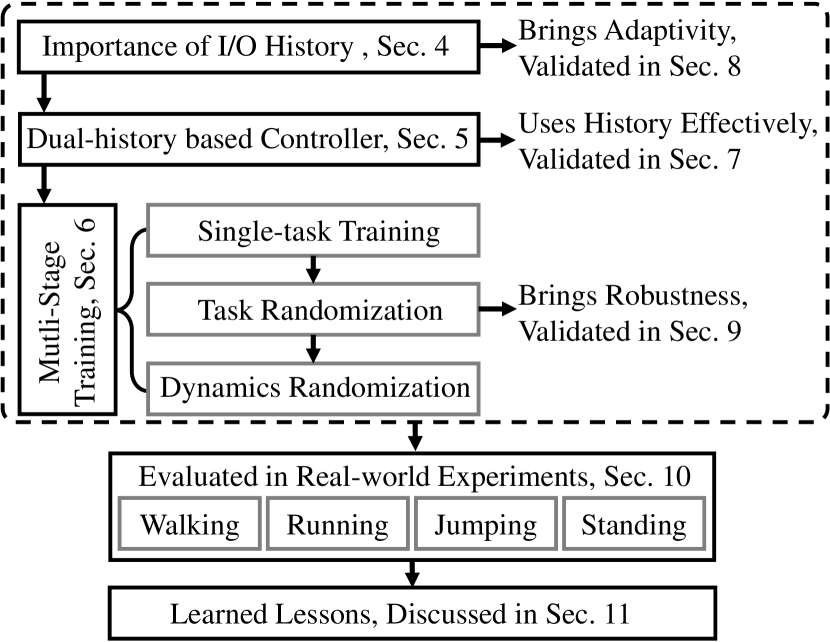
- 本文提出了一种基于深度强化学习的双历史架构控制器,能够处理多种动态运动技能。
- 实验结果表明,该控制器在多种技能上均优于现有方法,尤其在真实环境中表现出色。
📝 摘要(中文)
本文全面研究了利用深度强化学习(RL)为双足机器人创建动态运动控制器。我们开发了一种通用控制解决方案,能够支持多种动态双足技能,包括周期性行走、奔跑以及非周期性跳跃和站立。该RL控制器采用了一种新颖的双历史架构,利用机器人的长短期输入/输出(I/O)历史。经过端到端的RL训练,该控制架构在多种技能上表现优于其他方法,展现了适应性和鲁棒性,能够应对时间不变的动态变化和时间变化的接触事件。最终,该控制策略成功应用于人形双足机器人Cassie,推动了双足机器人的灵活性极限。
🔬 方法详解
问题定义:本文旨在解决现有双足机器人控制方法在多样化运动技能上的局限性,现有方法通常专注于单一技能,缺乏适应性和鲁棒性。
核心思路:提出了一种基于深度强化学习的控制器,采用双历史架构,结合长短期I/O历史,以增强控制的灵活性和适应性。
技术框架:整体架构包括输入模块(接收传感器数据)、双历史存储(记录长短期历史)、强化学习训练模块(优化控制策略)和输出模块(生成控制指令)。
关键创新:最重要的创新在于双历史架构的设计,使得控制器能够有效利用历史信息,从而在动态环境中表现出更好的适应性和鲁棒性。
关键设计:在网络结构上,采用了深度神经网络,并设计了特定的损失函数以优化控制策略,同时进行了任务随机化以增强模型的泛化能力。
🖼️ 关键图片


📊 实验亮点
实验结果显示,所提出的控制器在多种运动技能上均优于现有基线方法,尤其在真实环境中表现出色。例如,在400米冲刺测试中,机器人展现了快速奔跑能力,且在跳跃技能上表现出多样性和鲁棒性。
🎯 应用场景
该研究的潜在应用领域包括服务机器人、救援机器人以及人形机器人等,能够在复杂和动态的环境中执行多种任务。其实际价值在于提升机器人在真实世界中的适应能力和灵活性,未来可能推动人机协作的进步。
📄 摘要(原文)
This paper presents a comprehensive study on using deep reinforcement learning (RL) to create dynamic locomotion controllers for bipedal robots. Going beyond focusing on a single locomotion skill, we develop a general control solution that can be used for a range of dynamic bipedal skills, from periodic walking and running to aperiodic jumping and standing. Our RL-based controller incorporates a novel dual-history architecture, utilizing both a long-term and short-term input/output (I/O) history of the robot. This control architecture, when trained through the proposed end-to-end RL approach, consistently outperforms other methods across a diverse range of skills in both simulation and the real world. The study also delves into the adaptivity and robustness introduced by the proposed RL system in developing locomotion controllers. We demonstrate that the proposed architecture can adapt to both time-invariant dynamics shifts and time-variant changes, such as contact events, by effectively using the robot's I/O history. Additionally, we identify task randomization as another key source of robustness, fostering better task generalization and compliance to disturbances. The resulting control policies can be successfully deployed on Cassie, a torque-controlled human-sized bipedal robot. This work pushes the limits of agility for bipedal robots through extensive real-world experiments. We demonstrate a diverse range of locomotion skills, including: robust standing, versatile walking, fast running with a demonstration of a 400-meter dash, and a diverse set of jumping skills, such as standing long jumps and high jumps.