TraKDis: A Transformer-based Knowledge Distillation Approach for Visual Reinforcement Learning with Application to Cloth Manipulation
作者: Wei Chen, Nicolas Rojas
分类: cs.RO
发布日期: 2024-01-24
备注: Accepted for IEEE Robotics and Automation Letters in January 2024
💡 一句话要点
提出TraKDis以解决视觉强化学习中的布料操控问题
🎯 匹配领域: 支柱一:机器人控制 (Robot Control) 支柱二:RL算法与架构 (RL & Architecture)
关键词: 视觉强化学习 知识蒸馏 布料操控 机器人技术 Transformer 鲁棒性 状态估计
📋 核心要点
- 现有方法在处理布料操控时面临复杂动态和高维状态的问题,影响了实际应用效果。
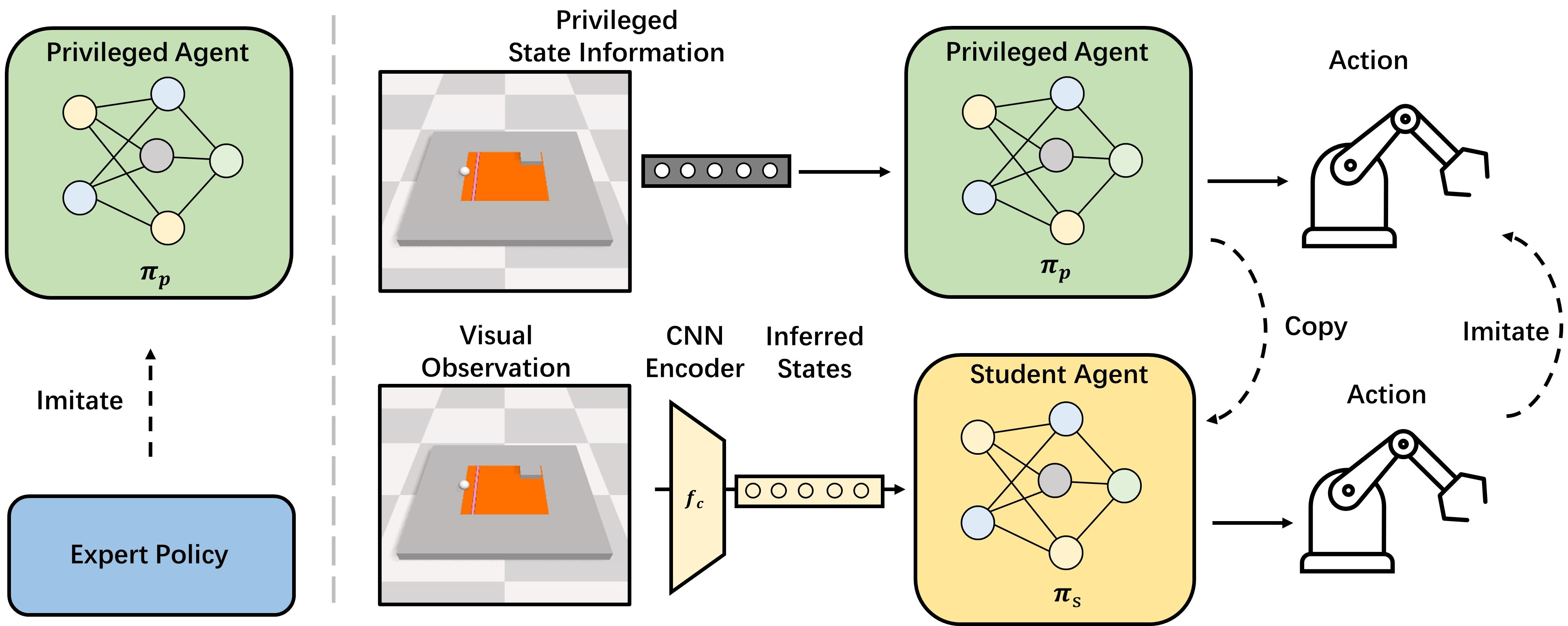
- 本文提出TraKDis,通过特权代理和知识蒸馏的两阶段方法,提升视觉强化学习的效果。
- 实验结果显示,TraKDis在布料折叠任务中性能提升显著,并能在噪声环境中保持鲁棒性。
📝 摘要(中文)
通过基于视觉反馈的强化学习来处理机器人布料操控是一个具有吸引力的方向,因为机器人感知与控制可以同时学习。然而,由于布料的复杂动态和相应状态的高维性,这一想法的实际应用面临重大挑战。为了解决这些问题,本文提出了TraKDis,一种新颖的基于Transformer的知识蒸馏方法,将视觉强化学习问题分解为两个不同阶段。在第一个阶段,训练一个拥有完整布料状态信息的特权代理,该代理作为教师,为后续阶段提供有价值的指导和训练信号。第二个阶段涉及知识蒸馏过程,将特权代理获得的知识通过利用预训练的状态估计和权重初始化转移到基于视觉的代理。TraKDis在与最先进的强化学习技术比较时表现更佳,在模拟中的布料折叠任务中性能提升分别为21.9%、13.8%和8.3%。此外,为验证其鲁棒性,我们在噪声环境中评估了该代理,结果表明其能够有效处理和适应环境的不确定性。还进行了真实机器人实验,以展示我们方法在现实场景中的效率。
🔬 方法详解
问题定义:本文旨在解决机器人在布料操控中面临的复杂动态和高维状态问题,现有方法在这方面的表现不足,难以实现有效的学习和控制。
核心思路:TraKDis的核心思路是通过训练一个特权代理来获取完整的布料状态信息,并将其知识蒸馏到基于视觉的代理中,从而提升后者的学习效率和控制能力。
技术框架:该方法分为两个主要阶段:第一阶段训练特权代理,第二阶段进行知识蒸馏。特权代理提供指导信号,帮助视觉代理更好地学习。
关键创新:TraKDis的创新在于将知识蒸馏与视觉强化学习相结合,利用特权代理的完整信息来提升视觉代理的性能,这在现有方法中尚属首次。
关键设计:在设计中,特权代理使用完整的状态信息进行训练,而视觉代理则依赖于预训练的状态估计和权重初始化,确保知识的有效转移。
🖼️ 关键图片


📊 实验亮点
TraKDis在布料折叠任务中相较于最先进的强化学习技术,性能分别提升21.9%、13.8%和8.3%。在噪声环境中,代理表现出良好的适应能力,证明了其鲁棒性。此外,真实机器人实验进一步验证了方法的有效性。
🎯 应用场景
该研究的潜在应用领域包括机器人布料操控、智能家居和自动化生产线等。通过提升机器人在复杂环境中的操作能力,TraKDis能够在实际场景中实现更高效的布料处理,具有重要的实际价值和广泛的应用前景。
📄 摘要(原文)
Approaching robotic cloth manipulation using reinforcement learning based on visual feedback is appealing as robot perception and control can be learned simultaneously. However, major challenges result due to the intricate dynamics of cloth and the high dimensionality of the corresponding states, what shadows the practicality of the idea. To tackle these issues, we propose TraKDis, a novel Transformer-based Knowledge Distillation approach that decomposes the visual reinforcement learning problem into two distinct stages. In the first stage, a privileged agent is trained, which possesses complete knowledge of the cloth state information. This privileged agent acts as a teacher, providing valuable guidance and training signals for subsequent stages. The second stage involves a knowledge distillation procedure, where the knowledge acquired by the privileged agent is transferred to a vision-based agent by leveraging pre-trained state estimation and weight initialization. TraKDis demonstrates better performance when compared to state-of-the-art RL techniques, showing a higher performance of 21.9%, 13.8%, and 8.3% in cloth folding tasks in simulation. Furthermore, to validate robustness, we evaluate the agent in a noisy environment; the results indicate its ability to handle and adapt to environmental uncertainties effectively. Real robot experiments are also conducted to showcase the efficiency of our method in real-world scenarios.