Back-stepping Experience Replay with Application to Model-free Reinforcement Learning for a Soft Snake Robot
作者: Xinda Qi, Dong Chen, Zhaojian Li, Xiaobo Tan
分类: cs.RO, cs.LG
发布日期: 2024-01-21 (更新: 2024-09-23)
备注: This paper has been published on IEEE Robotics and Automation Letters. Digital Object Identifier 10.1109/LRA.2024.3427550
💡 一句话要点
提出反向经验重放技术以提升软蛇机器人强化学习效率
🎯 匹配领域: 支柱一:机器人控制 (Robot Control) 支柱二:RL算法与架构 (RL & Architecture)
关键词: 反向经验重放 强化学习 软机器人 运动导航 蒸馏技术
📋 核心要点
- 现有强化学习方法在处理近似可逆系统时效率低下,且复杂的奖励塑造增加了学习的难度。
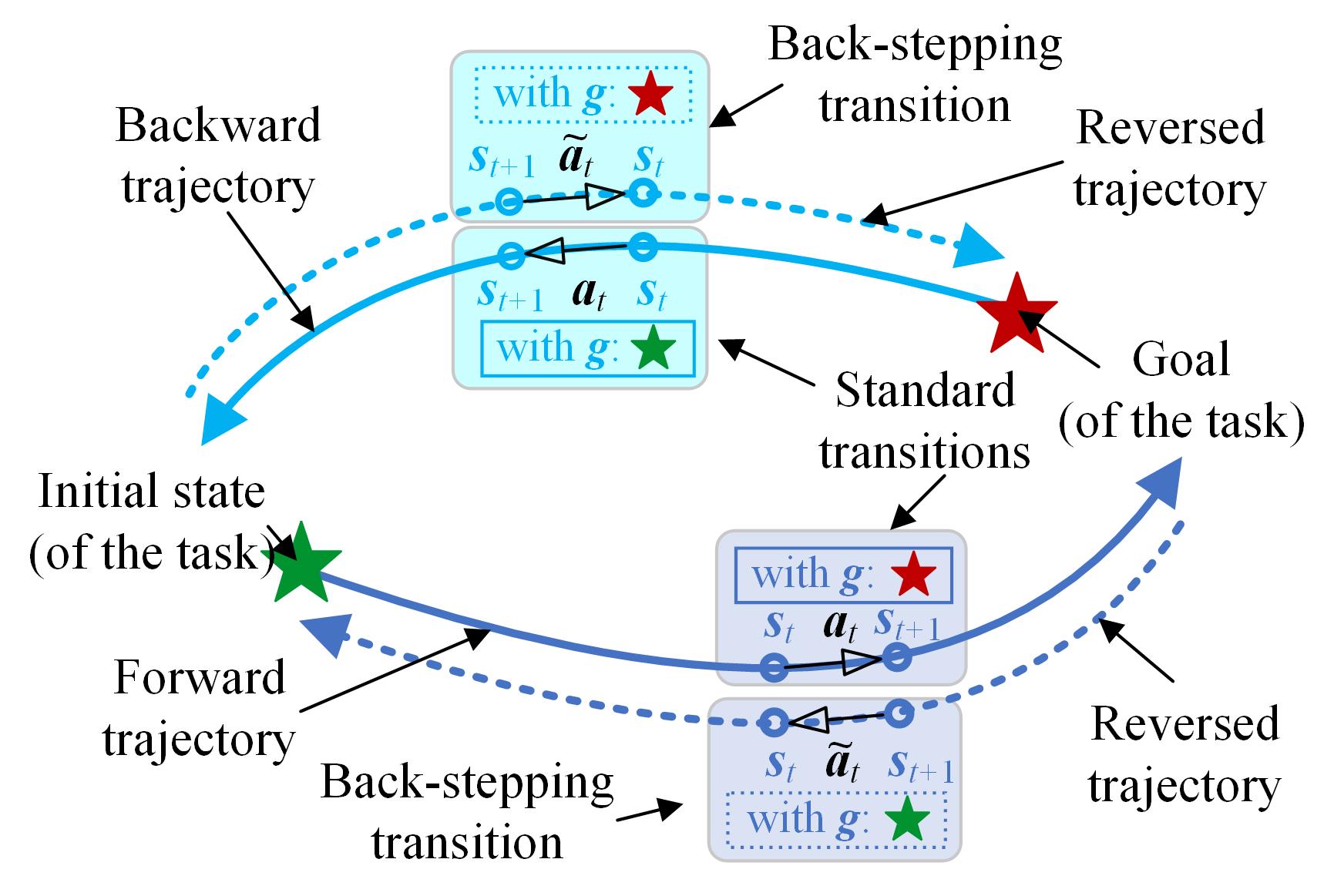
- 反向经验重放(BER)通过构建反向轨迹和蒸馏重放经验,提升了学习效率,减少了对复杂奖励的依赖。
- 实验结果表明,软蛇机器人在应用BER后成功率达到100%,且其平均速度比最佳基线快48%。
📝 摘要(中文)
本文提出了一种新颖的技术——反向经验重放(BER),该技术兼容任意离线强化学习算法。BER旨在提高近似可逆系统的学习效率,减少复杂奖励塑造的需求。该方法通过反向过渡构建反向轨迹,以达到随机或固定目标。BER被解释为一种双向方法,通过在学习过程中对重放经验进行蒸馏,解决了反向过渡的不准确性。针对软机器人复杂的环境交互,本文展示了BER在无模型强化学习中的应用,成功实现软蛇机器人的运动和导航,机器人在学习过程中达到100%的成功率,且平均速度比最佳基线方法快48%。
🔬 方法详解
问题定义:本文解决了在近似可逆系统中强化学习效率低下的问题,现有方法在复杂环境中难以有效学习。
核心思路:反向经验重放(BER)通过反向过渡构建轨迹,利用蒸馏技术优化重放经验,从而提高学习效率。
技术框架:BER的整体架构包括反向过渡生成模块、重放经验蒸馏模块和目标达成模块,形成一个完整的学习流程。
关键创新:BER的主要创新在于其双向学习机制,通过反向轨迹的构建和经验蒸馏,显著提升了学习的准确性和效率。
关键设计:在BER中,关键设计包括反向过渡的选择策略、蒸馏过程中的损失函数设置,以及适用于软蛇机器人的网络结构设计。
🖼️ 关键图片


📊 实验亮点
实验结果显示,软蛇机器人在应用BER后成功率达到了100%,并且其平均速度比最佳基线方法快48%。这一显著提升证明了BER在复杂环境中强化学习的有效性。
🎯 应用场景
该研究的潜在应用领域包括软机器人控制、自动化导航和复杂环境中的任务执行。BER技术的有效性为未来的机器人学习和自主系统提供了新的思路,具有重要的实际价值和广泛的应用前景。
📄 摘要(原文)
In this paper, we propose a novel technique, Back-stepping Experience Replay (BER), that is compatible with arbitrary off-policy reinforcement learning (RL) algorithms. BER aims to enhance learning efficiency in systems with approximate reversibility, reducing the need for complex reward shaping. The method constructs reversed trajectories using back-stepping transitions to reach random or fixed targets. Interpretable as a bi-directional approach, BER addresses inaccuracies in back-stepping transitions through a distillation of the replay experience during learning. Given the intricate nature of soft robots and their complex interactions with environments, we present an application of BER in a model-free RL approach for the locomotion and navigation of a soft snake robot, which is capable of serpentine motion enabled by anisotropic friction between the body and ground. In addition, a dynamic simulator is developed to assess the effectiveness and efficiency of the BER algorithm, in which the robot demonstrates successful learning (reaching a 100% success rate) and adeptly reaches random targets, achieving an average speed 48% faster than that of the best baseline approach.