Design and trajectory tracking control of CuRobot: A Cubic Reversible Robot
作者: Kai Yang, Jiahui Wang, Yuchen Weng, Baolei Wu, Fuqiang Li, Jihong Zhu, Jun Wang
分类: cs.RO
发布日期: 2023-11-28
💡 一句话要点
提出CuRobot以解决机器人翻转后功能恢复问题
🎯 匹配领域: 支柱一:机器人控制 (Robot Control)
关键词: 全向移动机器人 轨迹跟踪 模型预测控制 运动学模型 自动化技术 机器人设计 翻转恢复 野外应用
📋 核心要点
- 现有的机器人在翻转后常常需要人工干预,导致操作效率低下,影响其在复杂环境中的应用。
- 本文提出了一种立方体结构的全向移动机器人CuRobot,能够在翻转后继续进行全向移动,减少人工干预需求。
- 通过仿真和原型实验,验证了CuRobot在轨迹跟踪和翻转后持续移动方面的优越性能,显著提高了操作效率。
📝 摘要(中文)
在野外环境中,许多机器人在翻转后需要人工干预才能恢复功能,导致操作效率降低。本研究提出了一种创新的可逆全向移动机器人CuRobot,采用立方体结构,能够在翻转后持续进行全向移动。通过在立方体的八个顶点上安装锥形轮,确保无论哪个面接触地面,机器人都能保持一致的全向运动。此外,本文为CuRobot建立了运动学模型,并开发了基于模型预测控制的轨迹跟踪控制器。通过仿真实验,研究了轨迹跟踪精度与机器人运动方向之间的关系,并通过仿真和原型实验验证了机器人在翻转后持续移动的能力。这一设计减少了人工干预带来的低效,提高了机器人在野外环境中的操作鲁棒性。
🔬 方法详解
问题定义:本研究旨在解决现有机器人在翻转后需要人工干预才能恢复功能的问题。这种需求降低了机器人的操作效率,限制了其在复杂环境中的应用。
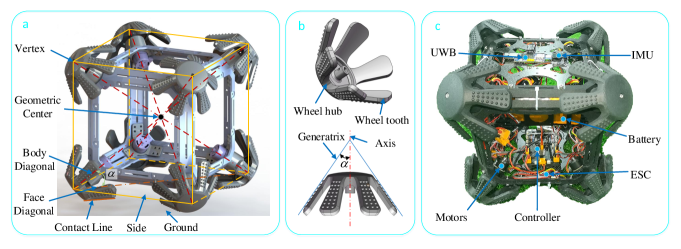
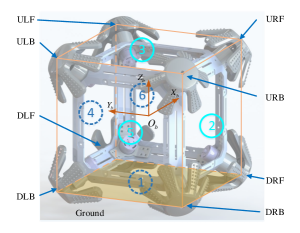
核心思路:CuRobot采用立方体结构设计,结合八个锥形轮的布局,使机器人在翻转后仍能保持全向移动能力,从而减少人工干预的必要性。
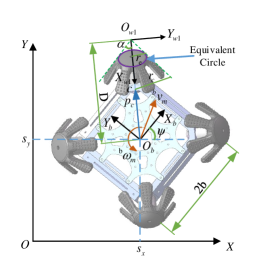
技术框架:整体架构包括运动学模型的建立和基于模型预测控制的轨迹跟踪控制器的开发。运动学模型用于描述机器人的运动特性,而控制器则负责实现精确的轨迹跟踪。
关键创新:CuRobot的设计创新在于其立方体结构和锥形轮的结合,使其在翻转后仍能有效运动。这一设计与传统机器人依赖于特定姿态的运动方式形成鲜明对比。
关键设计:在控制器设计中,采用了模型预测控制方法,以实现对机器人运动的精确控制。关键参数包括运动学模型的参数设置和控制器的优化策略,确保机器人在不同运动方向下的轨迹跟踪精度。
🖼️ 关键图片
📊 实验亮点
实验结果表明,CuRobot在不同运动方向下的轨迹跟踪精度显著提高,尤其是在翻转后,机器人能够保持稳定的全向移动能力。仿真和原型实验均验证了其在复杂环境中的优越性能,减少了人工干预的需求。
🎯 应用场景
CuRobot的设计具有广泛的应用潜力,尤其适用于需要在复杂和动态环境中自主移动的场景,如灾后救援、农业监测和工业自动化等领域。其翻转后持续移动的能力将显著提高机器人在实际应用中的效率和可靠性。
📄 摘要(原文)
In field environments, numerous robots necessitate manual intervention for restoration of functionality post a turnover, resulting in diminished operational efficiency. This study presents an innovative design solution for a reversible omnidirectional mobile robot denoted as CuRobot, featuring a cube structure, thereby facilitating uninterrupted omnidirectional movement even in the event of flipping. The incorporation of eight conical wheels at the cube vertices ensures consistent omnidirectional motion no matter which face of the cube contacts the ground. Additionally, a kinematic model is formulated for CuRobot, accompanied by the development of a trajectory tracking controller utilizing model predictive control. Through simulation experiments, the correlation between trajectory tracking accuracy and the robot's motion direction is examined. Furthermore, the robot's proficiency in omnidirectional mobility and sustained movement post-flipping is substantiated via both simulation and prototype experiments. This design reduces the inefficiencies associated with manual intervention, thereby increasing the operational robustness of robots in field environments.