Self-Contained Calibration of an Elastic Humanoid Upper Body Using Only a Head-Mounted RGB Camera
作者: Johannes Tenhumberg, Dominik Winkelbauer, Darius Burschka, Berthold Bäuml
分类: cs.RO
发布日期: 2023-11-14
期刊: 2022 IEEE-RAS International Conference on Humanoid Robots (Humanoids)
DOI: 10.1109/Humanoids53995.2022.10000184
💡 一句话要点
提出自包含的校准方法以解决人形机器人精确性问题
🎯 匹配领域: 支柱一:机器人控制 (Robot Control)
关键词: 人形机器人 自包含校准 视觉传感器 运动学树 精确性提升
📋 核心要点
- 现有方法依赖外部测量设备,导致校准过程复杂且耗时,限制了人形机器人在动态环境中的应用。
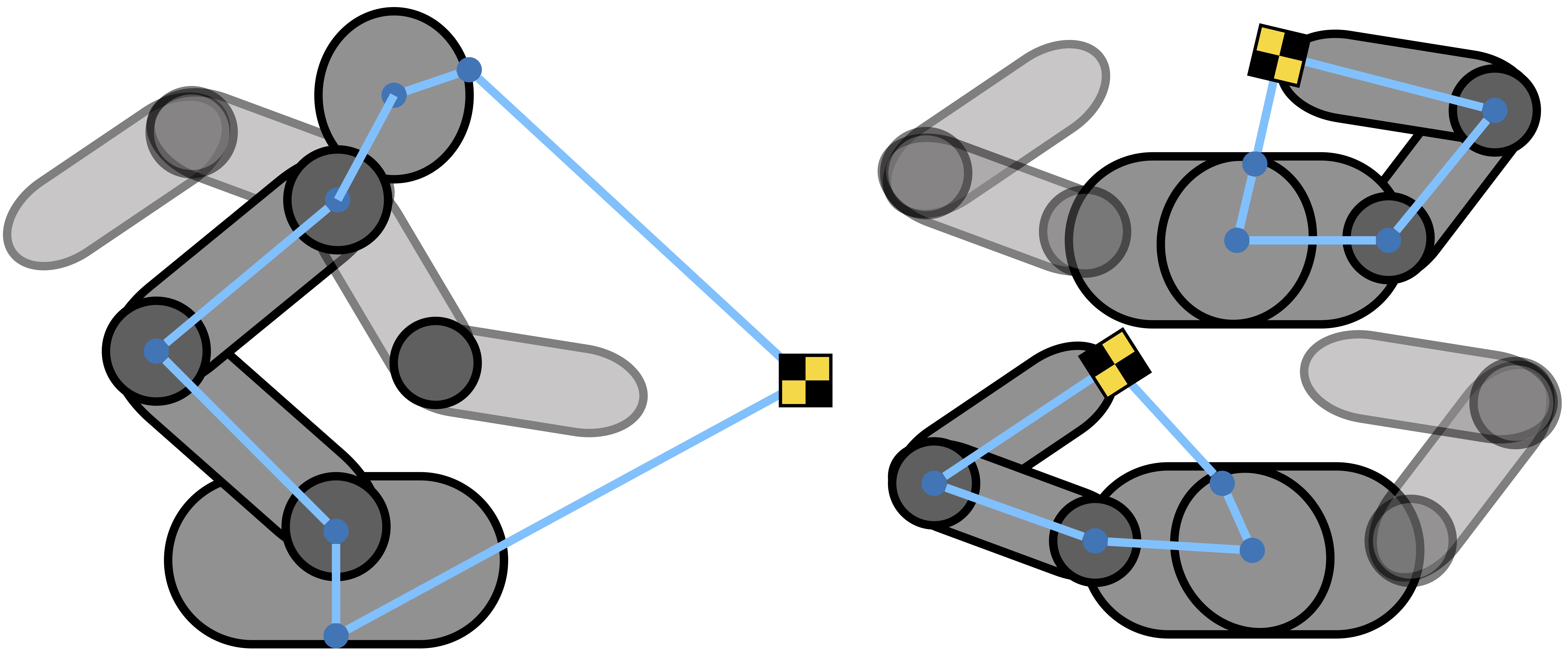
- 本文提出了一种仅依赖于头戴RGB相机的自包含校准方法,通过视觉标记获取运动学树的测量数据。
- 实验结果表明,采用该方法后,末端执行器的笛卡尔误差减少超过20%,实现了与外部系统相同的精度。
📝 摘要(中文)
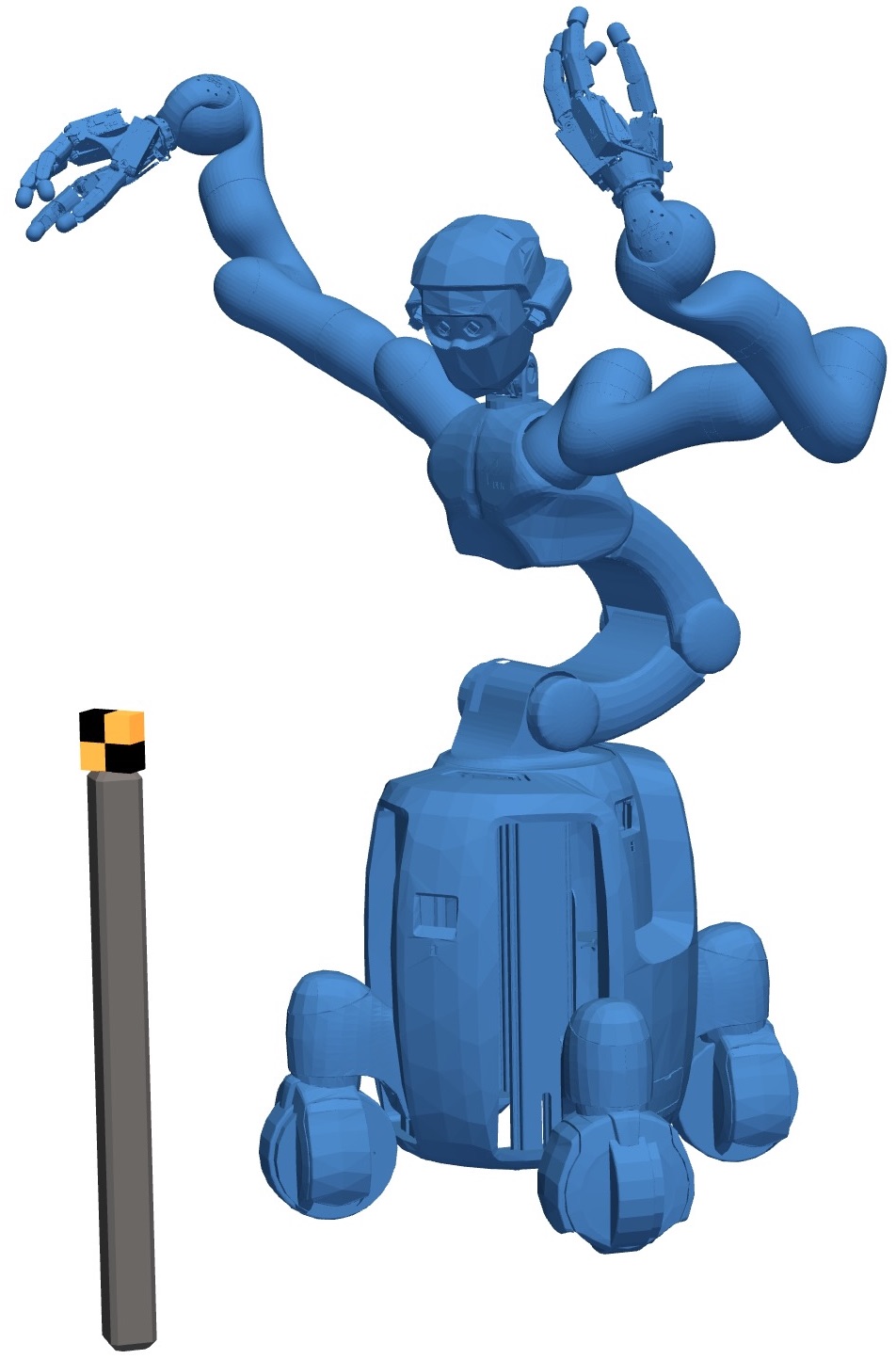
当人形机器人执行操作任务时,它首先利用视觉传感器构建世界模型,然后规划身体运动。为了实现这一目标,需要精确的相机参数和运动学树的校准。本文扩展了之前的研究,提出了一种仅使用头戴RGB相机的自包含校准方法。通过在运动学链的末端和机器人前方的杆上放置简单的视觉标记,获取整个运动学树的测量数据。为确保末端执行器的任务相关笛卡尔误差最小化,本文引入虚拟噪声,使得像素误差在标记距离相机较远时权重更高。最终,校准精度达到了平均3.9mm,最差情况下为9.1mm,达到了与使用外部跟踪系统相同的精度。
🔬 方法详解
问题定义:本文旨在解决人形机器人在执行任务时相机参数和运动学树的精确校准问题。现有方法依赖外部测量设备,导致校准过程复杂且耗时,限制了机器人的灵活性和实时性。
核心思路:论文提出了一种自包含的校准方法,仅使用头戴RGB相机和简单的视觉标记。通过这种方式,机器人能够在没有外部设备的情况下完成精确校准,提升了操作的灵活性。
技术框架:整体流程包括使用头戴相机捕捉视觉标记的图像,计算相机与运动学链的相对位置,并通过引入虚拟噪声来优化模型。主要模块包括图像处理、标记识别和误差优化。
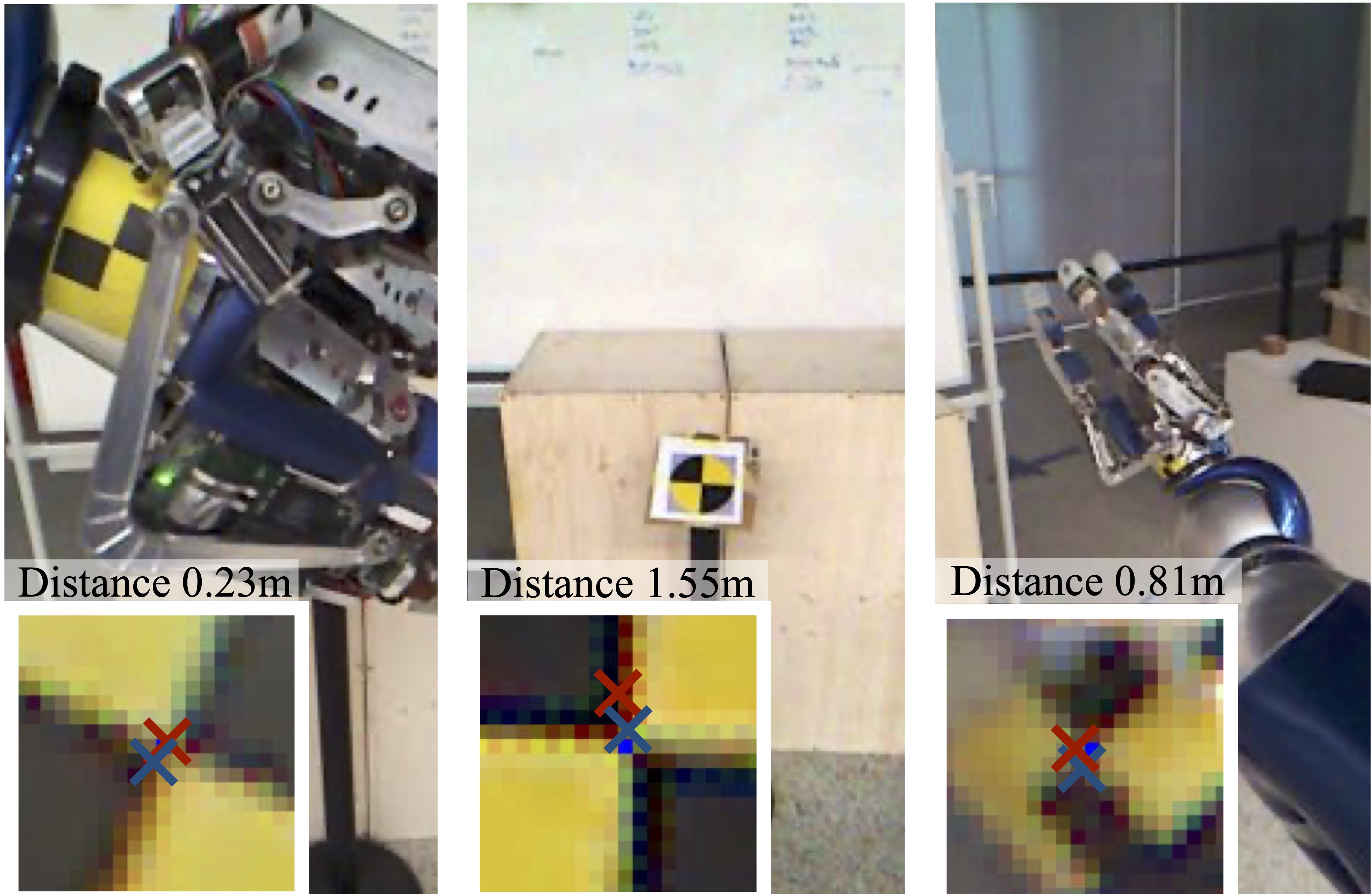
关键创新:最重要的创新在于引入虚拟噪声来调整像素误差权重,使得远离相机的标记对最终校准结果的影响更大。这一设计显著提高了校准的准确性。
关键设计:在参数设置上,采用了特定的损失函数来平衡不同距离标记的影响,确保末端执行器的笛卡尔误差最小化。
🖼️ 关键图片
📊 实验亮点
实验结果显示,采用新方法后,末端执行器的笛卡尔误差减少超过20%,最终平均精度达到3.9mm,最差情况下为9.1mm。这一精度与之前依赖外部跟踪系统的结果相当,证明了方法的有效性。
🎯 应用场景
该研究的潜在应用领域包括人形机器人在家庭、医疗和服务行业的自主操作。通过提高机器人在动态环境中的自我校准能力,可以显著提升其工作效率和适应性,推动智能机器人技术的进一步发展。
📄 摘要(原文)
When a humanoid robot performs a manipulation task, it first makes a model of the world using its visual sensors and then plans the motion of its body in this model. For this, precise calibration of the camera parameters and the kinematic tree is needed. Besides the accuracy of the calibrated model, the calibration process should be fast and self-contained, i.e., no external measurement equipment should be used. Therefore, we extend our prior work on calibrating the elastic upper body of DLR's Agile Justin by now using only its internal head-mounted RGB camera. We use simple visual markers at the ends of the kinematic chain and one in front of the robot, mounted on a pole, to get measurements for the whole kinematic tree. To ensure that the task-relevant cartesian error at the end-effectors is minimized, we introduce virtual noise to fit our imperfect robot model so that the pixel error has a higher weight if the marker is further away from the camera. This correction reduces the cartesian error by more than 20%, resulting in a final accuracy of 3.9mm on average and 9.1mm in the worst case. This way, we achieve the same precision as in our previous work, where an external cartesian tracking system was used.