Bridging the Sim-to-Real Gap with Dynamic Compliance Tuning for Industrial Insertion
作者: Xiang Zhang, Masayoshi Tomizuka, Hui Li
分类: cs.RO
发布日期: 2023-11-13 (更新: 2024-03-01)
备注: Accepted by ICRA 24
💡 一句话要点
提出动态合规调节框架以解决工业插入任务的仿真与现实差距问题
🎯 匹配领域: 支柱一:机器人控制 (Robot Control)
关键词: 仿真与现实迁移 动态合规调节 工业插入任务 机器人操作 接触动态 力规划 增益调节
📋 核心要点
- 现有方法在处理复杂的接触动态时存在困难,导致仿真与现实之间的性能差距显著。
- 本文提出的框架通过动态调整合规控制增益,能够在任务执行中调节接触力,从而实现更好的仿真到现实的迁移。
- 实验结果显示,所提方法在多种现实插入任务中表现优异,且无需进行微调,展现了良好的通用性。
📝 摘要(中文)
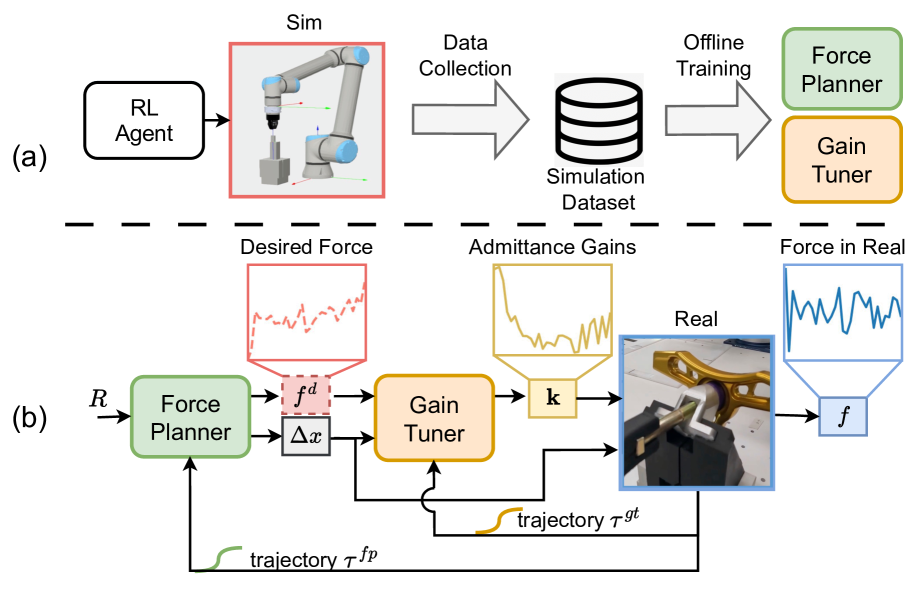
接触丰富的操作任务常常存在较大的仿真与现实差距。例如,工业组装任务中,插入间隙通常小于0.1毫米,甚至在处理可变形接收器时可能为负值。这种狭窄的间隙导致复杂的接触动态,难以在仿真中准确建模,从而使得仿真学习的策略难以迁移到现实机器人中。本文提出了一种新颖的框架,通过仅使用仿真数据来稳健地学习现实任务的操作技能。该框架由“力规划器”和“增益调节器”两个主要组件组成,前者规划机器人运动和期望接触力,后者在任务执行过程中动态调整合规控制增益。通过动态调整合规控制增益,我们可以在新环境中调节接触力,从而生成与仿真训练相似的轨迹,缩小仿真与现实之间的差距。实验结果表明,我们的方法在仿真中训练的通用方块插入任务上,能够推广到多种现实插入任务,且无需任何微调。
🔬 方法详解
问题定义:本文旨在解决工业插入任务中仿真与现实之间的差距,现有方法在处理复杂接触动态时表现不佳,导致难以有效迁移仿真学习的策略。
核心思路:论文的核心思路是通过动态调整机器人的合规控制增益,在任务执行过程中调节接触力,从而生成与仿真训练相似的轨迹,缩小仿真与现实之间的差距。
技术框架:整体框架包括两个主要模块:力规划器和增益调节器。力规划器负责规划机器人运动和期望接触力,而增益调节器则在任务执行过程中动态调整合规控制增益。
关键创新:最重要的技术创新点在于动态合规调节的引入,使得机器人能够在新环境中灵活应对复杂的接触情况,与传统静态控制方法相比,具有更好的适应性和灵活性。
关键设计:在设计中,增益调节器的参数设置和控制策略至关重要,确保在不同的插入任务中能够实时调整合规性,保持期望接触力的稳定性。
🖼️ 关键图片


📊 实验亮点
实验结果表明,所提方法在多种现实插入任务中表现优异,成功实现了从仿真到现实的迁移,且无需微调。具体而言,方法在处理狭窄和负间隙的插入任务时,展现出显著的性能提升,验证了其有效性和通用性。
🎯 应用场景
该研究的潜在应用领域包括工业自动化、机器人组装、精密插入等任务,能够显著提升机器人在复杂环境中的操作能力。未来,随着技术的进一步发展,该框架有望在更多实际场景中得到应用,推动智能制造的进步。
📄 摘要(原文)
Contact-rich manipulation tasks often exhibit a large sim-to-real gap. For instance, industrial assembly tasks frequently involve tight insertions where the clearance is less than 0.1 mm and can even be negative when dealing with a deformable receptacle. This narrow clearance leads to complex contact dynamics that are difficult to model accurately in simulation, making it challenging to transfer simulation-learned policies to real-world robots. In this paper, we propose a novel framework for robustly learning manipulation skills for real-world tasks using simulated data only. Our framework consists of two main components: the "Force Planner" and the "Gain Tuner". The Force Planner plans both the robot motion and desired contact force, while the Gain Tuner dynamically adjusts the compliance control gains to track the desired contact force during task execution. The key insight is that by dynamically adjusting the robot's compliance control gains during task execution, we can modulate contact force in the new environment, thereby generating trajectories similar to those trained in simulation and narrowing the sim-to-real gap. Experimental results show that our method, trained in simulation on a generic square peg-and-hole task, can generalize to a variety of real-world insertion tasks involving narrow and negative clearances, all without requiring any fine-tuning. Videos are available at https://dynamic-compliance.github.io.