SynH2R: Synthesizing Hand-Object Motions for Learning Human-to-Robot Handovers
作者: Sammy Christen, Lan Feng, Wei Yang, Yu-Wei Chao, Otmar Hilliges, Jie Song
分类: cs.RO, cs.AI
发布日期: 2023-11-09 (更新: 2024-12-31)
备注: Accepted to ICRA 2024. Project page: https://eth-ait.github.io/synthetic-handovers/
期刊: IEEE International Conference on Robotics and Automation (ICRA), Yokohama, Japan, 2024, pp. 3168-3175
DOI: 10.1109/ICRA57147.2024.10610694
🔗 代码/项目: PROJECT_PAGE
💡 一句话要点
提出SynH2R框架以解决人机交互中的手物交接问题
🎯 匹配领域: 支柱七:动作重定向 (Motion Retargeting) 支柱八:物理动画 (Physics-based Animation)
关键词: 人机交互 手物交接 合成数据 机器人训练 深度学习
📋 核心要点
- 现有方法依赖昂贵的人体运动捕捉数据,难以扩展到多样化的对象和抓取动作。
- 提出了一种手-物体合成方法,能够生成适合手物交接的合成抓取动作。
- 实验结果显示,使用合成数据训练的模型在性能上与真实数据的模型相当,并且在未见对象和动作上具有更好的扩展性。
📝 摘要(中文)
基于视觉的人机手物交接是人机交互中的一项重要且具有挑战性的任务。现有研究依赖于昂贵的人体运动捕捉数据,难以扩展到任意对象和人类抓取动作。本文提出了一种生成可信的人类抓取动作的框架,旨在为机器人训练提供合适的数据。通过手-物体合成方法,我们能够生成比以往多100倍的合成训练和测试数据。实验表明,使用合成数据训练的模型在模拟和真实系统中与依赖真实人类运动数据的最先进方法具有竞争力,并且在更大规模的评估中表现更佳。
🔬 方法详解
问题定义:本研究旨在解决人机交互中手物交接的训练数据获取问题。现有方法依赖于昂贵且难以扩展的人体运动捕捉数据,限制了其应用范围。
核心思路:本文提出的框架通过合成手-物体交接动作,生成适合机器人训练的合成数据。这种方法能够在不依赖真实数据的情况下,提供丰富的训练样本。
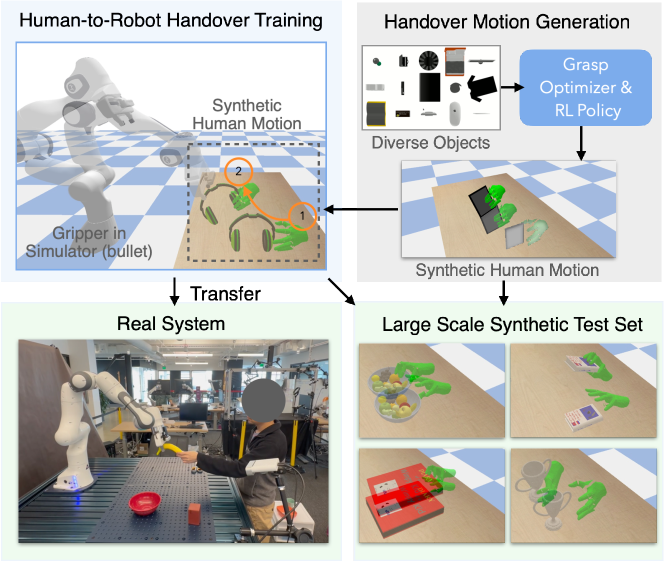
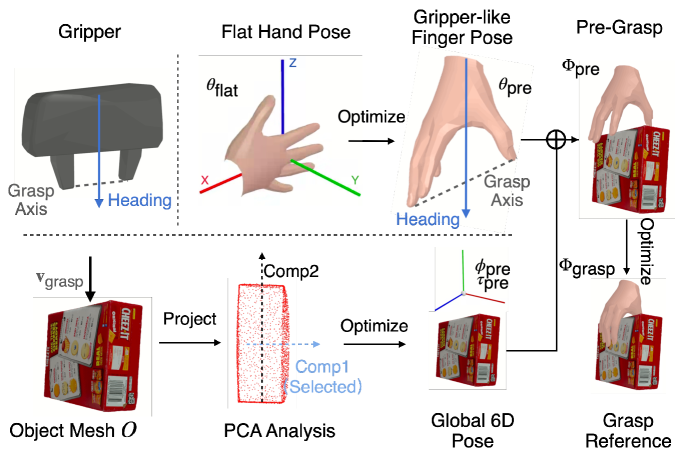
技术框架:整体架构包括手-物体合成模块和数据生成模块。手-物体合成模块负责生成符合人类抓取习惯的动作,而数据生成模块则将这些动作与多样化的对象结合,形成训练数据集。
关键创新:最重要的创新在于提出了一种高效的手-物体合成方法,能够生成比以往多100倍的合成数据。这一方法显著降低了对真实运动捕捉数据的依赖。
关键设计:在技术细节上,设计了特定的损失函数以优化合成动作的自然性和有效性,同时采用了深度学习网络结构来实现手-物体动作的生成。
🖼️ 关键图片

📊 实验亮点
实验结果表明,使用合成数据训练的模型在多种任务中表现出色,尤其是在与依赖真实数据的基线模型比较时,性能相当。新引入的测试集显示,该模型在未见对象和人类动作的适应性上优于基线,展示了更好的扩展性和灵活性。
🎯 应用场景
该研究的潜在应用领域包括服务机器人、工业自动化以及智能家居等场景。通过提供丰富的合成训练数据,能够加速机器人在复杂环境中的学习和适应能力,提升人机交互的效率和安全性。未来,该方法可能会推动更多领域的机器人技术发展。
📄 摘要(原文)
Vision-based human-to-robot handover is an important and challenging task in human-robot interaction. Recent work has attempted to train robot policies by interacting with dynamic virtual humans in simulated environments, where the policies can later be transferred to the real world. However, a major bottleneck is the reliance on human motion capture data, which is expensive to acquire and difficult to scale to arbitrary objects and human grasping motions. In this paper, we introduce a framework that can generate plausible human grasping motions suitable for training the robot. To achieve this, we propose a hand-object synthesis method that is designed to generate handover-friendly motions similar to humans. This allows us to generate synthetic training and testing data with 100x more objects than previous work. In our experiments, we show that our method trained purely with synthetic data is competitive with state-of-the-art methods that rely on real human motion data both in simulation and on a real system. In addition, we can perform evaluations on a larger scale compared to prior work. With our newly introduced test set, we show that our model can better scale to a large variety of unseen objects and human motions compared to the baselines. Project page: https://eth-ait.github.io/synthetic-handovers/