Vision-Language Foundation Models as Effective Robot Imitators
作者: Xinghang Li, Minghuan Liu, Hanbo Zhang, Cunjun Yu, Jie Xu, Hongtao Wu, Chilam Cheang, Ya Jing, Weinan Zhang, Huaping Liu, Hang Li, Tao Kong
分类: cs.RO, cs.AI, cs.LG
发布日期: 2023-11-02 (更新: 2024-02-05)
备注: Fix typos. Project page: https://roboflamingo.github.io
💡 一句话要点
提出RoboFlamingo以解决机器人模仿控制问题
🎯 匹配领域: 支柱一:机器人控制 (Robot Control) 支柱二:RL算法与架构 (RL & Architecture) 支柱九:具身大模型 (Embodied Foundation Models)
关键词: 视觉语言模型 机器人操作 模仿学习 多模态理解 开放环控制 预训练模型 策略学习
📋 核心要点
- 现有的视觉语言模型在机器人操作中的应用仍面临复杂性和性能限制的问题。
- 论文提出的RoboFlamingo框架通过简单的微调,利用预训练的视觉语言模型来实现机器人模仿控制。
- 实验结果表明,RoboFlamingo在多个基准测试中显著超越了现有的最先进性能,展示了其有效性。
📝 摘要(中文)
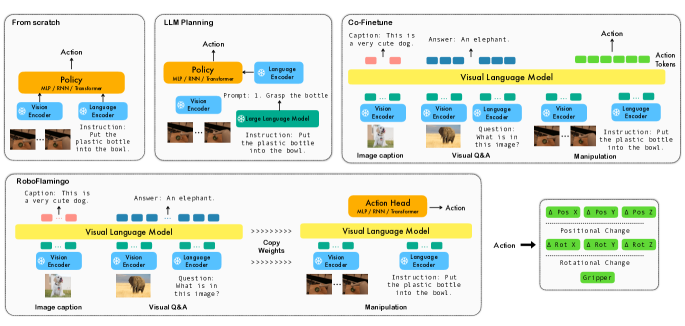
近年来,视觉语言基础模型在理解多模态数据和解决复杂的视觉语言任务方面取得了显著进展,包括机器人操作。我们寻求一种简单的方法,通过对机器人数据进行微调,利用现有的视觉语言模型(VLMs)。为此,我们提出了一种新颖的视觉语言操作框架RoboFlamingo,基于开源的VLM OpenFlamingo。与以往工作不同,RoboFlamingo利用预训练的VLM进行单步视觉语言理解,使用显式策略头建模序列历史信息,并仅通过模仿学习对语言条件的操作数据集进行轻微微调。这种分解为RoboFlamingo提供了开放环控制和在低性能平台上部署的灵活性。通过在测试基准上大幅超越现有最先进的性能,我们展示了RoboFlamingo可以成为将VLM适应于机器人控制的有效且具有竞争力的替代方案。
🔬 方法详解
问题定义:本论文旨在解决现有视觉语言模型在机器人操作中的应用复杂性和性能不足的问题。现有方法通常需要大量的任务特定数据和复杂的训练流程,限制了其在实际机器人控制中的应用。
核心思路:RoboFlamingo的核心思路是利用预训练的视觉语言模型进行单步视觉语言理解,并通过模仿学习对操作数据集进行轻微微调。这种方法简化了训练流程,同时保留了模型的灵活性。
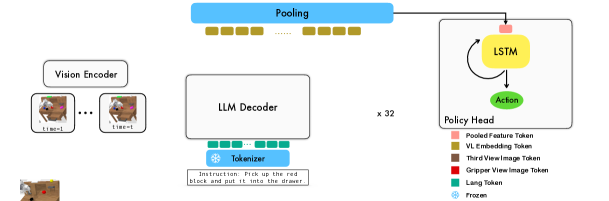
技术框架:RoboFlamingo的整体架构包括三个主要模块:预训练的视觉语言模型、显式策略头用于建模序列历史信息,以及模仿学习模块用于微调。该框架支持开放环控制,适用于低性能平台。
关键创新:RoboFlamingo的主要创新在于其将预训练的视觉语言模型与显式策略头结合,能够有效处理序列历史信息。这种设计与传统方法的本质区别在于其简化了训练过程并提高了模型的适应性。
关键设计:在关键设计方面,RoboFlamingo采用了轻量级的网络结构,并在损失函数中引入了语言条件的操作数据集,以优化模型的学习效果。
🖼️ 关键图片
📊 实验亮点
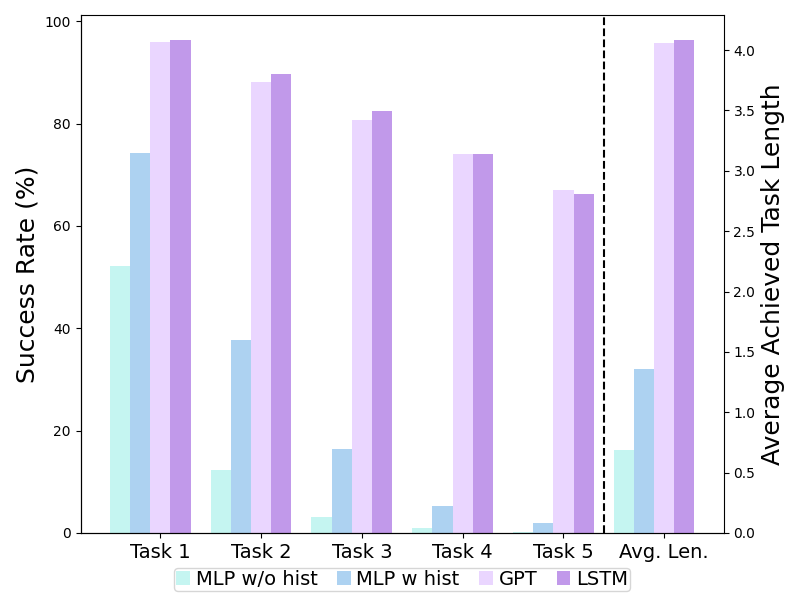
在多个基准测试中,RoboFlamingo的性能超越了现有最先进的模型,提升幅度达到显著的水平,证明了其在机器人模仿控制任务中的有效性和竞争力。
🎯 应用场景
RoboFlamingo框架具有广泛的应用潜力,尤其是在机器人操作和自动化领域。其简单易用的特性使得研究人员和开发者能够快速微调和部署自己的机器人控制策略,降低了技术门槛,推动了机器人技术的普及与应用。
📄 摘要(原文)
Recent progress in vision language foundation models has shown their ability to understand multimodal data and resolve complicated vision language tasks, including robotics manipulation. We seek a straightforward way of making use of existing vision-language models (VLMs) with simple fine-tuning on robotics data. To this end, we derive a simple and novel vision-language manipulation framework, dubbed RoboFlamingo, built upon the open-source VLMs, OpenFlamingo. Unlike prior works, RoboFlamingo utilizes pre-trained VLMs for single-step vision-language comprehension, models sequential history information with an explicit policy head, and is slightly fine-tuned by imitation learning only on language-conditioned manipulation datasets. Such a decomposition provides RoboFlamingo the flexibility for open-loop control and deployment on low-performance platforms. By exceeding the state-of-the-art performance with a large margin on the tested benchmark, we show RoboFlamingo can be an effective and competitive alternative to adapt VLMs to robot control. Our extensive experimental results also reveal several interesting conclusions regarding the behavior of different pre-trained VLMs on manipulation tasks. We believe RoboFlamingo has the potential to be a cost-effective and easy-to-use solution for robotics manipulation, empowering everyone with the ability to fine-tune their own robotics policy.