Learning to Design and Use Tools for Robotic Manipulation
作者: Ziang Liu, Stephen Tian, Michelle Guo, C. Karen Liu, Jiajun Wu
分类: cs.RO, cs.AI, cs.LG
发布日期: 2023-11-01
备注: First two authors contributed equally. Accepted at CoRL 2023
💡 一句话要点
提出工具设计学习方法以提升机器人操作能力
🎯 匹配领域: 支柱一:机器人控制 (Robot Control) 支柱二:RL算法与架构 (RL & Architecture)
关键词: 机器人操作 工具设计 强化学习 多目标适应 深度学习
📋 核心要点
- 现有方法在机器人操作中缺乏灵活性,无法适应不同任务目标的多样化需求。
- 本文提出了一种设计策略学习方法,通过任务信息生成工具设计,进而实现高效的操作。
- 实验结果表明,该框架在样本效率和适应性上优于传统方法,并成功应用于真实机器人。
📝 摘要(中文)
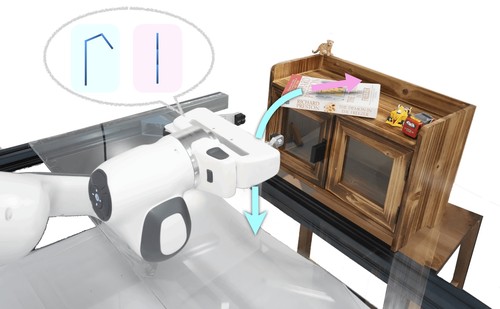
在受限于自身形态的情况下,人类和某些动物能够利用环境中的物体完成原本不可能的任务。机器人通过工具使用也能解锁更多能力。现有的深度学习技术在设计运动代理方面有效,但对于操作任务而言,单一的形态输出并不适用。本文提出了一种学习设计策略的方法,该策略基于任务信息生成工具设计,从而实现快速原型化。我们引入了一种强化学习框架,联合学习设计和控制策略。通过模拟操作任务,我们展示了该框架在多目标设置下的样本效率优于以往方法,并能够进行零-shot插值或微调以应对未见目标,最终将学习到的策略部署到真实机器人上。
🔬 方法详解
问题定义:本文旨在解决机器人在操作任务中因形态限制而无法灵活应对多样化目标的问题。现有方法通常输出单一形态,无法满足不同任务的需求。
核心思路:我们提出了一种学习设计策略的方法,该策略根据具体任务信息生成相应的工具设计,从而使机器人能够快速适应不同的操作需求。
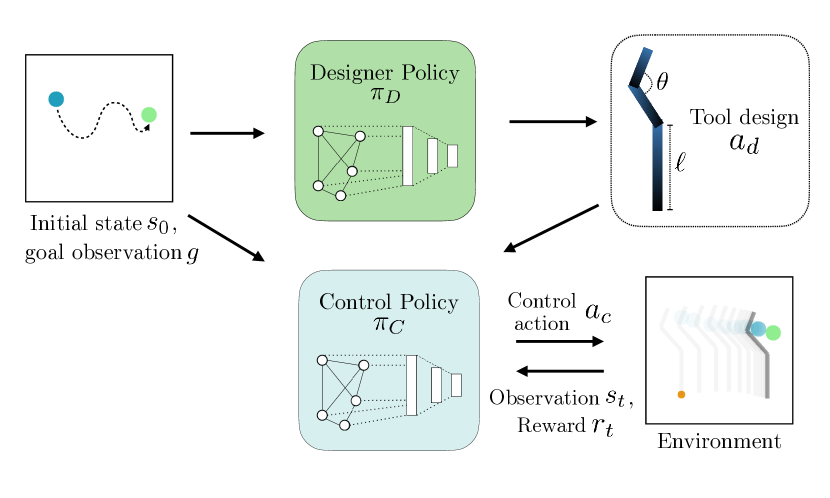
技术框架:整体架构包括两个主要模块:设计策略和控制策略。设计策略根据任务信息生成工具设计,而控制策略则利用这些工具进行操作。通过强化学习框架,两个策略可以联合优化。
关键创新:最重要的创新在于提出了设计策略的概念,使得机器人能够在面对多变的操作任务时,快速生成适合的工具设计。这一方法与传统的单一形态输出方法本质上不同,提供了更高的灵活性。
关键设计:在技术细节上,我们采用了适应性损失函数来平衡设计复杂性与控制效率,同时使用了深度神经网络来实现设计和控制策略的学习。
🖼️ 关键图片

📊 实验亮点
实验结果显示,所提出的框架在多目标和多变设置下的样本效率显著提高,相较于传统方法,能够实现零-shot插值和微调,成功应对未见目标,展示了在复杂操作任务中的优越性能。
🎯 应用场景
该研究的潜在应用场景包括工业自动化、服务机器人以及医疗辅助等领域。通过提升机器人在操作任务中的灵活性和适应性,能够显著提高其在复杂环境中的工作效率和实用性,未来可能推动机器人技术的广泛应用。
📄 摘要(原文)
When limited by their own morphologies, humans and some species of animals have the remarkable ability to use objects from the environment toward accomplishing otherwise impossible tasks. Robots might similarly unlock a range of additional capabilities through tool use. Recent techniques for jointly optimizing morphology and control via deep learning are effective at designing locomotion agents. But while outputting a single morphology makes sense for locomotion, manipulation involves a variety of strategies depending on the task goals at hand. A manipulation agent must be capable of rapidly prototyping specialized tools for different goals. Therefore, we propose learning a designer policy, rather than a single design. A designer policy is conditioned on task information and outputs a tool design that helps solve the task. A design-conditioned controller policy can then perform manipulation using these tools. In this work, we take a step towards this goal by introducing a reinforcement learning framework for jointly learning these policies. Through simulated manipulation tasks, we show that this framework is more sample efficient than prior methods in multi-goal or multi-variant settings, can perform zero-shot interpolation or fine-tuning to tackle previously unseen goals, and allows tradeoffs between the complexity of design and control policies under practical constraints. Finally, we deploy our learned policies onto a real robot. Please see our supplementary video and website at https://robotic-tool-design.github.io/ for visualizations.