DiffCoord: Differentiable Coordination for Distributed Multi-Agent Trajectory Optimization
作者: Bingheng Wang, Yichao Gao, Tianchen Sun, Shanker Ajay, Lin Zhao
分类: cs.LG, cs.MA, cs.RO, eess.SY
发布日期: 2026-06-12
💡 一句话要点
提出DiffCoord以解决分布式多智能体轨迹优化问题
🎯 匹配领域: 支柱一:机器人控制 (Robot Control)
关键词: 多智能体系统 轨迹优化 元学习 微分动态规划 交替方向乘子法 无人机编队 计算效率
📋 核心要点
- 现有的ADMM-DDP方法在分布式多智能体轨迹优化中存在参数耦合问题,影响协调质量与任务性能。
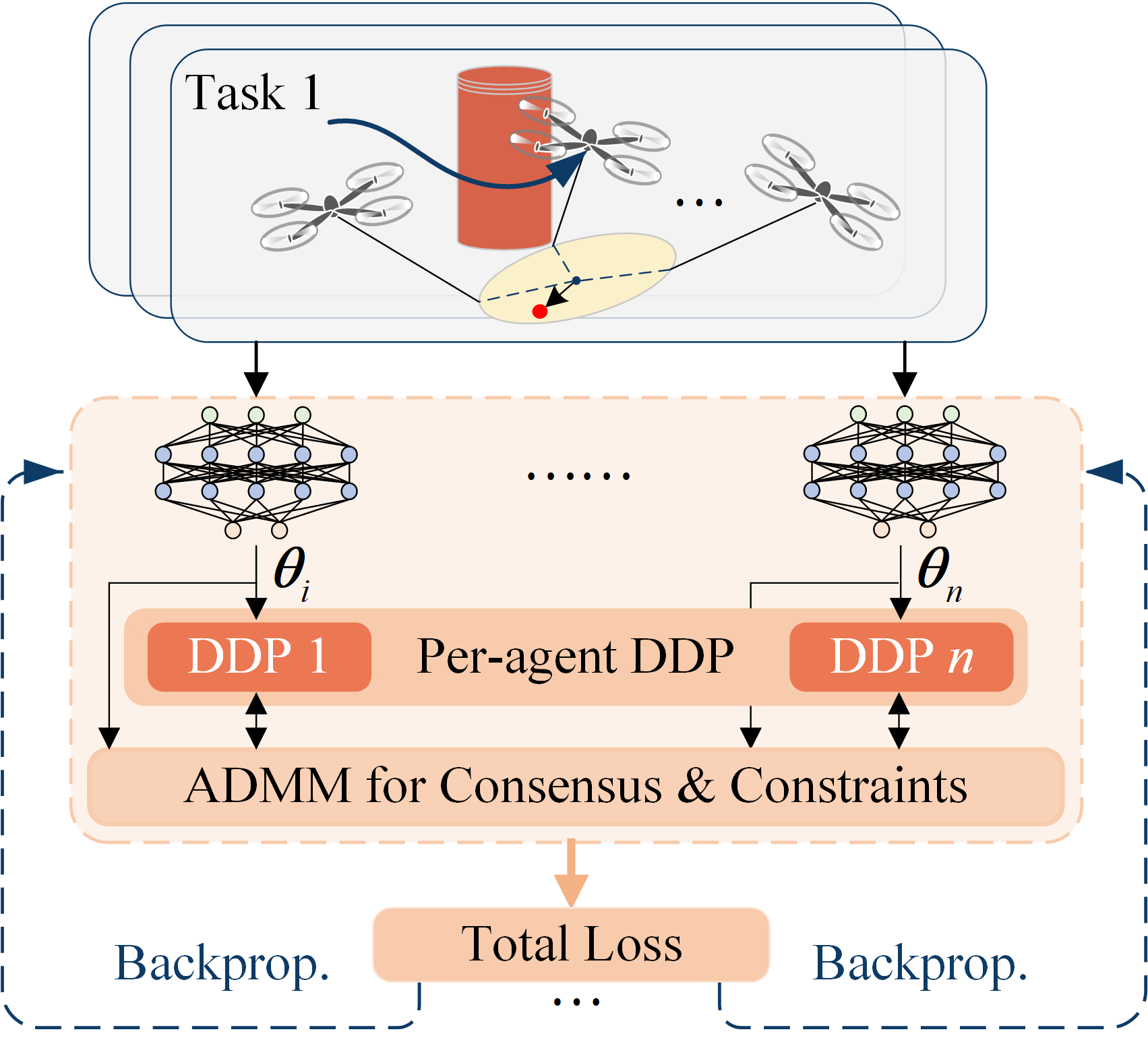
- DiffCoord通过元学习耦合参数,利用智能体级神经网络实现任务适应,并在同构智能体间共享网络,提升可扩展性。
- 在合作空中运输系统中,DiffCoord能够有效适应不同团队规模和负载动态,显著减少梯度计算时间,提升效率。
📝 摘要(中文)
本论文提出了一种名为DiffCoord的统一框架,将交替方向乘子法(ADMM)与微分动态规划(DDP)相结合,旨在实现可扩展的分布式多智能体轨迹优化。传统上,ADMM因计算效率而被截断,导致协调质量和任务性能的参数紧密耦合。DiffCoord通过元学习这些耦合参数,利用智能体级神经网络进行任务适应,并在同构智能体之间共享网络,以提高可扩展性。通过端到端微分ADMM-DDP管道,实现了高效的元学习,进而提出了辅助的ADMM-LQR分布式梯度求解器,显著提高了计算效率。实验结果表明,DiffCoord在合作空中运输系统中表现出色,能够在狭小空间中安全地重新配置四旋翼编队,并在不同团队规模和负载动态下表现出强大的适应能力,较现有方法减少了多达70%的每个智能体的梯度计算时间。
🔬 方法详解
问题定义:本论文旨在解决分布式多智能体轨迹优化中的参数耦合问题,现有方法在计算效率和协调质量上存在不足,导致性能下降。
核心思路:DiffCoord提出了一种统一框架,通过元学习耦合参数,利用智能体级神经网络进行任务适应,且在同构智能体间共享网络,以实现可扩展性。
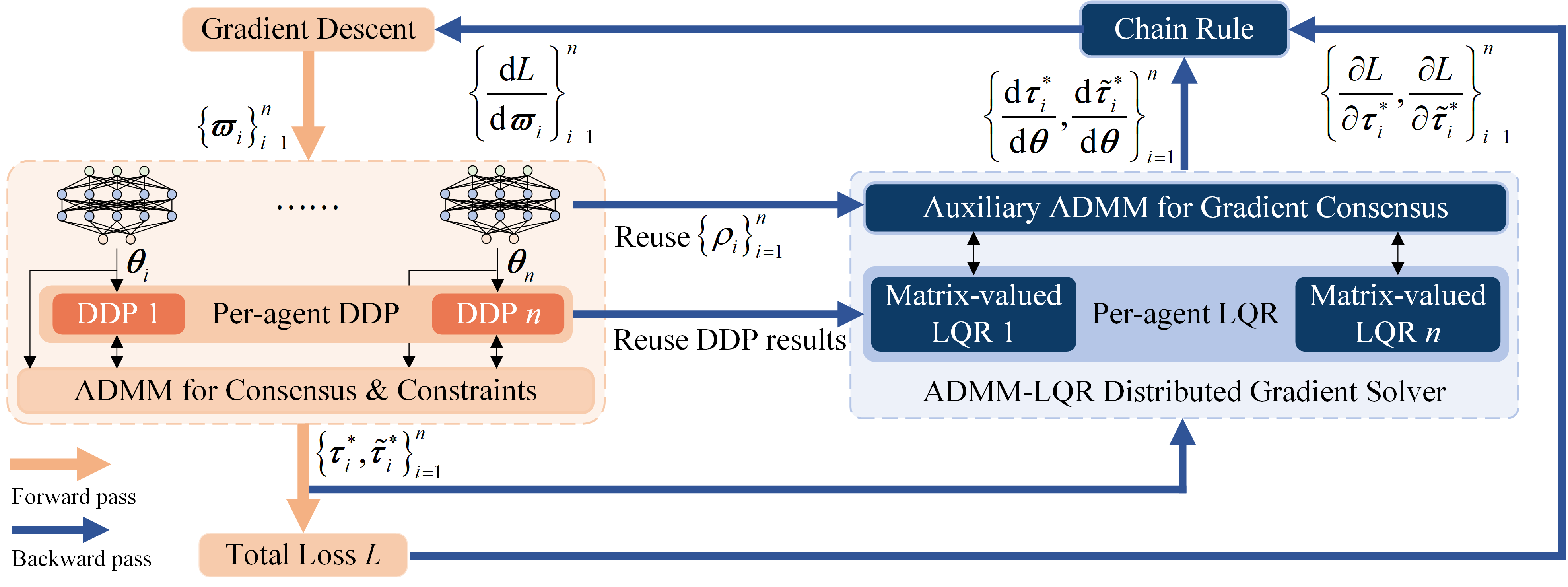
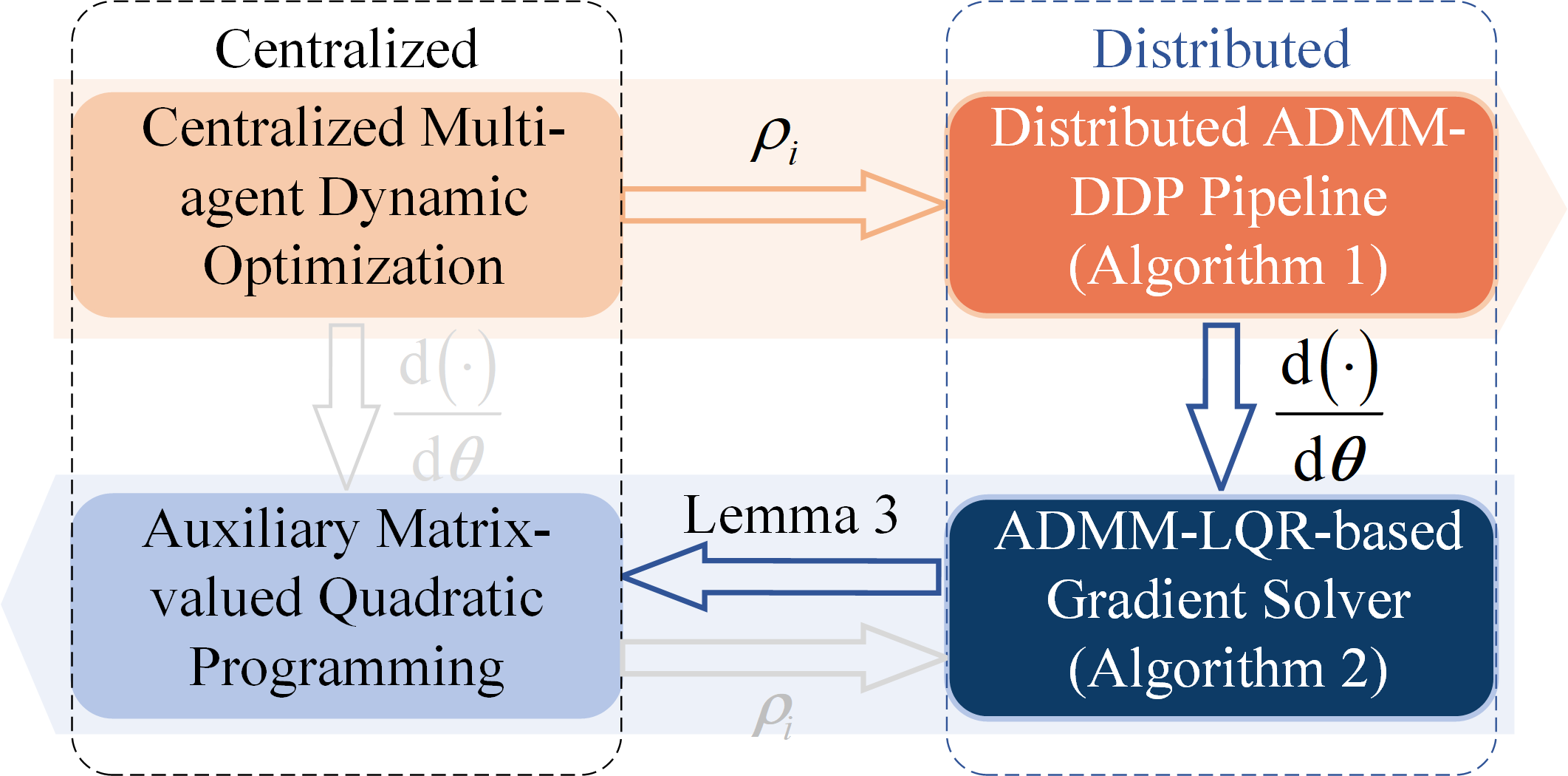
技术框架:整体架构包括ADMM-DDP管道与辅助的ADMM-LQR分布式梯度求解器。通过端到端微分实现高效的元学习,计算和协调元梯度。
关键创新:DiffCoord的主要创新在于将ADMM与DDP结合,并通过元学习优化耦合参数,显著提高了计算效率和适应性,区别于传统的ADMM截断方法。
关键设计:采用智能体级神经网络生成耦合参数,设计了适应性强的损失函数,并实现了关键计算结果的重用与智能体间的高效并行化。
🖼️ 关键图片
📊 实验亮点
在实验中,DiffCoord在合作空中运输系统中表现出色,能够安全地重新配置四旋翼编队,适应不同的团队规模和负载动态。与最先进的轨迹梯度方法相比,DiffCoord在每个智能体的梯度计算时间上减少了多达70%,显示出显著的性能提升。
🎯 应用场景
该研究在多智能体系统中具有广泛的应用潜力,尤其是在无人机编队、自动驾驶车辆和机器人协作等领域。通过提升轨迹优化的效率和适应性,DiffCoord能够在复杂环境中实现更高效的任务执行,推动相关技术的发展与应用。
📄 摘要(原文)
Integrating the Alternating Direction Method of Multipliers (ADMM) with Differential Dynamic Programming (DDP) provides a scalable framework for distributed multi-agent trajectory optimization. In practice, ADMM is typically truncated for computational efficiency, tightly coupling parameters that would otherwise separately govern coordination quality and task performance. In this paper, we propose Differentiable Coordination (DiffCoord), a unified framework that jointly meta-learns these coupled parameters for the truncated ADMM-DDP pipeline. These parameters are generated by agent-wise neural networks for task adaptation, and the same networks are shared among isomorphic agents to enable scalability to varying agent counts. We achieve efficient meta-learning by differentiating the ADMM-DDP pipeline end-to-end. Notably, this yields an auxiliary ADMM-LQR distributed gradient solver that computes and coordinates meta-gradients with respect to these parameters. This solver inherits the computational structure of the pipeline, enabling reuse of key computation results and efficient parallelization over agents and along trajectory horizons. We validate DiffCoord through numerical and physical experiments on a cooperative aerial transport system, where it reconfigures quadrotor formations for safe 6-DoF load manipulation in tight spaces. It adapts robustly to varying team sizes and load dynamics, while reducing per-agent gradient computation time by up to 70% compared with state-of-the-art trajectory-gradient methods.