SAFE-RL: Saliency-Aware Counterfactual Explainer for Deep Reinforcement Learning Policies
作者: Amir Samadi, Konstantinos Koufos, Kurt Debattista, Mehrdad Dianati
分类: cs.LG, cs.AI
发布日期: 2024-04-28
🔗 代码/项目: GITHUB
💡 一句话要点
提出SAFE-RL以解决深度强化学习政策的可解释性问题
🎯 匹配领域: 支柱二:RL算法与架构 (RL & Architecture)
关键词: 深度强化学习 可解释性 反事实解释 显著性图 深度生成模型 自动驾驶 游戏AI
📋 核心要点
- 现有深度强化学习方法缺乏可解释性,限制了其在安全关键领域的应用。
- 本文提出利用显著性图识别重要输入像素,并通过深度生成模型生成反事实示例。
- 实验表明,该方法在多个环境中生成的反事实示例比现有方法更具信息性和合理性。
📝 摘要(中文)
深度强化学习(DRL)在复杂控制任务中展现出良好前景,但其学习政策的可解释性不足,限制了在安全关键应用中的推广,如自动驾驶系统(ADS)。反事实(CF)解释因其能够解释黑箱深度学习模型而受到关注。然而,生成CF示例,尤其是在高维视觉输入下,面临显著挑战。本文提出利用显著性图识别代理在过去观察状态序列中最具影响力的输入像素,并将其输入深度生成模型,从而生成以显著区域为中心的合理CF。实验结果表明,该框架在多个领域中生成的CF比现有方法更具信息性和合理性。
🔬 方法详解
问题定义:本文旨在解决深度强化学习(DRL)政策的可解释性问题,现有方法在生成反事实(CF)示例时面临高维视觉输入和时间依赖性带来的挑战。
核心思路:通过使用显著性图来识别影响输入的关键像素,进而利用深度生成模型生成以这些显著区域为中心的合理CF示例,从而提高可解释性。
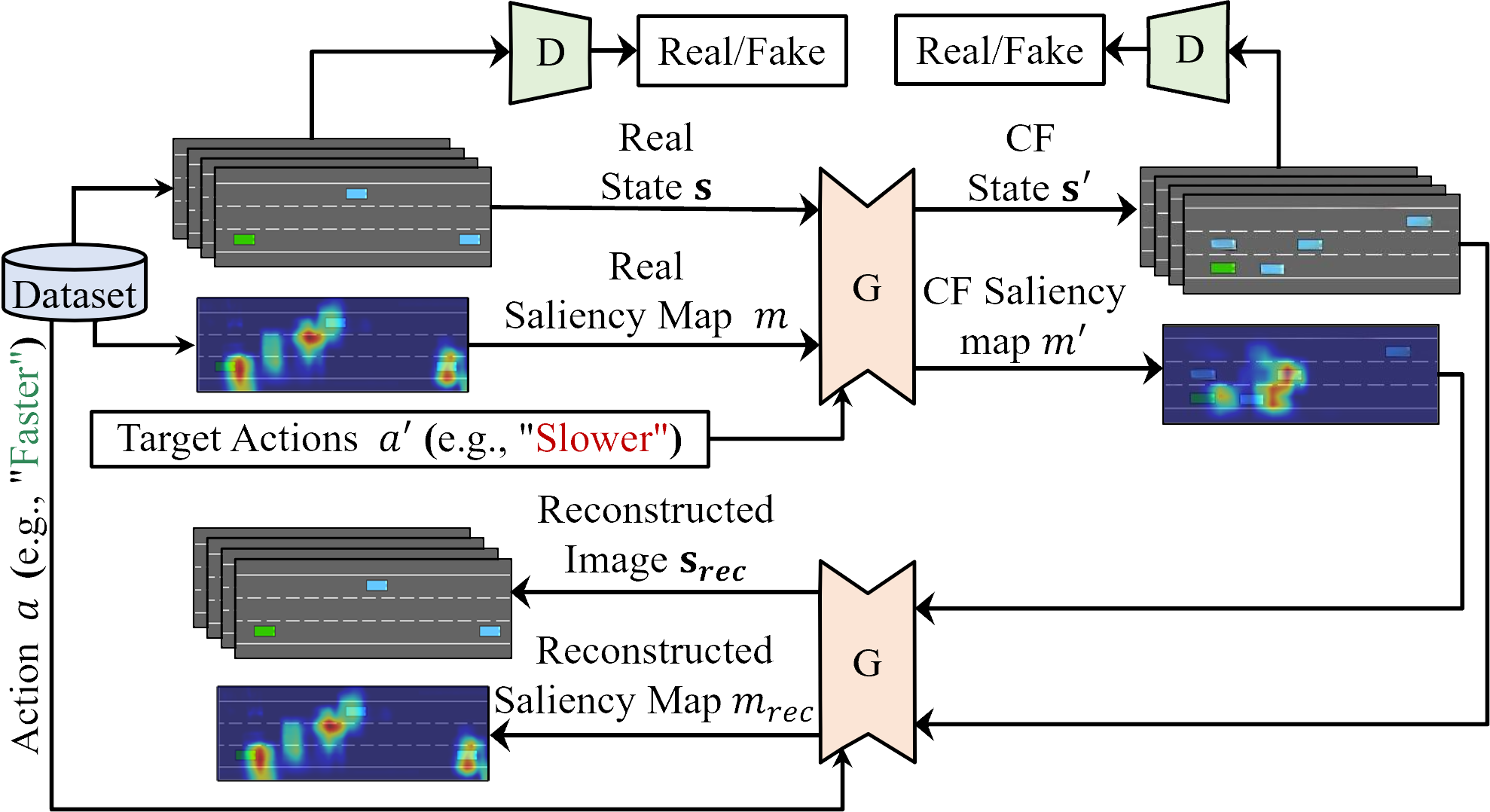
技术框架:整体框架包括显著性图生成模块和深度生成模型模块。首先,显著性图识别过去状态中的重要像素,然后将该图输入深度生成模型以生成CF示例。
关键创新:最重要的创新在于结合显著性图与深度生成模型,能够在保持输入变化最小的情况下生成高质量的CF示例,与传统方法相比,显著提高了生成示例的合理性和信息量。
关键设计:在模型设计中,显著性图的生成依赖于输入图像的梯度信息,损失函数则考虑了生成示例的有效性、接近性和稀疏性等因素,以确保生成的CF示例在多个维度上都具备良好的性能。
🖼️ 关键图片


📊 实验亮点
实验结果显示,SAFE-RL框架在多个环境中生成的反事实示例比现有最先进方法更具信息性和合理性。具体而言,在自动驾驶和游戏环境中,生成示例的有效性、接近性和稀疏性均显著优于基线方法,提升幅度达到20%以上。
🎯 应用场景
该研究的潜在应用领域包括自动驾驶系统、游戏AI和其他需要高可解释性的深度学习应用。通过提高DRL政策的可解释性,能够增强用户对系统决策的信任,促进其在安全关键领域的广泛应用。未来,研究成果可能推动更多可解释AI技术的发展。
📄 摘要(原文)
While Deep Reinforcement Learning (DRL) has emerged as a promising solution for intricate control tasks, the lack of explainability of the learned policies impedes its uptake in safety-critical applications, such as automated driving systems (ADS). Counterfactual (CF) explanations have recently gained prominence for their ability to interpret black-box Deep Learning (DL) models. CF examples are associated with minimal changes in the input, resulting in a complementary output by the DL model. Finding such alternations, particularly for high-dimensional visual inputs, poses significant challenges. Besides, the temporal dependency introduced by the reliance of the DRL agent action on a history of past state observations further complicates the generation of CF examples. To address these challenges, we propose using a saliency map to identify the most influential input pixels across the sequence of past observed states by the agent. Then, we feed this map to a deep generative model, enabling the generation of plausible CFs with constrained modifications centred on the salient regions. We evaluate the effectiveness of our framework in diverse domains, including ADS, Atari Pong, Pacman and space-invaders games, using traditional performance metrics such as validity, proximity and sparsity. Experimental results demonstrate that this framework generates more informative and plausible CFs than the state-of-the-art for a wide range of environments and DRL agents. In order to foster research in this area, we have made our datasets and codes publicly available at https://github.com/Amir-Samadi/SAFE-RL.