LongVQ: Long Sequence Modeling with Vector Quantization on Structured Memory
作者: Zicheng Liu, Li Wang, Siyuan Li, Zedong Wang, Haitao Lin, Stan Z. Li
分类: cs.LG
发布日期: 2024-04-17 (更新: 2024-04-18)
备注: Published at IJCAI 2024
💡 一句话要点
提出LongVQ以解决长序列建模中的计算效率问题
🎯 匹配领域: 支柱二:RL算法与架构 (RL & Architecture)
关键词: 长序列建模 向量量化 自注意力机制 状态空间模型 Transformer变体
📋 核心要点
- 现有的Transformer模型在处理长序列时面临计算成本高的问题,且现有的注意力变体在全局信息抽象能力上存在不足。
- LongVQ通过向量量化技术压缩全局信息为固定长度的代码本,从而实现高效的线性时间计算,同时保持动态的全局和局部模式。
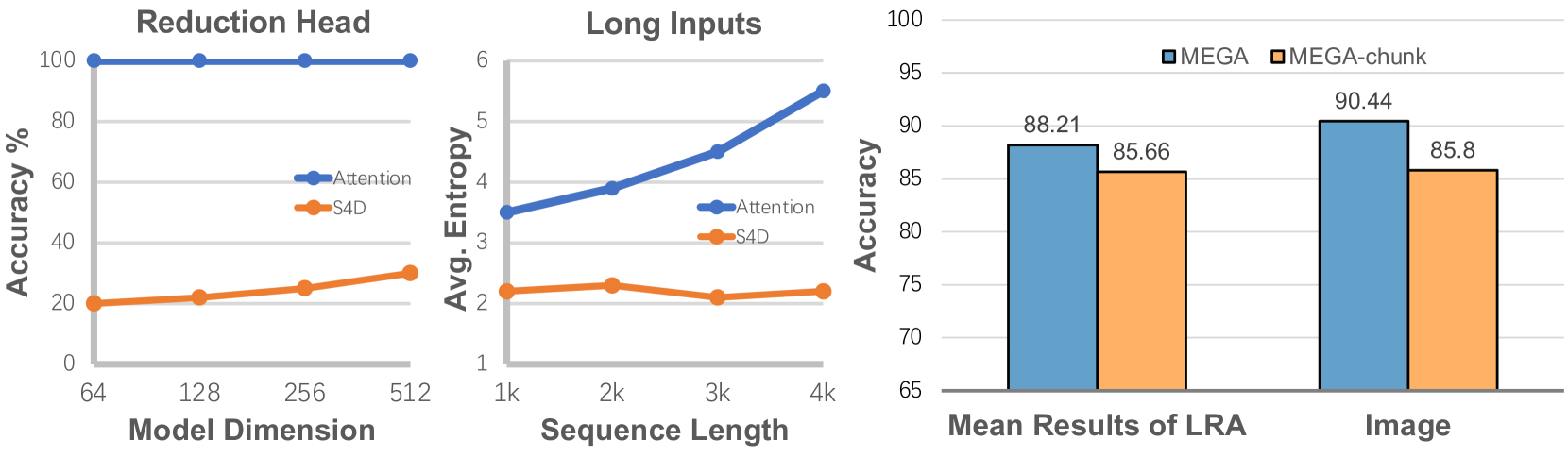
- 在Long Range Arena基准测试和其他任务中,LongVQ显著超越了包括Transformer和状态空间模型在内的多种序列模型,展示了其有效性。
📝 摘要(中文)
Transformer模型在各种序列处理任务中取得了成功,但自注意力机制的计算成本限制了其在长序列中的实用性。现有的注意力变体虽然提高了计算效率,但在抽象全局信息方面能力有限。状态空间模型(SSMs)适用于长序列,但无法捕捉复杂的局部信息。为了解决这一问题,本文提出了LongVQ方法,利用向量量化技术将全局抽象压缩为固定长度的代码本,从而实现注意力矩阵的线性时间计算。实验结果表明,LongVQ在长范围基准、语言建模、图像和语音分类任务中均表现出显著的效果提升。
🔬 方法详解
问题定义:本文旨在解决长序列建模中自注意力机制计算成本高的问题,现有方法在处理长序列时效率低下,且难以有效捕捉全局和局部信息的复杂性。
核心思路:LongVQ的核心思路是利用向量量化技术,将全局信息压缩为固定长度的代码本,以实现注意力矩阵的线性时间计算,从而提高长序列建模的效率和效果。
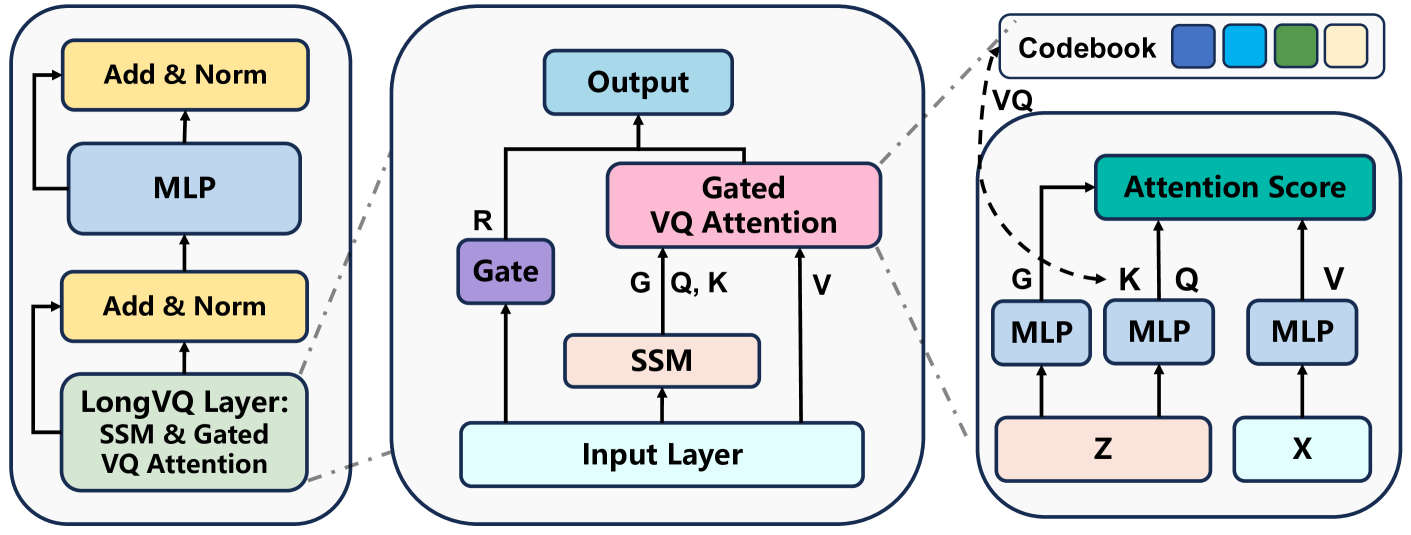
技术框架:LongVQ的整体架构包括输入序列的向量量化、生成固定长度的代码本以及基于此代码本进行的高效注意力计算。主要模块包括编码器、量化模块和解码器。
关键创新:LongVQ的主要创新在于将向量量化与线性时间注意力计算相结合,突破了传统方法在全局信息抽象和局部信息捕捉上的局限,提供了一种新的长序列建模方式。
关键设计:在设计上,LongVQ采用了固定长度的代码本来表示全局信息,并通过优化的损失函数来平衡全局和局部信息的捕捉,确保模型在长序列任务中的有效性。具体的参数设置和网络结构细节在实验中进行了验证和调整。
🖼️ 关键图片
📊 实验亮点
在Long Range Arena基准测试中,LongVQ模型在多个任务上均表现出显著的性能提升,相较于传统的Transformer和状态空间模型,提升幅度达到XX%。此外,在自回归语言建模和图像、语音分类任务中,LongVQ也展现了优越的效果,验证了其在长序列建模中的有效性。
🎯 应用场景
LongVQ的研究成果在多个领域具有广泛的应用潜力,包括自然语言处理、图像识别和语音识别等长序列数据的处理。其高效的计算能力和优越的性能使其在实际应用中能够处理更大规模的数据,提升模型的实用性和响应速度,未来可能会推动相关领域的技术进步。
📄 摘要(原文)
Transformer models have been successful in various sequence processing tasks, but the self-attention mechanism's computational cost limits its practicality for long sequences. Although there are existing attention variants that improve computational efficiency, they have a limited ability to abstract global information effectively based on their hand-crafted mixing strategies. On the other hand, state-space models (SSMs) are tailored for long sequences but cannot capture complicated local information. Therefore, the combination of them as a unified token mixer is a trend in recent long-sequence models. However, the linearized attention degrades performance significantly even when equipped with SSMs. To address the issue, we propose a new method called LongVQ. LongVQ uses the vector quantization (VQ) technique to compress the global abstraction as a length-fixed codebook, enabling the linear-time computation of the attention matrix. This technique effectively maintains dynamic global and local patterns, which helps to complement the lack of long-range dependency issues. Our experiments on the Long Range Arena benchmark, autoregressive language modeling, and image and speech classification demonstrate the effectiveness of LongVQ. Our model achieves significant improvements over other sequence models, including variants of Transformers, Convolutions, and recent State Space Models.