ReffAKD: Resource-efficient Autoencoder-based Knowledge Distillation
作者: Divyang Doshi, Jung-Eun Kim
分类: cs.LG, cs.CV
发布日期: 2024-04-15
🔗 代码/项目: GITHUB
💡 一句话要点
提出ReffAKD以解决知识蒸馏资源消耗问题
🎯 匹配领域: 支柱二:RL算法与架构 (RL & Architecture)
关键词: 知识蒸馏 自编码器 模型训练 资源效率 深度学习
📋 核心要点
- 现有知识蒸馏方法依赖大型教师模型,计算成本高且资源消耗大,限制了其实际应用。
- 本研究提出ReffAKD,通过自编码器生成软标签,消除了对大型教师模型的需求,从而提高了知识蒸馏的效率。
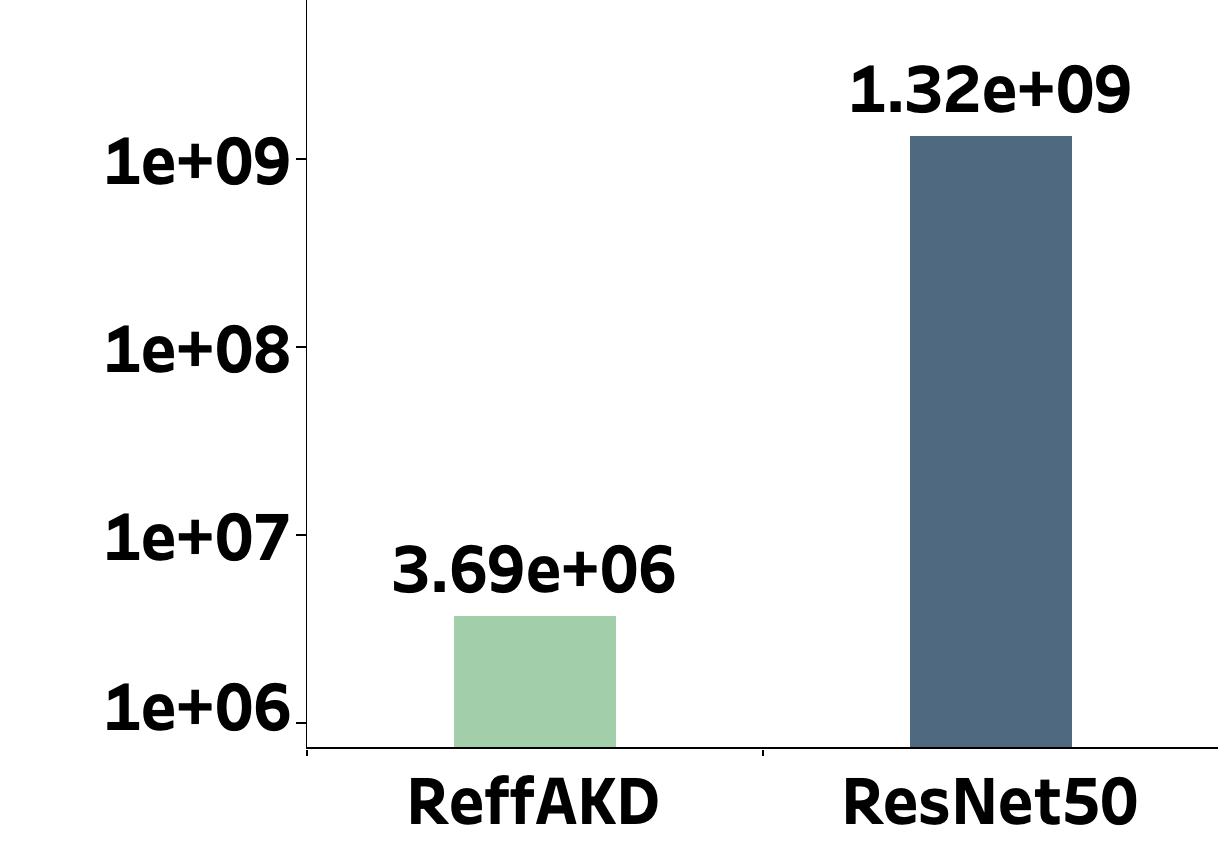
- 实验结果显示,ReffAKD在多个数据集上表现出色,资源消耗显著降低,同时模型准确性保持在相似或更高水平。
📝 摘要(中文)
本研究提出了一种创新方法ReffAKD,旨在提高知识蒸馏的效率,而无需依赖资源密集型的教师模型。知识蒸馏通过大型教师模型指导小型学生模型进行训练,然而这种方法计算成本高。我们的方法通过紧凑的自编码器提取关键特征,并计算不同类别之间的相似性分数,随后应用softmax函数生成软概率向量,作为学生模型训练的指导。我们在CIFAR-100、Tiny Imagenet和Fashion MNIST等多个数据集上的实验表明,与传统依赖大型教师模型的知识蒸馏方法相比,我们的方法在资源效率上具有显著优势,并且在模型准确性上表现相似甚至更优。我们的研究为知识蒸馏的实际应用提供了更具成本效益的解决方案。
🔬 方法详解
问题定义:本研究旨在解决传统知识蒸馏方法中对大型教师模型的依赖问题,这导致了高昂的计算成本和资源消耗。
核心思路:我们提出的ReffAKD方法通过使用紧凑的自编码器来提取关键特征,并计算类别之间的相似性分数,从而生成软标签,指导学生模型的训练,避免了大型教师模型的使用。
技术框架:整体架构包括三个主要模块:首先,使用自编码器提取输入数据的特征;其次,计算不同类别之间的相似性分数;最后,应用softmax函数将相似性分数转换为软概率向量,作为学生模型的训练指导。
关键创新:本研究的主要创新在于通过自编码器生成软标签,显著降低了知识蒸馏过程中的资源需求,与传统方法相比,提供了一种更高效的替代方案。
关键设计:在技术细节上,我们设计了自编码器的结构以确保特征提取的有效性,同时在计算相似性分数时,采用了适当的距离度量方法,以确保生成的软概率向量能够有效指导学生模型的训练。我们还进行了多组实验以优化模型参数和损失函数。
🖼️ 关键图片


📊 实验亮点
我们的实验结果表明,ReffAKD在CIFAR-100、Tiny Imagenet和Fashion MNIST等数据集上,资源消耗显著低于传统知识蒸馏方法,同时在模型准确性上保持相似或更优的表现。这一成果展示了我们方法的有效性和实用性,具有重要的研究和应用价值。
🎯 应用场景
ReffAKD方法具有广泛的应用潜力,尤其在资源受限的环境中,如移动设备和边缘计算场景。通过降低知识蒸馏的资源消耗,该方法可以使得更多的实际应用能够利用深度学习模型进行高效训练,推动智能设备的普及和应用。未来,该方法还可能与其他深度学习技术结合,进一步提升模型训练的效率和效果。
📄 摘要(原文)
In this research, we propose an innovative method to boost Knowledge Distillation efficiency without the need for resource-heavy teacher models. Knowledge Distillation trains a smaller
student'' model with guidance from a largerteacher'' model, which is computationally costly. However, the main benefit comes from the soft labels provided by the teacher, helping the student grasp nuanced class similarities. In our work, we propose an efficient method for generating these soft labels, thereby eliminating the need for a large teacher model. We employ a compact autoencoder to extract essential features and calculate similarity scores between different classes. Afterward, we apply the softmax function to these similarity scores to obtain a soft probability vector. This vector serves as valuable guidance during the training of the student model. Our extensive experiments on various datasets, including CIFAR-100, Tiny Imagenet, and Fashion MNIST, demonstrate the superior resource efficiency of our approach compared to traditional knowledge distillation methods that rely on large teacher models. Importantly, our approach consistently achieves similar or even superior performance in terms of model accuracy. We also perform a comparative study with various techniques recently developed for knowledge distillation showing our approach achieves competitive performance with using significantly less resources. We also show that our approach can be easily added to any logit based knowledge distillation method. This research contributes to making knowledge distillation more accessible and cost-effective for practical applications, making it a promising avenue for improving the efficiency of model training. The code for this work is available at, https://github.com/JEKimLab/ReffAKD.