Hierarchical Decision Making Based on Structural Information Principles
作者: Xianghua Zeng, Hao Peng, Dingli Su, Angsheng Li
分类: cs.LG, cs.AI
发布日期: 2024-04-15 (更新: 2025-06-22)
备注: Submitted to JMLR
💡 一句话要点
提出基于结构信息原则的SIDM框架以优化层次决策
🎯 匹配领域: 支柱二:RL算法与架构 (RL & Architecture)
关键词: 层次强化学习 结构信息 决策支持 技能发现 多代理系统
📋 核心要点
- 现有的层次强化学习方法依赖于手动假设和先验知识,导致技能定义和任务分解的灵活性不足。
- 本文提出的SIDM框架通过利用结构信息,动态发现和学习层次策略,增强了决策过程的适应性。
- 在多个基准测试中,SIDM框架在平均奖励、收敛时间和标准差上分别提升了32.70%、64.86%和88.26%。
📝 摘要(中文)
层次强化学习(HRL)是一种有效管理多层次任务复杂性的方法,但其效果依赖于对技能定义和任务分解的先验知识。本文提出了一种新颖的基于结构信息原则的框架SIDM,旨在单代理和多代理场景中实现层次决策。我们利用嵌入决策过程中的结构信息,动态发现和学习层次策略。通过处理历史状态-动作轨迹构建抽象表示,并定义优化有向结构熵以捕捉关键转移模式,开发了单代理和多代理的学习方法。实验结果表明,该框架在多个基准测试中显著超越了现有最优方法,提升了策略学习的有效性、效率和稳定性。
🔬 方法详解
问题定义:本文旨在解决现有层次强化学习方法对先验知识和手动假设的依赖,导致技能定义和任务分解灵活性不足的问题。
核心思路:通过引入结构信息,SIDM框架能够动态地发现和学习层次策略,从而提高决策过程的适应性和效率。
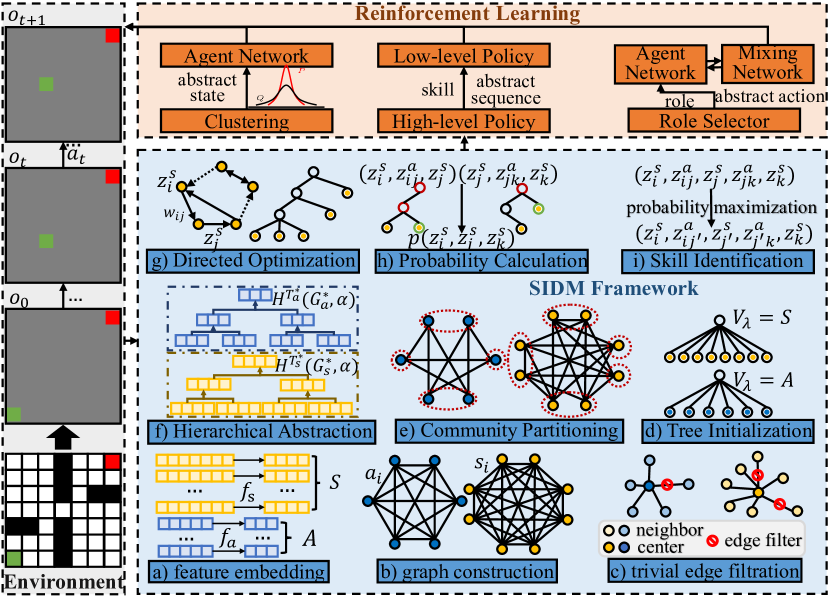
技术框架:SIDM框架包括历史状态-动作轨迹处理模块、抽象表示构建模块和技能发现模块,形成一个完整的决策支持系统。
关键创新:最重要的创新点在于定义和优化有向结构熵,量化抽象状态间转移动态的不确定性,从而有效捕捉关键转移模式。
关键设计:在设计中,SIDM框架采用了针对历史轨迹的抽象机制,并灵活集成多种底层算法以提升性能。
🖼️ 关键图片

📊 实验亮点
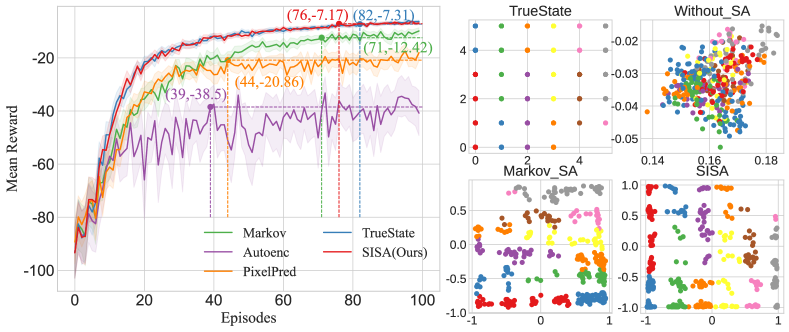
在实验中,SIDM框架在多个挑战性基准上表现出色,平均奖励提升32.70%,收敛时间减少64.86%,标准差降低88.26%,显著超越了现有最优基线,证明了其在策略学习中的有效性和稳定性。
🎯 应用场景
该研究的SIDM框架具有广泛的应用潜力,尤其在复杂任务的自动化决策、机器人控制和多智能体系统中,能够有效提升系统的学习能力和决策效率。未来,该框架可能推动智能体在动态环境中的自主学习和适应能力。
📄 摘要(原文)
Hierarchical Reinforcement Learning (HRL) is a promising approach for managing task complexity across multiple levels of abstraction and accelerating long-horizon agent exploration. However, the effectiveness of hierarchical policies heavily depends on prior knowledge and manual assumptions about skill definitions and task decomposition. In this paper, we propose a novel Structural Information principles-based framework, namely SIDM, for hierarchical Decision Making in both single-agent and multi-agent scenarios. Central to our work is the utilization of structural information embedded in the decision-making process to adaptively and dynamically discover and learn hierarchical policies through environmental abstractions. Specifically, we present an abstraction mechanism that processes historical state-action trajectories to construct abstract representations of states and actions. We define and optimize directed structural entropy, a metric quantifying the uncertainty in transition dynamics between abstract states, to discover skills that capture key transition patterns in RL environments. Building on these findings, we develop a skill-based learning method for single-agent scenarios and a role-based collaboration method for multi-agent scenarios, both of which can flexibly integrate various underlying algorithms for enhanced performance. Extensive evaluations on challenging benchmarks demonstrate that our framework significantly and consistently outperforms state-of-the-art baselines, improving the effectiveness, efficiency, and stability of policy learning by up to 32.70%, 64.86%, and 88.26%, respectively, as measured by average rewards, convergence timesteps, and standard deviations.