Representation Learning of Tangled Key-Value Sequence Data for Early Classification
作者: Tao Duan, Junzhou Zhao, Shuo Zhang, Jing Tao, Pinghui Wang
分类: cs.LG, cs.NI
发布日期: 2024-04-11
备注: 12 pages, 31 figures, Accepted by ICDE2024
💡 一句话要点
提出KVEC方法以解决复杂键值序列的早期分类问题
🎯 匹配领域: 支柱二:RL算法与架构 (RL & Architecture)
关键词: 键值序列 早期分类 序列表示学习 网络安全 用户画像
📋 核心要点
- 现有方法在处理复杂键值序列时,难以同时满足分类准确性和分类时效性的要求。
- 本文提出KVEC方法,通过分析键值序列中的内部和外部关联性,优化序列表示以实现早期分类。
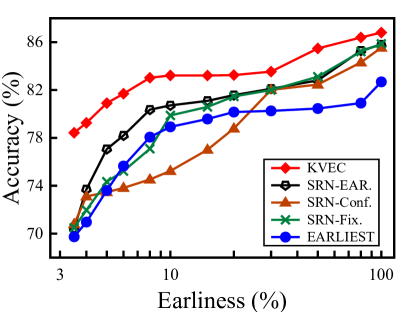
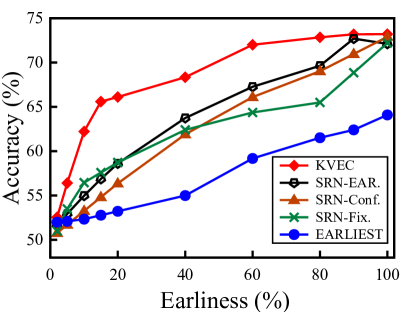
- 实验结果显示,KVEC在相同的预测时效条件下,准确率提升4.7%至17.5%,和准确性与时效性的调和平均提升3.7%至14.0%。
📝 摘要(中文)
键值序列数据在电商用户购买行为和网络数据包转发等多个实际应用中广泛存在。对这些序列进行分类在用户画像和恶意应用识别等场景中至关重要。然而,准确分类与早期分类之间存在内在矛盾,难以同时实现。本文提出了一种新颖的复杂键值序列早期分类问题的框架,并提出了KVEC方法,通过利用序列内部和外部的关联性来学习更优的序列表示。同时,设计了一种时间感知的停止策略,以决定何时停止序列并进行分类。实验结果表明,所提方法在真实和合成数据集上显著优于现有最先进的基线,准确率提升达4.7%至17.5%。
🔬 方法详解
问题定义:本文解决的是复杂键值序列的早期分类问题,现有方法在准确性与时效性之间存在矛盾,难以同时满足。
核心思路:提出KVEC方法,通过分析键值序列中的键关联性和值关联性,优化序列表示,从而实现更早的分类决策。
技术框架:整体架构包括序列表示学习模块和时间感知的停止策略模块。前者通过内外部关联性学习序列特征,后者则决定何时进行分类。
关键创新:最重要的创新在于同时考虑了键和值的关联性,提升了序列表示的质量,与传统方法相比,能够更好地平衡准确性与时效性。
关键设计:在参数设置上,采用了适应性学习率和特定的损失函数来优化分类性能,网络结构上则设计了多层次的特征提取模块,以增强模型的表达能力。
🖼️ 关键图片

📊 实验亮点
实验结果表明,KVEC方法在真实和合成数据集上显著优于现有最先进的基线,准确率提升幅度达到4.7%至17.5%,同时在准确性与时效性的调和平均上提升3.7%至14.0%。
🎯 应用场景
该研究的潜在应用领域包括电商推荐系统、网络安全监测和用户行为分析等。通过实现早期分类,能够快速响应用户需求和识别潜在的恶意行为,具有重要的实际价值和广泛的应用前景。
📄 摘要(原文)
Key-value sequence data has become ubiquitous and naturally appears in a variety of real-world applications, ranging from the user-product purchasing sequences in e-commerce, to network packet sequences forwarded by routers in networking. Classifying these key-value sequences is important in many scenarios such as user profiling and malicious applications identification. In many time-sensitive scenarios, besides the requirement of classifying a key-value sequence accurately, it is also desired to classify a key-value sequence early, in order to respond fast. However, these two goals are conflicting in nature, and it is challenging to achieve them simultaneously. In this work, we formulate a novel tangled key-value sequence early classification problem, where a tangled key-value sequence is a mixture of several concurrent key-value sequences with different keys. The goal is to classify each individual key-value sequence sharing a same key both accurately and early. To address this problem, we propose a novel method, i.e., Key-Value sequence Early Co-classification (KVEC), which leverages both inner- and inter-correlations of items in a tangled key-value sequence through key correlation and value correlation to learn a better sequence representation. Meanwhile, a time-aware halting policy decides when to stop the ongoing key-value sequence and classify it based on current sequence representation. Experiments on both real-world and synthetic datasets demonstrate that our method outperforms the state-of-the-art baselines significantly. KVEC improves the prediction accuracy by up to $4.7 - 17.5\%$ under the same prediction earliness condition, and improves the harmonic mean of accuracy and earliness by up to $3.7 - 14.0\%$.